Protein puppy chow is the classic muddy buddies snack — crunchy rice cereal folded into melted chocolate and peanut butter, then shaken in a powdered coating — rebuilt so the coating carries protein instead of only sugar. This version blends vanilla whey protein powder into the powdered-sugar coating, which puts one 3/4-cup serving at about 12g of protein and about 325 calories, with 15 minutes of prep and no oven at all. The cereal stays crisp, the chocolate-peanut-butter flavor stays exactly where it belongs, and the whole batch is mixed, coated, and spread out to set inside 45 minutes. It is still a sweet snack, and this page will not pretend otherwise — it is simply a sweet snack whose numbers you can see, measured out ingredient by ingredient.
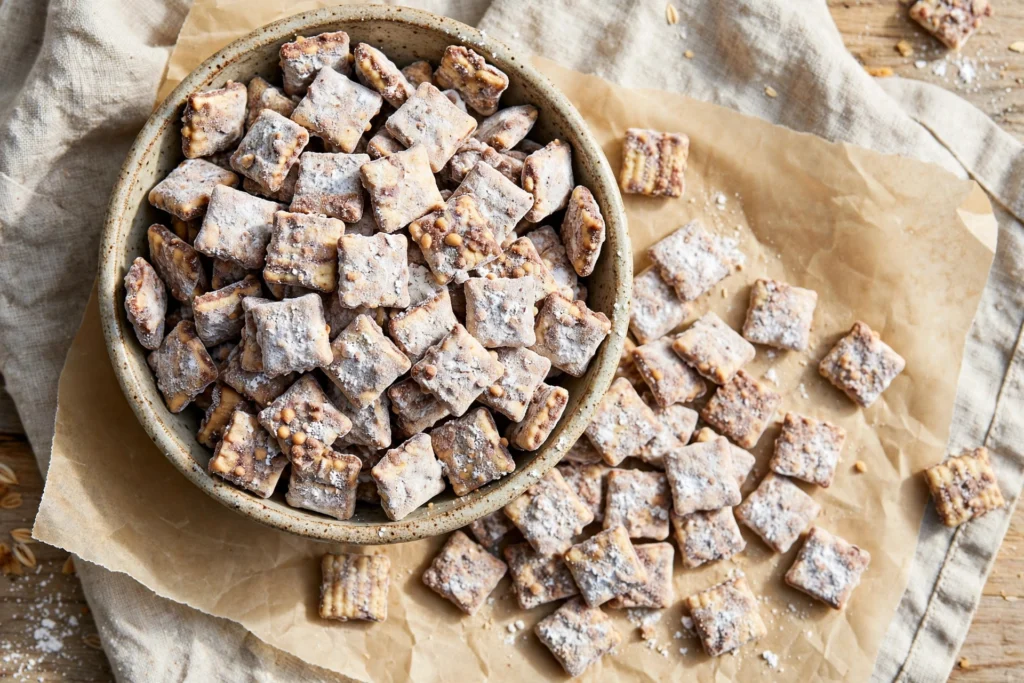
Table of Contents
ToggleWhat Is Protein Puppy Chow?
Puppy chow is a Midwest party snack: squares of crunchy rice cereal coated in a warm chocolate and peanut butter mixture, then tossed in powdered sugar until every piece wears a pale, sweet shell. Somewhere along the way it picked up a second name, muddy buddies — that is the name Chex prints on its own version of the recipe — and the two names mean the same thing. Same cereal, same coating, same bag-shaking step.
One clarification, because the name genuinely confuses people: puppy chow is a snack for humans. It is not dog food, it was never dog food, and it should never be fed to a dog — chocolate is toxic to dogs, and the sugar and protein powder in this version are not pet ingredients either. The name is a joke about how the coated cereal looks, nothing more.
The protein version changes one layer. In the classic recipe the dry coating is straight powdered sugar. Here, half of that coating is replaced with vanilla whey protein powder, whisked into the sugar before the cereal is shaken in it. The chocolate layer, the peanut butter, and the method stay the same, which is why the finished snack still eats like muddy buddies — sweet, crunchy, a little messy — instead of like a protein bar that lost its way. It is also fully no-bake: the only heat involved is melting chocolate.
Why You’ll Love This Protein Puppy Chow Recipe
No oven, no baking. The microwave or a small saucepan does all the work; the coating sets at room temperature.
Five minutes of real technique. Melt, fold gently, shake. The only way to go wrong is rushing the folding and snapping the cereal, and the method below is built to prevent that.
The protein is in the coating, not forced into the chocolate. Powder stirred into hot chocolate can seize and turn grainy. Powder whisked into the dry coating stays smooth and distributes evenly.
Real portions. The batch divides into 8 servings of 3/4 cup, each a known quantity — about 12g of protein — instead of an open bag eaten standing at the counter.
It keeps. A week in an airtight container at room temperature, which makes it a practical make-ahead snack for parties, road trips, and lunchboxes.
Ingredients for Protein Puppy Chow
Makes about 6 cups; 8 servings of 3/4 cup (about 72g) each.
For the cereal mixture
Rice Chex cereal, 6 cups (about 180g). The crunchy base. Rice Chex is the classic choice because the hollow squares hold their shape under a warm coating and their mild flavor lets the chocolate lead. Corn Chex works with a slightly heartier bite. What matters most is freshness — cereal that has gone soft in an open box will not come back crunchy under any coating.
Semisweet chocolate chips, 3/4 cup (128g). The body of the warm coating and most of its flavor. Semisweet is the balance point: dark enough to taste like chocolate, sweet enough that the coating needs no extra sugar beyond what is already in it.
Creamy peanut butter, 1/2 cup (128g). Richness, and the glue. Peanut butter is what makes the chocolate mixture cling to every ridge of the cereal instead of sliding off, and it brings a real share of the protein — about 28g across the batch. Use a standard creamy peanut butter here, the kind that holds its shape on a spoon; the very runny natural styles make a thinner coating that sets softer.
Unsalted butter, 1 tablespoon (14g). A small amount with a specific job: it loosens the melted chocolate just enough that the mixture pours in a ribbon and coats thinly instead of clumping. Thin coating, even coverage, better crunch.
Vanilla extract, 1 teaspoon. Rounds the chocolate out and bridges the gap between the warm coating and the vanilla whey in the dry coating.
Fine salt, 1/8 teaspoon. Optional but recommended if your peanut butter is unsalted. Salt keeps a sweet coating from tasting flat.
For the protein coating
Vanilla whey protein powder, 2 scoops (60g). This recipe is developed with whey — specifically a vanilla whey or whey blend at the common label standard of about 24g of protein per 30g scoop. It is the largest single protein source in the recipe, about 48g across the batch, and vanilla is doing quiet flavor work: it makes the coating taste like a sweeter, more finished version of the classic powdered sugar rather than like a supplement. Check your own tub’s label before you start; scoops range from 25g to 35g between brands, and the nutrition below is calculated on 60g total.
Powdered sugar, 1/2 cup (60g). Half of the traditional coating, kept on purpose. Powdered sugar is what gives muddy buddies their signature dry, snowy shell and stops the pieces from sticking to each other. Replacing all of it with protein powder sounds cleaner on paper and eats worse in practice — the pieces clump, the texture goes chalky, and the shell never quite dries. The blend is the point.
What Protein Powder Works Best for Puppy Chow?
The coating is a dry environment, and powders behave differently there than they do in a shake. What matters is flavor, sweetness, how finely the powder is milled, and how much ambient moisture it grabs once it lands on the warm cereal.
Whey protein is the default for this recipe, and the right one. Whey powders are finely milled, mildly flavored, and usually sweetened, so a vanilla whey disappears into the powdered sugar and reads as flavor rather than as an ingredient. It does not absorb much moisture, which keeps the shell dry and the cereal crisp. A whey isolate behaves the same as a concentrate here; the difference that matters in a glass of milk barely registers in a dry coating.
Casein protein is thicker and far more absorbent. In a coating, that absorbency is a mixed gift: casein grabs moisture from the warm chocolate layer quickly, which can set the shell fast — but it can also pull that moisture unevenly and turn the coating pasty in patches, especially on a humid day. If casein is what you have, it works, but add it in smaller additions and shake longer, and expect a slightly heavier, more matte shell.
Plant-based protein powders (pea, rice, and soy blends) vary the most. They tend to be less sweet, more strongly flavored — a faint earthiness that vanilla and chocolate mostly cover — and milled a little coarser, which can leave the coating feeling gritty if the blend is a coarse one. Sift a plant powder through a fine-mesh sieve with the powdered sugar before coating and the grittiness mostly disappears. Protein content per scoop also runs lower on many plant blends, so a 60g portion may carry less protein than the figures below; read the label and adjust your expectations, not the method.
Unflavored versus vanilla: vanilla is the safer choice. The dry coating is where the reader tastes the powder most directly, and an unflavored whey there reads plainly chalky. An unflavored powder can be used if you add 1/2 teaspoon of vanilla extract to the melted chocolate mixture and an extra tablespoon of powdered sugar to the coating — the flavor gap is real and has to be filled from somewhere. Chocolate whey is a legitimate third option; it deepens the coating’s color and flavor and is the base of the brownie variation below.
One limit worth stating plainly: no two brands produce an identical result. Sweetness, flavor intensity, and milling differ enough that the first batch with a new powder is always partly a calibration. The method absorbs those differences — the flavor of the finished snack simply follows the powder you chose.
How to Make Protein Puppy Chow
1. Measure the cereal. Pour the 6 cups of Rice Chex into the largest mixing bowl you own — bigger than you think you need. The folding step later is where cereal gets crushed, and a crowded bowl is the main cause. Pick out any broken pieces at the bottom of the box if a handful is mostly crumbs; crumbs drink up coating and leave whole pieces bare.
2. Whisk the coating first. In a medium bowl, whisk the protein powder and powdered sugar together until the blend is one uniform color with no white or tan pockets. Doing this now, before anything is warm, is what prevents clumps later — powder added to warm cereal in two separate handfuls coats unevenly.
3. Melt the chocolate and butter. Put the chocolate chips and butter in a microwave-safe bowl and microwave in 30-second bursts, stirring after each, until the chocolate is almost fully melted — about 90 seconds total for most microwaves. Stir for a full 30 seconds off the heat; the residual warmth finishes the melt. (A saucepan over the lowest heat works the same way; pull it off the burner while a few lumps remain.)
4. Add the peanut butter and vanilla. Stir the peanut butter, vanilla, and salt into the warm chocolate until the mixture is completely smooth and pours in a thick ribbon. If it looks stiff rather than pourable, microwave it for 10 more seconds — coating thickness at this moment decides the whole texture.
5. Let it cool slightly. Set the bowl aside for 2 to 3 minutes. The mixture should be warm and fluid, not steaming. Poured on boiling-hot, it soaks into the cereal and softens it; poured on too cool, it thickens and coats in lumps. Warm-to-the-touch is the window.
6. Pour and fold gently. Pour about two-thirds of the chocolate mixture over the cereal. Fold with a large spatula using slow lifts from the bottom of the bowl — never stirring in circles, which snaps the squares. Add the remaining mixture and keep folding until every piece carries a thin, even layer and no pool of chocolate sits at the bottom. Take your time; this step rewards patience more than any other.

7. Transfer to a bag. Spoon the coated cereal into a clean gallon-size zip-top bag (a large paper grocery bag, folded closed, is the traditional alternative). Work gently and do not press the air out — the cereal needs room to move.
8. Add the coating in two additions. Sprinkle in half the protein-powder blend, seal the bag with plenty of air inside, and shake gently — rolling and tumbling rather than violent shaking — for about 20 seconds. Open, add the rest of the blend, and shake again until every piece looks pale and dry. Adding powder all at once is how clumps happen: the first pieces it touches take too much, the last take none.
9. Spread out to set. Tip the puppy chow onto a parchment-lined baking sheet in a single layer and separate any pieces stuck together while the coating is still tacky. Leave it undisturbed for about 30 minutes at room temperature, until the shell feels dry to a light touch. No refrigeration is needed, and the fridge at this stage can dull the cereal’s crunch.
10. Serve or store. Once the coating is fully dry, transfer to an airtight container. Eat it the same day for peak crunch, or store it following the guidance below.
How to Keep Protein Puppy Chow Crunchy
Every version of this snack that disappoints fails in one of four ways. Each has a specific cause.
Soggy cereal. The cause is moisture meeting cereal before the coating has sealed it — a chocolate mixture poured on steaming hot, a batch bagged and sealed while still warm, or a humid kitchen doing slow work over days. The defenses are built into the method: cool the chocolate mixture for 2 to 3 minutes before it touches the cereal, let the coated batch set fully uncovered before it goes into a container, and store it airtight. A puppy chow that has gone soft cannot be re-crisped in an oven without melting its own coating; prevention is the whole game.
Clumpy protein powder. Powder clumps when it lands in bulk on a warm, tacky surface — the outside of each clump hydrates and seals the dry powder inside. Three habits prevent it: whisk the powder into the powdered sugar before it goes anywhere near the cereal, add the blend in two additions instead of one, and make sure the chocolate layer has cooled slightly and is thin. If a few clumps appear anyway, break them apart with clean fingers during the setting step, while the coating is still workable.
Broken cereal pieces. Almost always a folding problem. Stirring in circles, using a small bowl, or shaking the bag like a paint can will shatter the squares, and shattered squares coat unevenly and eat like crumbs. Use the biggest bowl, fold with slow lifts from the bottom, and tumble the bag gently. Also start with fresh cereal — a box that has been open for weeks breaks far more easily than a fresh one.
Coating that does not stick. This happens when the chocolate layer has gone too cool and thick before the powder goes on, so the powder sits on the surface dry and falls off at the first touch, or when the chocolate coating was spread so thin that pieces are barely tacky. The powder needs a warm, slightly tacky surface to grip. If pieces come out of the bag looking patchy, return them to the bag while they are still warm, mist nothing, add a tablespoon more of the powder blend, and shake again — the remaining tack is usually enough for a second pass.

Easy Protein Puppy Chow Variations
Each of these starts from the base recipe and changes the coating or the chocolate layer. Additions and swaps change the nutrition somewhat; the figures in the recipe card apply to the base version.
Dark chocolate. Swap the semisweet chips for the same amount of dark chocolate chips (60–70%). The flavor goes deeper and less sweet, and the coating’s vanilla reads more clearly against it. Nutrition is essentially unchanged — a gram or so less sugar per serving. This is the version to make for adults who find classic muddy buddies too sweet.
Pure vanilla. Use vanilla whey as written and add an extra 1/2 teaspoon of vanilla extract to the melted chocolate mixture, then whisk 1/2 teaspoon of vanilla bean paste — or scrape half a vanilla bean — into the coating blend if you have it. The chocolate fades to a background note and the snack reads like a vanilla-sugar cereal treat. Keep the chocolate semisweet; white chocolate chips melt thinner and set softer, and the coating balance changes with them.
Chocolate brownie. Use chocolate whey instead of vanilla, and whisk 2 tablespoons (10g) of unsweetened cocoa powder into the coating blend while reducing the powdered sugar by 2 tablespoons to keep the coating’s volume and sweetness in balance. The shell comes out darker, less sweet, and properly chocolate-forward — closer to a brownie crumb coating than to the classic pale shell.
Nut-free. Replace the peanut butter with the same amount (1/2 cup, 128g) of sunflower seed butter. The method is identical and the protein lands in the same neighborhood, but two warnings are fair: seed butter is runnier than peanut butter, so the warm coating sets a little softer and the finished pieces are slightly more fragile; and the flavor runs earthier and less sweet, which an extra tablespoon of powdered sugar in the coating can offset. Check labels carefully if the batch is for someone with a nut allergy — cereal and chocolate chips should be certified nut-free for a truly nut-free batch, since standard versions may carry cross-contact warnings.
Is Protein Puppy Chow High in Protein?
By the standards of this snack category, yes — and the honest framing matters. A classic batch of muddy buddies gets nearly all of its protein from the peanut butter alone and lands around 2 to 3g per serving — and that is the classic recipe’s own smaller portion, about two-thirds the size of the serving used here. This version calculates to about 12g of protein per 3/4-cup serving, because the coating itself is half whey. The breakdown by ingredient shows where it comes from: the whey contributes about 48g of protein across the batch, the peanut butter about 28g, the cereal itself about 14g, and the chocolate chips the remaining few grams.
It is equally true that the same serving carries about 325 calories and about 20g of sugar. Adding protein powder to a chocolate-and-powdered-sugar snack does not convert it into a health food, and this page is not going to call it one. What the recipe offers is a familiar treat with a genuinely better protein number and every figure shown — the kind of planned snack that can carry a dessert slot or a post-training sweet tooth without pretending to be a chicken breast. For a protein dessert that eats cold and spoonable instead, the high protein chocolate mousse fills that slot; for a protein snack built for meal prep rather than the party bowl, the protein granola bars are the closer match.
How to Store Protein Puppy Chow
Let the batch set completely before it goes anywhere near a container — sealing it while the coating is still tacky traps moisture against the cereal, and trapped moisture is what kills the crunch.
Room temperature: store in an airtight container in a cool, dry spot for up to 1 week. The crunch is best in the first 3 to 4 days and softens gradually after that, even sealed.
Refrigerator: an airtight container in the fridge extends the window to about 2 weeks, and the cold firms the chocolate layer slightly. Let a serving sit out for a few minutes before eating if you want the coating at its best texture.
Freezer: freeze in a sealed freezer bag with the air pressed out for up to 3 months. Thaw at room temperature for 20 to 30 minutes, still sealed, so condensation forms on the bag rather than on the coating.
Those windows follow general food-safety storage guidance for shelf-stable, low-moisture snacks like this one; the limiting factor here is texture, not safety. If a stored batch smells stale or the coating tastes off, discard it regardless of the calendar. One more habit from the site’s other no-bake snacks: portioning the batch into single-serving containers, the same approach that turns the protein balls into a grab-and-go habit, keeps the main container closed and the remaining servings crisper.
Frequently Asked Questions
Is puppy chow the same as muddy buddies?
Yes. They are two names for the same snack — cereal coated in melted chocolate and peanut butter, then shaken in a powdered coating. “Muddy Buddies” is the name used on the Chex cereal box; “puppy chow” is the older regional name. And to repeat the point that matters: despite the name, it is a snack for people, never for dogs.
Can you add protein powder to puppy chow?
Yes, and the coating is the right place for it. Protein powder whisked into the powdered sugar distributes evenly and stays smooth; powder stirred directly into hot chocolate can seize and turn grainy. This recipe replaces half the powdered sugar with 2 scoops (60g) of vanilla whey, which is what lifts a serving to about 12g of protein.
What cereal is best for puppy chow?
Rice Chex is the classic and the best-balanced choice: the hollow squares hold their shape, coat evenly, and stay neutral enough for the chocolate to lead. Corn Chex works with a heartier crunch. Whatever you choose, use a fresh box — stale cereal will not turn crunchy again under a coating.
What protein powder works best for muddy buddies?
Vanilla whey. It is finely milled, mildly flavored, and sweetened, so it disappears into the powdered sugar coating instead of tasting like a supplement. Casein works but absorbs moisture faster and can set patchy; plant-based blends work if you sift them with the sugar first. Unflavored whey is usable but reads chalky unless you add vanilla and a little extra sugar.
Why is my puppy chow soggy?
Almost always moisture timing. The chocolate mixture went on steaming hot and soaked into the cereal, the batch was sealed into a container before the coating had fully set, or it was stored somewhere humid. Let the chocolate cool for 2 to 3 minutes before coating, set the finished batch uncovered for the full 30 minutes, and store it airtight.
How do you keep protein puppy chow crunchy?
Use fresh cereal, coat it thinly, let it set completely before storing, and keep it in an airtight container away from heat and humidity. The crunch peaks in the first 3 to 4 days. The full troubleshooting list — powder clumps, broken pieces, coating that will not stick — is in the crunch section above.
Can you make protein puppy chow without powdered sugar?
You can coat it in protein powder alone, and many recipes do — but be ready for the trade-offs: the pieces clump more, the shell stays slightly chalky, and it never quite dries to the classic finish. Keeping half the coating as powdered sugar, as this recipe does, is the middle ground that preserves the original texture. A powdered sugar substitute can replace the sugar portion; expect a slightly different sweetness and a coating that sets a touch softer.
Is protein puppy chow healthy?
It is a sweet snack with a better protein profile than the classic version — about 12g of protein per serving alongside about 20g of sugar and about 325 calories. That is a fuller picture than most versions of this snack give you, and it is the honest one. Treat it as a planned treat that happens to carry real protein, not as a health food.
Can you make puppy chow ahead of time?
Yes — it is one of the better make-ahead snacks. Make it a day or two before you need it and store it airtight at room temperature; it keeps for up to a week that way, 2 weeks refrigerated, and 3 months frozen. If it is for an event, day two or three is arguably its peak: the flavors have merged and the coating is fully set.
References
USDA FoodData Central — nutrient data for semisweet chocolate chips and powdered sugar, used as the calculation basis: https://fdc.nal.usda.gov/
General Mills — Rice Chex product nutrition label (per 1 1/3-cup serving), used as the calculation basis for the cereal: https://www.generalmills.com/
FoodSafety.gov — food storage guidance for shelf-stable snacks and pantry items (Cold Food Storage Chart): https://www.foodsafety.gov/food-safety-charts/cold-food-storage-charts
Chex / General Mills — Muddy Buddies recipe naming and the traditional method reference: https://www.chex.com/recipes/
Recipe: Protein Puppy Chow
Crunchy Rice Chex folded into melted chocolate and peanut butter, then shaken in a vanilla whey and powdered sugar coating — the classic muddy buddies snack at about 12g of protein per serving, with no baking.
Prep time: 15 minutes
Setting time: 30 minutes
Total time: 45 minutes
Yield: About 6 cups
Servings: 8
Serving size: 3/4 cup (about 72g)
Equipment: Large mixing bowl, medium bowl, microwave-safe bowl or small saucepan, large spatula, gallon-size zip-top bag (or a large paper grocery bag), parchment-lined baking sheet.
Ingredients:
For the cereal mixture:
- 6 cups Rice Chex cereal (about 180g)
- 3/4 cup semisweet chocolate chips (128g)
- 1/2 cup creamy peanut butter (128g)
- 1 tablespoon unsalted butter (14g)
- 1 teaspoon vanilla extract
- 1/8 teaspoon fine salt (optional; skip if your peanut butter is salted to taste)
For the protein coating:
- 2 scoops vanilla whey protein powder (60g; about 24g protein per 30g scoop)
- 1/2 cup powdered sugar (60g)
Instructions:
- Measure the cereal into a very large mixing bowl; discard any handful that is mostly crumbs.
- Whisk the protein powder and powdered sugar together in a medium bowl until uniform in color.
- Melt the chocolate chips and butter in a microwave-safe bowl in 30-second bursts, stirring between each, until almost melted; stir 30 seconds off the heat to finish. (Or melt in a saucepan over the lowest heat.)
- Stir in the peanut butter, vanilla, and salt until completely smooth and pourable.
- Rest the mixture 2 to 3 minutes, until warm and fluid but not steaming.
- Pour two-thirds over the cereal; fold gently with a spatula in slow lifts from the bottom. Add the rest and fold until every piece is thinly coated.
- Transfer the coated cereal gently into a gallon-size zip-top bag.
- Add half the coating blend, seal with air inside, and tumble gently for about 20 seconds. Add the rest and shake again until every piece looks pale and dry.
- Spread in a single layer on a parchment-lined baking sheet, separating stuck pieces, and let set undisturbed for about 30 minutes, until the coating feels dry.
- Transfer to an airtight container and serve, or store as below.
Storage: Airtight at room temperature up to 1 week (best crunch in the first 3 to 4 days); refrigerated up to 2 weeks; frozen up to 3 months, thawed sealed at room temperature for 20 to 30 minutes.
Nutrition per serving (calculated from the ingredients above; varies by brand): about 325 calories, 12g protein, 43g carbohydrates, 15g fat, 5g saturated fat, 3g fiber, 20g sugar, about 280mg sodium.
More snacks built the same calculated way: the baked protein powder cookies portion a batch into known numbers, and the protein cheesecake does the same job in dessert form.