Protein fluff is the dessert that looks like a cheat meal and reads like a protein shake: frozen strawberries, a scoop of casein, and a pinch of xanthan gum, whipped in a food processor until the mixture climbs, pales, and roughly doubles in volume. The whole bowl — and it is a big bowl, four cups or more of soft-serve-style fluff — comes to about 27g of protein and 215 calories, calculated from the ingredients below. It takes about 10 minutes, most of it the processor doing the work. The catch is built into the physics: fluff is held up by trapped air, and trapped air leaves. This is an eat-it-now dessert, not a meal-prep one, and the recipe below is honest about that from the start.
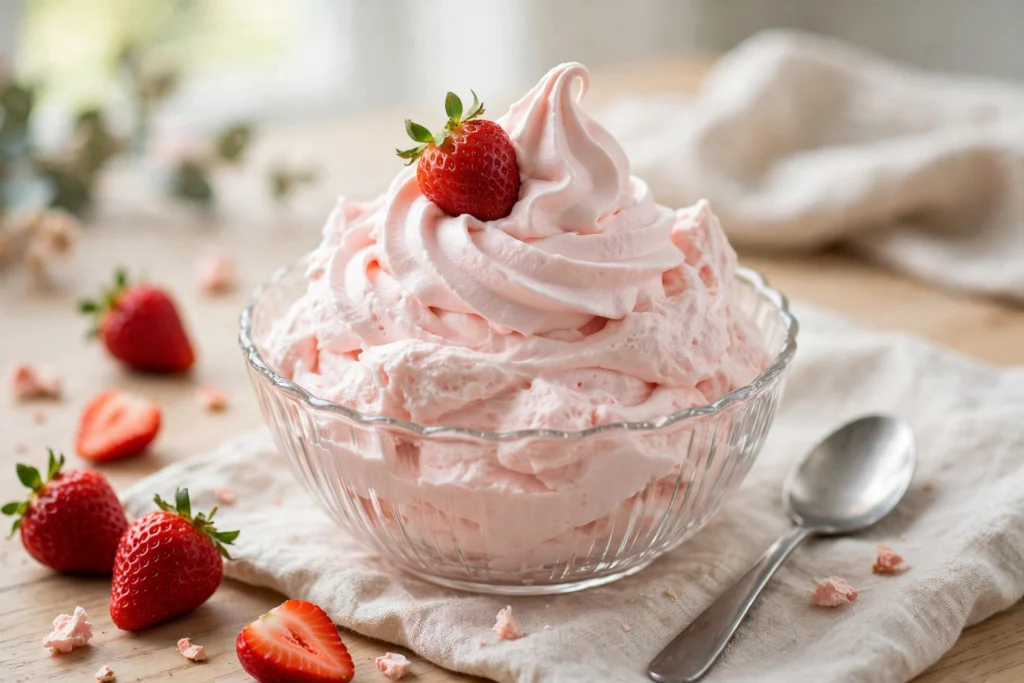
Table of Contents
ToggleWhy Protein Fluff Turns Into a Cloud
Three ingredients do the structural work, and each one has a specific job.
Casein is the frame. Casein forms micelles — clusters that unfold and stretch as the processor blades work, trapping air bubbles inside a protein web. That web is what lets the mixture hold soft peaks instead of collapsing back into smoothie. It is also why casein keeps you full longer than the same grams of whey: in the classic comparison study, casein emptied from the stomach slowly and produced a prolonged, moderate rise in amino acids, while whey spiked and faded fast (Boirie et al., 1997). Whey, built to dissolve instantly, is terrible at holding a foam — swap it in and the same recipe slumps. The powder-swap section below gives the honest version of what to expect.
Xanthan gum is the stabilizer. A half-teaspoon sounds like nothing, and that is roughly the right amount. Xanthan thickens the liquid phase between the bubbles, which slows the drainage that makes foams weep and collapse. It is a standard food additive (E 415), and EFSA’s 2017 re-evaluation found no safety concern at normal food-use levels and set no numerical daily limit. More is not better: past about ¾ teaspoon the texture turns slick and gummy.
Frozen fruit is the body and the cold. Partly-crushed frozen berries give the mixture its soft-serve density and keep everything cold while the processor runs. A processor warms food as it works; starting frozen buys the full whipping time before temperature becomes a problem.
This is also where fluff parts company with mousse. The site’s high protein chocolate mousse is a set dessert — blended smooth, spooned into cups, firm from the fridge. Fluff never sets. It is a foam, closer to soft serve eaten with a spoon, and it lives for about 20 minutes. Different dish, different method, different job.
Ingredients for Protein Fluff
Makes 1 large serving (the whole bowl), or 2 modest ones.
Frozen strawberries, 200g (about 1½ cups). Unsweetened, still fully frozen when they go in. Strawberries are the classic choice because they crush into a fine, icy snow and their acidity keeps the casein from tasting flat. Frozen mixed berries and frozen mango both work — the variations section has their numbers. Fresh berries do not work here: without the frozen structure, there is nothing for the foam to build on.
Vanilla casein protein powder, 1 scoop (30g; about 24g protein). Micellar casein, not a whey-casein “blend” if you can help it — blends sit halfway and whip halfway. Strawberry casein is an easy upgrade if you have it. Check your scoop size: casein scoops run 30–33g, and the difference is inside the rounding of the numbers given here.
Ice, about 100g (a loose cup of cubes). Ice stretches the volume and keeps the mixture cold during the long processing run. It melts into the fluff, so the texture stays soft rather than icy — provided it is crushed fine in the first stage, before the powder goes in.
2% milk, ¼ cup (60ml), added gradually. Start with about half of it; the rest goes in a tablespoon at a time, and only if the mixture stays crumbly — the method below works the same way. The milk is the adjustment liquid: too little and the processor churns a dry crumble; too much and no amount of whipping saves it. Skim milk, whole milk, and unsweetened almond milk all work at this quantity; the protein figure assumes 2% dairy milk, and plant milks shave off roughly 1–2g.
Xanthan gum, ½ teaspoon (about 1.6g). Non-negotiable for real fluff. Guar gum can substitute at the same amount with a slightly softer hold. Psyllium is not a substitute — it gels into a solid, slimy mass at these ratios.
Vanilla extract, ½ teaspoon; a pinch of salt. The salt is doing quiet work: berry acidity plus casein can read chalky, and a pinch pulls the flavor back toward dessert.
Optional sweetener, to taste. Flavored casein plus ripe berries is sweet enough for most people. If your powder is unflavored, 1–2 teaspoons of a stevia or erythritol blend fixes it without moving the numbers in any way that matters.
Equipment note: a food processor of at least 7-cup capacity is the right tool. A blender — even a good one — pushes the mixture outward and warms it, and the result lands closer to a thick smoothie. The FAQs cover the blender question in full.
How to Make Protein Fluff
Timings are estimates based on a standard home processor; your machine’s power shifts them by a minute or so either way.
- Crush the frozen base. Put the frozen strawberries and ice in the food processor. Pulse 8–10 times, then run for 60–90 seconds, scraping down once, until you have a fine, even, snow-like crumb with no berry chunks bigger than a pea. Chunks left at this stage survive to the end.
- Add the dry ingredients. Sprinkle the casein and xanthan gum evenly over the surface — do not dump them in one spot, where they form a gummy pocket that never distributes. Add the vanilla and salt.
- Start the whip, then drizzle the milk. Run the processor and pour in about half the milk through the feed tube. The mixture will look dry and sandy for the first 20–30 seconds. That is normal. It is not a cue to add the rest of the milk.
- Whip until it climbs and pales, about 3–4 minutes. The change is visible: the mixture lightens in color by several shades, pulls away from the sides, and roughly doubles in volume, with a texture like soft-serve ice cream or the top of a meringue. Add the remaining milk a tablespoon at a time only if the mixture stays crumbly past the 2-minute mark.
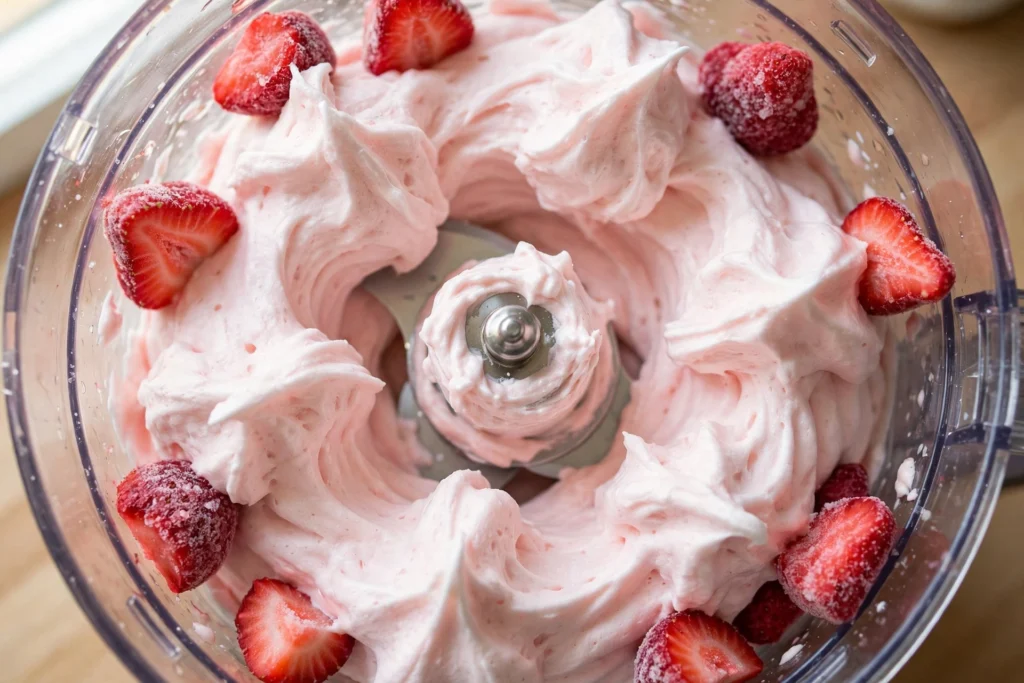
- Stop as soon as it holds soft peaks. Lift the lid at the 3-minute mark and check with a spoon. Over-processing warms the foam and it starts to slacken; under-processing leaves it dense. If it peaks, you are done, even if the timer in your head says otherwise.
- Serve immediately. Spoon it into a cold bowl — a bowl from the freezer buys you a few extra minutes — and eat it now. A few sliced fresh strawberries or a small handful of berries on top is the classic finish and adds roughly 15–20 calories.
Why Your Protein Fluff Went Soupy
Soupy is the default failure of this recipe, and it has a short list of causes. Work through them in this order before changing anything else.
The powder was whey. This accounts for most failed batches. Whey dissolves rather than stretches, so the foam never gets its frame. A whey-casein blend gives a partial result — it thickens but will not double — and pure whey gives flavored soup. If whey is all you own, the swaps section below is honest about the workaround and its limits.
Too much liquid, added too early. The mixture is supposed to look wrong — dry, sandy, crumbly — for the first half-minute of whipping. Adding all the milk at the start to “help it along” floods the foam before it forms, and foam does not form in a puddle. Next batch, hold back half the milk and add it only if the crumble persists.
The base was not frozen hard enough. Berries that sat on the counter while you found the xanthan gum, or a bag that has been half-thawed and refrozen into a block, both start the clock warm. The processor adds heat every second it runs. Everything goes in straight from the freezer.
You stopped too soon. Fluff has an awkward adolescence: at 90 seconds it looks like wet sand, and the instinct is to add liquid or give up. The transformation usually lands between minutes 2 and 4. If the volume has not moved by 4 minutes, the problem is one of the three above, not the timing.
You made it in a blender. Covered in the FAQs, but it belongs on this list too: a blender’s vortex heats and compresses rather than folds and lifts. Same ingredients, different machine, different dessert.
Protein Fluff Variations
The base method does not change. Swap the fruit, keep the casein, the xanthan, and the milk logic exactly where they are.
Mixed berry. Replace the strawberries with 200g frozen mixed berries (raspberries, blueberries, blackberries). Slightly tarter, deeper color, and the numbers move a little: about 27g protein and 255 calories for the bowl. Watch the first stage — blueberry skins need the full crush time.
Chocolate. Use chocolate casein and whisk 1 tablespoon of cocoa powder (about 7g) in with the dry ingredients. Richer and less fruity, at about 28g protein and 230 calories. A pinch more sweetener than the berry version usually wants, since cocoa adds bitterness without sugar.
Mango. Replace the strawberries with 200g frozen mango chunks. The sweetest version by a clear margin — drop the optional sweetener entirely — at about 27g protein and 265 calories. Mango is softer than strawberry at the same temperature, so give it an extra 10 minutes in the freezer if the bag has been opened a while, and expect a slightly denser fluff.
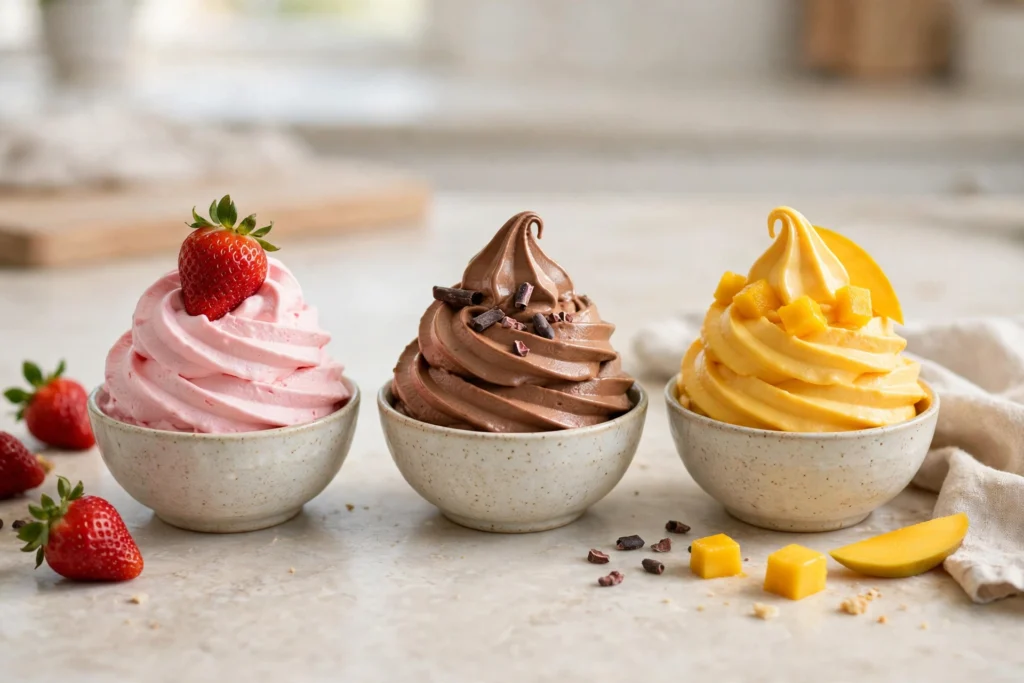
Half-batch for a smaller bowl. Halve everything, including the xanthan (¼ teaspoon). Small volumes whip faster and over-process sooner, so start checking at 90 seconds.
Making Protein Fluff With Whey or Without Powder
Whey concentrate or isolate. It works, with an asterisk large enough to read from across the room. Expect a thick, soft mixture rather than a doubled foam: reduce the milk to 2 tablespoons, keep everything frozen hard, and eat it the moment the processor stops, because it slackens within minutes. The numbers barely move, but they do depend on how much milk goes in: made with the full ¼ cup, a standard whey version lands at about 27g protein and 225 calories; with the milk cut back to 2 tablespoons, the way this swap calls for, it comes to about 26g protein and about 210 calories. Either way, the texture you get is closer to soft-serve on its way to melting. Calling it fluff would be generous.
Whey-casein blends. The middle path, and a reasonable one. Volume lands between the two: it whips, holds for maybe 10 minutes, and tastes like the powder it is. No other changes needed.
Plant protein powders. Pea-based powders thicken aggressively and can hold a modest whip; soy behaves similarly. Rice and hemp powders mostly do not. Plant powders also drink more liquid, so keep the full 60ml of milk within reach and add it sooner than the recipe’s caution suggests. Flavors vary too much between brands for a single honest number here; the protein lands wherever your scoop’s label says it does.
No powder at all (Greek yogurt version). Skip the casein. Whip the frozen strawberries and ice, then add 170g of fat-free Greek yogurt and the xanthan, with just 30ml of milk. The result is a thick, tangy berry whip — genuinely good, honestly different — at about 19g protein and 190 calories. It does not double in volume, and no technique makes yogurt behave like casein. It is the right version for people who simply do not keep protein powder in the house.
Can You Store Protein Fluff?
No — and this is the recipe’s one real limitation, so it gets a plain answer instead of a storage chart. Fluff is a foam, and foam drains. At room temperature it relaxes back toward smoothie within about 20 minutes; in the fridge it lasts a little longer but weeps liquid and loses its volume either way. There is no version of this that meal-preps.
Two partial salvage options, stated honestly. Leftovers can go into the freezer for 1–2 hours and come back as a soft, scoopable frozen block — a different texture, closer to a granita, still tasty. Or blend the deflated leftovers with a splash of milk and call it what it now is: a strawberry protein smoothie.
If what you actually want is a high-protein frozen dessert that waits in the freezer until you are ready, that is a different recipe — the machine-made ninja creami protein ice cream is built for exactly that. Protein fluff is for right now.
Frequently Asked Questions
What exactly is protein fluff?
A whipped dessert made by processing frozen fruit with casein protein powder and a small amount of xanthan gum until trapped air roughly doubles the volume. The texture sits between soft-serve ice cream and mousse, but it is neither — it is a foam, and it is eaten within minutes of making it.
How much protein is in protein fluff?
About 27g of protein and 215 calories for the whole bowl made as written — one scoop of casein (about 24g of protein) does nearly all of it, with the milk and berries adding the rest. Split the batch into two bowls and each lands at about 13g of protein and 110 calories.
Why casein and not whey?
Because the recipe runs on foam structure, and casein forms the stretchy protein web that traps and holds air; whey dissolves and the bubbles escape. The two proteins also digest at different speeds — casein slowly, whey quickly — as Boirie and colleagues documented in 1997, but for this recipe the whipping behavior is the deciding factor.
Do I really need the xanthan gum?
For real fluff, yes. Without it, the mixture whips briefly and then drains and collapses almost immediately. A half-teaspoon is enough; EFSA’s re-evaluation of xanthan gum (E 415) found no safety concern at food-use levels, and this recipe uses a fraction of the amounts in the studies behind that review.
Can I make protein fluff in a blender?
You can make something, but it will not be fluff. A blender’s vortex pulls the mixture down, warms it, and knocks out the air a food processor’s wide bowl folds in. Expect a thick smoothie. If a blender is genuinely your only option, use the whey-style adjustments — minimal liquid, everything frozen hard — and eat it straight from the jug.
Can I use fresh strawberries instead of frozen?
Not for this recipe. The frozen fruit is the structure: it crushes into an icy base that keeps the foam cold while it whips. Fresh berries give you a smoothie with protein powder in it. Freeze fresh berries solid on a tray for at least 4 hours if that is what you have.
How long does protein fluff keep?
About 20 minutes at room temperature before it visibly relaxes, and it does not recover. Make it when you are ready to eat it. Leftovers can be frozen into a soft block for 1–2 hours as a texture change, but they never re-whip to the original volume.
Is protein fluff a good post-workout snack?
It fits the usual guidance comfortably: sports-nutrition position stands put a sensible per-serving protein dose at roughly 20–40g for active people (Jäger et al., 2017), and this bowl delivers about 27g with very little fat to slow it down. It is a dessert that happens to hit a training target, not a supplement in disguise.
Recipe Card: Protein Fluff
Description: Frozen strawberries, casein, and a pinch of xanthan gum whipped in a food processor into a soft-serve-style fluff — about 27g of protein in one big bowl.
Prep time: About 5 minutes
Processing time: About 4–5 minutes
Total time: About 10 minutes
Yield: 1 large serving (or 2 small)
Equipment: Food processor, 7-cup capacity or larger
Ingredients
- 200g frozen strawberries, unsweetened (about 1½ cups)
- 1 scoop vanilla casein protein powder (30g)
- About 100g ice cubes (a loose cup)
- ¼ cup 2% milk (60ml), added gradually
- ½ teaspoon xanthan gum (about 1.6g)
- ½ teaspoon vanilla extract
- Pinch of salt
- Optional: 1–2 teaspoons stevia or erythritol blend, to taste
Instructions
- Process the frozen strawberries and ice, pulsing first, then running 60–90 seconds, until you have a fine, even snow with no chunks bigger than a pea. Scrape down once.
- Sprinkle the casein and xanthan gum evenly over the surface. Add the vanilla, salt, and sweetener if using.
- Run the processor and drizzle in half the milk. The mixture will look dry and sandy for the first 20–30 seconds — that is expected.
- Continue processing 3–4 minutes total, until the mixture pales, pulls from the sides, and roughly doubles in volume. Add the remaining milk a tablespoon at a time only if it stays crumbly past 2 minutes.
- Stop as soon as soft peaks hold. Spoon into a chilled bowl and serve immediately.
Storage: None — eat within about 20 minutes. Leftovers can be frozen 1–2 hours into a soft block, or blended with a splash of milk as a smoothie.
Nutrition per serving (whole bowl; calculated from the ingredients above, varies by brand): about 27g protein, 215 calories, 24g carbs, 2g fat, 5g fiber, 13g sugar, about 250mg sodium.
Two small servings: about 13g protein, 110 calories each.
One bowl, one scoop, ten minutes — protein fluff earns its place because the volume is real and the numbers hold up when you calculate them. It will not wait for you, and it will not meal-prep, and that is fine: not every recipe has to. Make it when you want dessert now. For the rest of the snack drawer — the bars, balls, and bites that do keep — the high protein snacks roundup has them organized.
References
- Boirie Y, Dangin M, Gachon P, Vasson MP, Maubois JL, Beaufrère B. Slow and fast dietary proteins differently modulate postprandial protein accretion. Proceedings of the National Academy of Sciences USA. 1997;94(26):14930–14935. https://pubmed.ncbi.nlm.nih.gov/9405716/
- EFSA Panel on Food Additives and Nutrient Sources Added to Food (Mortensen A, et al.). Re-evaluation of xanthan gum (E 415) as a food additive. EFSA Journal. 2017;15(7):e04909. https://pubmed.ncbi.nlm.nih.gov/32625570/
- Jäger R, Kerksick CM, Campbell BI, et al. International Society of Sports Nutrition position stand: protein and exercise. Journal of the International Society of Sports Nutrition. 2017;14:20. https://pmc.ncbi.nlm.nih.gov/articles/PMC5477153/
- U.S. Department of Agriculture. FoodData Central — Strawberries, frozen, unsweetened (SR Legacy): 35 kcal, 0.43g protein, 9.13g carbohydrate, 0.11g fat, 2.1g fiber per 100g. https://fdc.nal.usda.gov/