
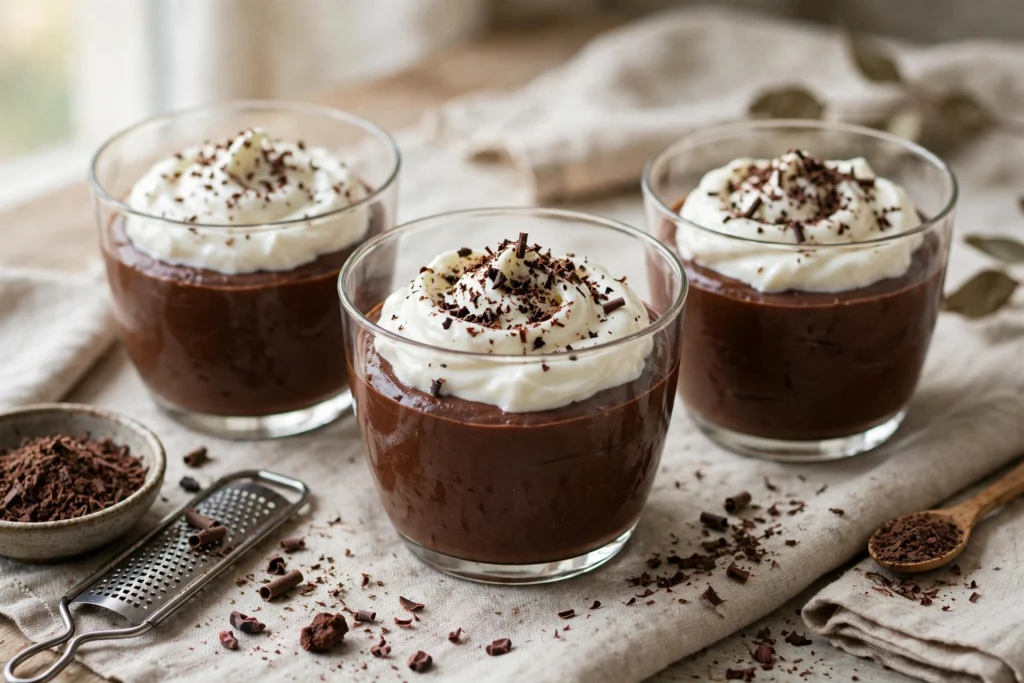
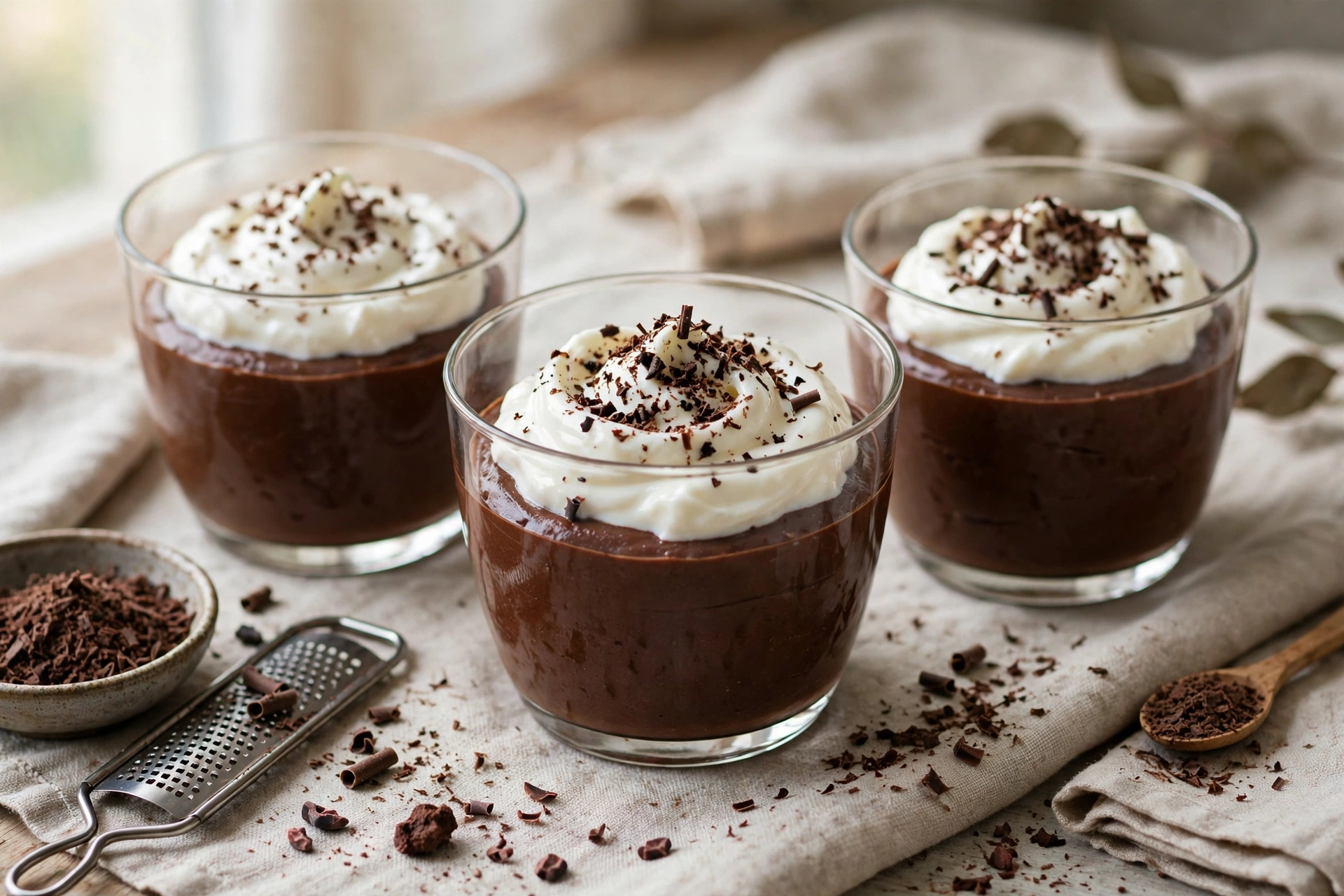
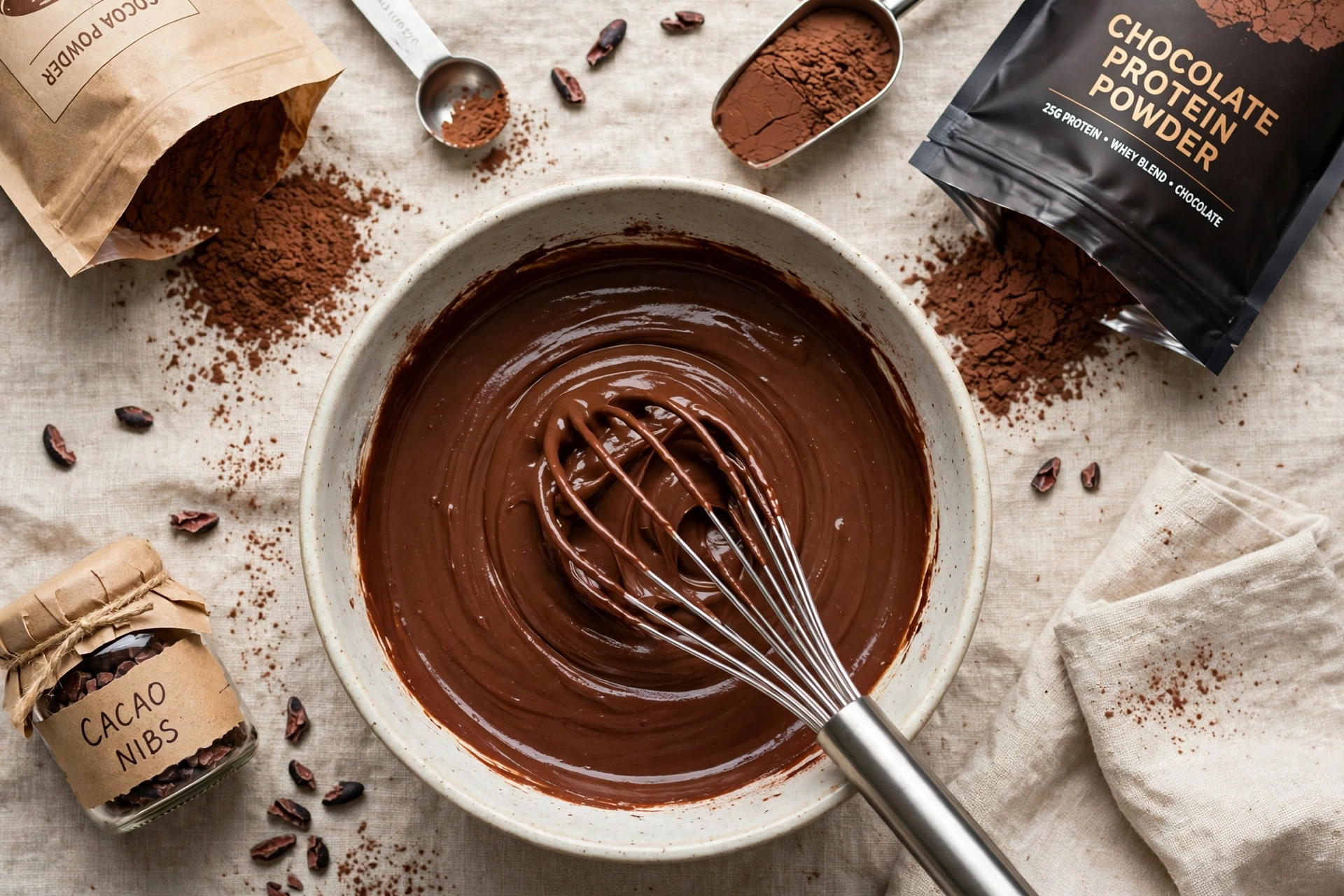
- Loosen the yogurt first. Whisk the Greek yogurt on its own for about 30 seconds, until it looks smooth and slightly relaxed. Cold yogurt straight from the tub is stiff, and dry powder folded into stiff yogurt forms lumps that no amount of later whisking fully removes.
- Add the cocoa, salt, and half the whey. Sprinkle them over the surface rather than dropping them in one mound, then whisk until no dry streaks remain. The mixture will look too thick at this point. That is expected.
- Add the rest of the whey, the maple syrup, and the vanilla. Whisk again until the color is uniform and the surface looks glossy. Scrape the bottom and sides of the bowl with a spatula and whisk once more — dry powder hides at the bottom edge of the bowl and shows up later as white flecks in a dark mousse.
- Adjust with milk, one tablespoon at a time. The target consistency is soft and spoonable: the mousse should fall off the whisk in a thick ribbon and hold a soft peak for a few seconds. It will firm up noticeably in the fridge, so stop while it still looks slightly softer than you want the finished dessert to be.
- Taste once. This is the moment to catch a powder that ran sweeter or more bitter than the one the recipe was balanced for. A teaspoon more maple syrup fixes bitter; a teaspoon more cocoa fixes flat. Either changes the nutrition slightly, and small corrections are worth more than exact figures on a dessert nobody finishes.
- Divide and chill. Spoon into 4 small bowls, glasses, or jars — about ⅔ cup (150g) each. Cover and refrigerate for at least 1 hour. The mousse is edible sooner, but the hour is when the cocoa hydrates fully, the flavors merge, and the texture firms from pudding-soft to mousse-dense.
- Serve cold, plain or with one of the toppings in the serving section below.
How to Get Smooth and Creamy Chocolate Mousse
Almost every failed batch of protein mousse fails in one of four ways, and each has a specific cause rather than a vague fix.
Grainy or chalky patches. This is dry powder that never fully hydrated — whey or cocoa that landed in a lump and got coated instead of dissolved. It is prevented, not repaired: loosen the yogurt first, add the powders in two stages, sprinkle rather than dump, and scrape the bowl. If you catch lumps before chilling, push the mixture through a fine-mesh sieve with the back of a spoon; two minutes of sieving rescues a batch that whisking alone will not.
Too thick and pasty. The powder absorbed more than expected, or the yogurt was an extra-thick strained style. Whisk in milk one tablespoon at a time and judge again after each addition. Remember the fridge firms this mousse — a mixture that looks perfect in the bowl will set up denser than you intended.
Too loose and runny. The opposite error, and usually self-inflicted: all the milk went in before the texture was judged, or the yogurt was a thin, non-strained style sold as “Greek-style.” Fix it in the bowl by whisking in 1 extra teaspoon of cocoa or a tablespoon more whey, then give it the full chilling hour before judging again. Adding liquid is a one-way door in this recipe, which is why the method doses it last and slowly.
A sharp, yogurty edge. Some tang is the nature of the base, but an aggressive one usually means the cocoa was under-measured or the powder was a mild one. A teaspoon of extra cocoa and a few drops more vanilla bring it back into balance more reliably than more sweetener does.
One expectation worth setting plainly: no two protein powders produce an identical mousse. A powder sweetened heavily will need the full maple amount held back slightly; a lean, unsweetened one may want the extra teaspoon. The recipe gives a working center point and the adjustment levers, in the order to pull them.
How to Make Chocolate Mousse Taste Richer
Chocolate flavor in a cold, no-bake dessert comes from layers, not from a single big dose of anything.
The cocoa does the heavy lifting. It is already the main chocolate source here; if your mousse tastes sweet but not deeply chocolate, the fix is another teaspoon of cocoa whisked in before chilling, not more syrup. Dutch-process cocoa gives the darkest, smoothest result.
Sweetness should be adjusted last and gradually. Cocoa bitterness reads stronger when a mousse is under-sweetened and disappears oddly when it is over-sweetened, leaving a flat, sugary yogurt. Add maple syrup a teaspoon at a time, tasting between additions, and stop at “clearly chocolate” rather than “clearly sweet.”
The powder choice matters. A chocolate whey you already like as a shake will taste right here; one you find artificial in a glass will taste artificial in a mousse, only colder and more concentrated. Vanilla whey also works in this recipe — the cocoa carries the chocolate — and produces a slightly lighter flavor.
Vanilla and salt are flavor multipliers, already in the recipe for this reason. Vanilla deepens how cocoa registers; salt suppresses raw bitterness. Skipping either makes the same ingredients taste thinner.
Optional, and outside the base nutrition: a tablespoon of finely grated dark chocolate folded in at the end, or a few drops of the mousse served over a teaspoon of melted dark chocolate in the bottom of the glass. Both add real chocolate intensity along with calories the base figures do not include.
Can You Make Protein Chocolate Mousse Without Protein Powder?
Yes — but the powder is doing three jobs in this recipe (protein, chocolate flavor, and sweetness), so the honest version adjusts for all three rather than just leaving it out. The adjusted no-powder recipe: keep the Greek yogurt at 2 cups (480g), raise the cocoa to ¼ cup (20g), raise the maple syrup to 4 tablespoons (80g), keep the milk at 2 tablespoons added gradually, and keep the vanilla and salt the same. Method unchanged.
That version lands at about 13g of protein and about 140 calories per serving (21g carbs, 1g fat, 2g fiber, 17g sugar, about 125mg sodium) — still a genuinely protein-carrying dessert, because the yogurt base was doing most of the work all along. Two texture notes: without whey absorbing liquid, the mixture starts slightly softer, so the full chilling hour matters more; and the flavor runs darker and less sweet, closer to a bittersweet pudding. What it is not is an equal swap — anyone who tells you the powder can simply be deleted from a recipe like this is handing you a thinner, paler mousse and the same headline number.
High Protein Chocolate Mousse Variations
Each of these starts from the base recipe. Additions change the nutrition unless noted.
Chocolate peanut butter. Whisk 2 tablespoons of creamy peanut butter into the yogurt before the powders go in. The texture turns slightly denser and the flavor unmistakably peanut-butter-cup. Calculated: about 21g protein and about 200 calories per serving.
Mocha. Dissolve 1 teaspoon of instant espresso powder in the milk before adding it. Coffee does not make the mousse taste like coffee at this dose; it makes the chocolate taste more like itself. Negligible change to the nutrition.
Mint chocolate. Add ¼ teaspoon of mint extract with the vanilla — a quarter teaspoon, measured, because mint extract overshoots fast and cannot be whisked back out. A drop of extra cocoa on top balances it.
Dark chocolate. Fold in 1 tablespoon of finely grated dark chocolate (70% or higher) after the final whisk, or melt it and swirl it over the top of each portion before chilling. Not counted in the base nutrition.
Chocolate strawberry. Change nothing in the bowl. Serve each portion with sliced fresh strawberries, which cut the richness in a way extra sweetness never does. The berries are a topping, so they sit outside the base figures too.
How to Serve High Protein Chocolate Mousse
Serve it cold, in small portions — this is a dense mousse, and about ⅔ cup is a complete serving, not a starter. Good toppings, all optional and all outside the base nutrition: fresh strawberries or raspberries; a small spoonful of Greek yogurt swirled on top; finely grated dark chocolate; a few chopped nuts for contrast against the smooth texture; or a light dollop of whipped cream if the occasion calls for it. For make-ahead serving, portion the mousse into small lidded jars right after mixing — the same trick used for the protein granola bars on this site, where individual portions are what turn a batch into a grab-and-go habit. A wider set of ideas lives in the high-protein dessert recipes roundup; this page stays with the one mousse.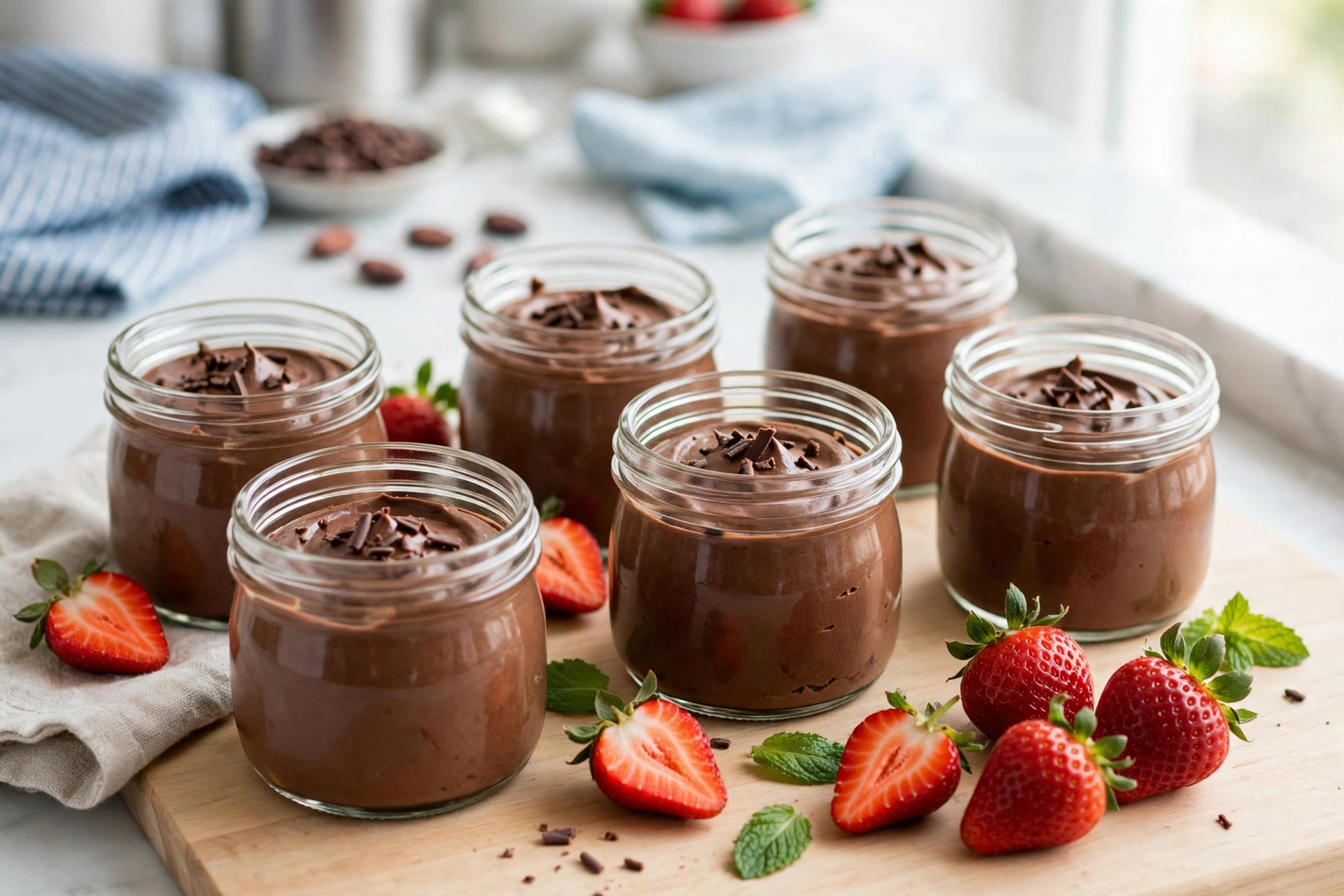
How to Store Protein Chocolate Mousse
Store the mousse in the refrigerator in covered individual containers — portioned jars or bowls sealed with lids or wrap — and eat it within 3 to 4 days, the standard window food-safety guidance gives refrigerated leftovers and dairy-based dishes like this one. Refrigerate it promptly after making it rather than leaving portions out on the counter, and add fresh fruit toppings at serving time rather than storing them on the mousse, where they weep and shorten the life of the batch. The texture firms further over the first day; if a portion feels too dense straight from the fridge, let it stand for 5 minutes and stir it gently once before eating.
Freezing is possible but is not the recommended storage route for this recipe. A yogurt-based mousse freezes solid and thaws loose and slightly grainy, because the yogurt’s structure does not survive the freeze-thaw cycle intact — it comes back as a soft chocolate yogurt, not a mousse. If you freeze portions anyway, use them within about a month, thaw them in the refrigerator, and expect the texture change; eaten half-frozen, they work better, more like a frozen yogurt cup.
Frequently Asked Questions
Is chocolate mousse high in protein?
Traditional chocolate mousse is not — it is built on cream and chocolate, and its protein is incidental. A protein chocolate mousse is high in protein by construction: this version carries about 19g per serving, calculated from the yogurt, whey, and cocoa, which is in the range of a lighter protein shake, in dessert form.
How much protein is in homemade chocolate mousse?
It depends entirely on the base and whether powder is used, which is why headline numbers vary so widely between recipes. In this recipe: about 19g per serving with the whey included, and about 13g per serving in the adjusted no-powder version. Both figures are calculated ingredient-by-ingredient from the quantities on this page.
Can you make protein chocolate mousse without protein powder?
Yes. The adjusted version above — more cocoa, a little more maple syrup, the same yogurt base — reaches about 13g of protein per serving with no powder at all. Simply omitting the powder without adjusting gives a thinner, less chocolatey result, because the powder was also carrying flavor and body.
Can you use cottage cheese to make chocolate mousse?
Yes — blended cottage cheese is the other common base for a protein mousse, and it works when the cheese is blended completely smooth before anything else is added, since any surviving curd shows up as graininess in the finished dessert. This recipe uses Greek yogurt as the base instead, which reaches a smooth texture with a whisk and no blender.
Can Greek yogurt be used instead of cottage cheese?
That is exactly the swap this recipe is built on. Greek yogurt gives a tangier, slightly denser mousse than a cottage cheese base, needs no blending equipment, and carries comparable protein. If you adapt a cottage-cheese mousse recipe to yogurt, expect the result to set a little firmer and to taste a touch sharper.
Why is my chocolate protein mousse grainy?
In a yogurt-based mousse, graininess almost always traces back to dry ingredients: whey or cocoa that went in all at once and formed coated lumps instead of dispersing. Loosen the yogurt first, add the powders in two stages, scrape the bowl, and sieve the mixture if lumps survive the whisk. In a cottage-cheese mousse, the same symptom means the base was under-blended.
Does protein chocolate mousse need to be refrigerated?
Yes. It is a dairy dessert with no cooking step, so it goes into the refrigerator as soon as it is mixed — the 1-hour chill is both a setting step and a food-safety one — and it stays refrigerated, in covered containers, for up to 3 to 4 days.
Can you freeze high-protein chocolate mousse?
You can, but the texture pays for it: this yogurt-based mousse thaws looser and slightly grainy rather than returning to its original smoothness. Freezing is a backup, not the plan. The refrigerator window of 3 to 4 days is short enough that most batches are finished well inside it.
References
- USDA FoodData Central — nutrition values for Greek yogurt (non-fat), unsweetened cocoa powder, and maple syrup used in the calculations on this page: https://fdc.nal.usda.gov/
- FoodSafety.gov — refrigerated storage guidance for leftovers and perishable prepared foods (3 to 4 days): https://www.foodsafety.gov/food-safety-charts/cold-food-storage-charts
- Protein powder figures follow a standard chocolate whey label (1 scoop / 32g); check your own tub, as protein, sugar, and sodium vary by brand and the per-serving totals shift with them.
Recipe: High Protein Chocolate Mousse
A no-bake chocolate mousse built on Greek yogurt and chocolate whey — thick, smooth, and spoonable, with about 19g of protein per serving.
- Prep time: about 10 minutes
- Chilling time: at least 1 hour
- Total time: about 1 hour 10 minutes
- Servings: 4 (about ⅔ cup / 150g each)
Ingredients
- Non-fat Greek yogurt, 2 cups (480g)
- Chocolate whey protein powder, 1 scoop (32g)
- Unsweetened cocoa powder, 3 tablespoons (15g)
- Pure maple syrup, 3 tablespoons (60g)
- 2% milk, 2 tablespoons (30ml), added gradually
- Vanilla extract, 1 teaspoon
- Fine salt, ⅛ teaspoon
Instructions
- Whisk the yogurt alone for about 30 seconds until smooth and loosened.
- Sprinkle in the cocoa, salt, and half the whey; whisk until no dry streaks remain.
- Add the remaining whey, maple syrup, and vanilla; whisk until uniform and glossy. Scrape the bowl and whisk once more.
- Add milk 1 tablespoon at a time until the mousse falls in a thick ribbon and holds a soft peak.
- Taste; correct with a teaspoon more maple syrup (bitter) or cocoa (flat) if needed.
- Divide among 4 small bowls or jars, cover, and refrigerate at least 1 hour.
- Serve cold, plain or topped.
Serving suggestions: Fresh strawberries or raspberries, a swirl of Greek yogurt, grated dark chocolate, chopped nuts, or a small dollop of whipped cream (toppings not included in the nutrition).
Storage: Refrigerate in covered containers and eat within 3 to 4 days. Freezing is possible for up to about a month but the thawed texture turns loose and slightly grainy; refrigeration is the recommended route.
Nutrition per serving (calculated): about 155 kcal · 19g protein · 18g carbs · 2g fat · 1g saturated fat · 1g fiber · 14g sugar · about 155mg sodium