Protein cheesecake is cheesecake rebuilt so the filling carries real protein: this baked protein cheesecake keeps the graham crust, the tang, and the dense, creamy slice of the original, but the filling blends Neufchâtel cream cheese with cottage cheese, Greek yogurt, and vanilla protein powder, so each of the 10 slices lands at about 15g of protein and 290 calories — roughly double the protein of a traditional slice, calculated ingredient by ingredient below. What follows is the whole method: blending the filling completely smooth, baking at one steady temperature until the center still wobbles, cooling gradually so the top stays intact, and chilling long enough for clean slices. One honest note before the recipe: adding protein does not make a cheesecake low in sugar or fat, and this one does not pretend to — it is a proper dessert with a better protein number.
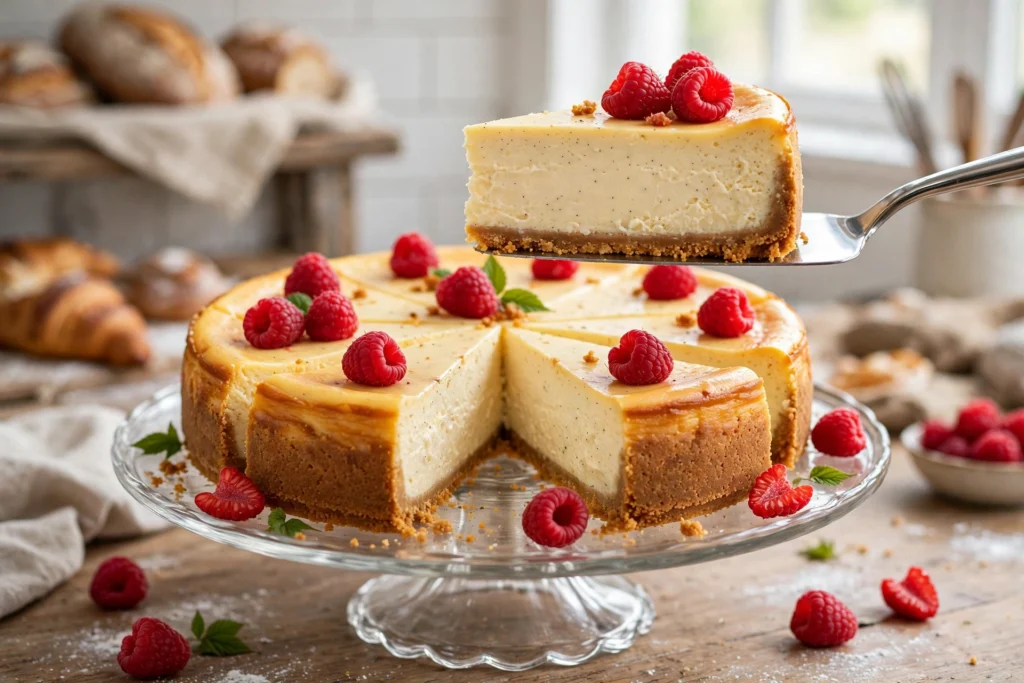
Table of Contents
ToggleWhat Is Protein Cheesecake?
Protein cheesecake is a cheesecake whose filling includes ingredients chosen partly for their protein — here, cottage cheese, Greek yogurt, and protein powder alongside the cream cheese — rather than cream cheese, sugar, and eggs alone. The texture shifts a little with the formulation: yogurt brings tang and moisture, blended cottage cheese keeps the filling dense without heaviness, and protein powder firms the set while adding a vanilla sweetness of its own. A well-made one still eats like cheesecake — smooth, rich, and sliceable — not like a baked protein shake. And to be plain about the trade: protein is the thing this recipe adds. The crust is a real graham crust with butter, the filling is sweetened with real sugar, and the slice carries about 18g of sugar. Whether that trade suits your goals is your call; the numbers are printed in full so you can make it with open eyes.
Ingredients for Protein Cheesecake
For the crust:
Graham cracker crumbs, 1½ cups (150g). The classic base — fine crumbs press into an even layer that slices cleanly.
Unsalted butter, 4 tablespoons (56g), melted. Binds the crumbs and crisps the crust in its short pre-bake.
Granulated sugar, 1 tablespoon (12g). A little sweetness and a firmer set for the crust.
For the filling:
Neufchâtel cheese, 8 ounces (227g), at room temperature. The cream cheese flavor and tang at about a third less fat than regular cream cheese. It must be genuinely soft before mixing — cold cream cheese is the number one cause of a lumpy filling.
Low-fat cottage cheese, 1 cup (226g). About 25g of protein, and the ingredient readers question most. It disappears completely: the filling is blended until the curds are gone, and no one slicing this cake would guess it is there. What remains is density and protein.
Plain non-fat Greek yogurt, 1½ cups (360g), at room temperature. About 36g of protein plus the moisture that keeps a lower-fat filling creamy instead of dry.
Vanilla whey protein powder, 2 scoops (60g; about 48g protein). The single largest protein contributor in the cake. Whey is specified because it bakes into the smoothest set here; casein makes the filling noticeably firmer and drier at the same amount, and plant powders vary too much in sweetness and absorbency to swap blindly — if you use one, expect a denser slice.
Granulated sugar, ½ cup (100g). Sweetness and tenderness. Sugar also keeps the filling supple; cutting it hard changes the texture, not just the taste.
Large eggs, 2, at room temperature. The setting agent. They go in last and are mixed the least — overbeaten eggs are how a cheesecake puffs, falls, and cracks.
Cornstarch, 2 tablespoons (16g). Insurance for the set: it helps a yogurt-rich filling slice cleanly and makes small cracks less likely.
Vanilla extract, 2 teaspoons, and lemon zest, 1 teaspoon (optional). Vanilla rounds out the powder’s flavor; the zest brightens the tang.
Do You Need a Crust?
This recipe includes the graham crust — it is part of the calculated nutrition, part of the classic cheesecake experience, and it protects the slices when you lift them from the pan. It is not, however, structural: the filling sets firmly enough to bake crustless in a parchment-lined springform if you prefer. Without the crust, each slice drops to about 180 calories and the protein stays at about 14g, because the filling was always where the protein lives. The method below is written for the crust version; for crustless, line the pan, grease it well, and follow everything else exactly the same.
How to Make Protein Cheesecake
1. Set up. Take the Neufchâtel, yogurt, and eggs out of the fridge 45 to 60 minutes ahead. Position a rack in the center of the oven and preheat to 325°F (163°C). Lightly grease a 9-inch springform pan and line its base with a round of parchment.
2. Make and pre-bake the crust. Stir the graham crumbs, sugar, and melted butter until the mixture looks like wet sand. Press it firmly and evenly over the base of the pan with the flat bottom of a measuring cup. Bake 8 to 10 minutes, until it smells toasty and looks a shade darker. Cool on a rack while you make the filling — filling on a hot crust starts cooking the bottom unevenly.
3. Blend the filling base until perfectly smooth. In a blender or food processor, combine the cottage cheese, Greek yogurt, Neufchâtel, protein powder, sugar, cornstarch, vanilla, and lemon zest, and blend until completely smooth, stopping to scrape the sides once. This is the step that guarantees a lump-free filling — the cottage cheese curds and any cream cheese lumps must be gone now, because no gentle stirring later will fix them.

4. Add the eggs with the least mixing possible. Pour the blended base into a bowl, add the 2 eggs, and stir by hand with a spatula just until no yellow streaks remain — under a minute. Blending or beating after the eggs go in whips in air, and air is what puffs the top in the oven and cracks it as it falls.
5. Fill the pan. Pour the filling over the cooled crust and smooth the top with the spatula. Tap the pan gently on the counter two or three times to bring any large air bubbles to the surface.
6. Bake at 325°F (163°C) for 50 to 60 minutes. No water bath is needed at this moderate temperature for this filling. The cheesecake is done when the outer two-thirds look set and slightly puffed while the center — a circle about 2 to 3 inches across — still wobbles like set gelatin when you nudge the pan. If you use an instant-read thermometer, the center should read about 150°F (66°C). Baking until the center is fully firm is how a cheesecake turns dry and cracked; it finishes setting as it cools and chills.
7. Cool gradually. Turn the oven off, crack the door open with a wooden spoon, and leave the cheesecake inside for 1 hour. Then move it to a rack for 30 minutes, run a thin knife around the edge (this lets the cake contract without tearing its own top), cover loosely, and refrigerate.
8. Chill at least 6 hours, ideally overnight, before removing the springform ring and slicing. The flavor and texture both improve on the second day. Slice with a long knife dipped in hot water and wiped between cuts.
How to Make Protein Cheesecake Creamy
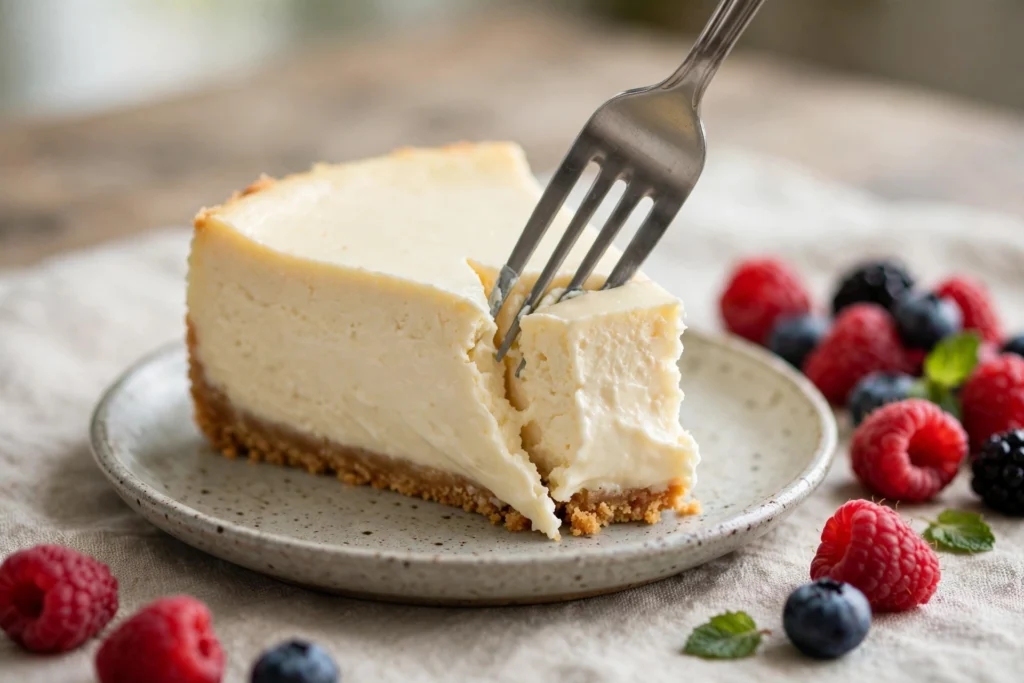
Creaminess in a cheesecake is decided before the oven, not in it. Start with room-temperature dairy. Neufchâtel and yogurt that sit out for 45 to 60 minutes blend into a silk-smooth base; cold cream cheese stays in flecks that no amount of baking melts away. Blend the base hard, then never again. The blender is where smoothness happens — cottage cheese curds and cream cheese lumps are eliminated there, before the eggs exist in the mixture. From the moment the eggs go in, the spatula takes over and mixing drops to the minimum that removes the yellow streaks. Air beaten in at that stage expands in the oven and collapses afterward, and the collapse is what tears the top. Bake gently and stop early. A steady 325°F (163°C) and a center that still wobbles when the oven goes off are what separate a creamy slice from a dry one — the filling finishes setting during the gradual cool and the long chill. Chill the full time. A cheesecake cut at 2 hours is a different, softer dessert than the same cake at 8 hours; the dense, clean-slicing texture only exists after the chill. One caveat the recipe cannot engineer away: texture depends on formulation. More powder, leaner dairy, or a sugar substitute will each move the result — firmer, drier, or softer — which is why the versions below give adjusted quantities instead of inviting blind swaps.
Common Protein Cheesecake Mistakes
Lumpy filling. Almost always one of two causes: the Neufchâtel went in cold, or the base was stirred rather than blended. Cottage cheese makes this unforgiving — if the curds are not fully blended before the eggs are added, they stay visible in the baked slice. Blend until you cannot see a single fleck, and scrape the blender sides once mid-blend.
Cracks on top. Overbaking is the leading cause: a center baked fully firm in the oven has nowhere to go as it cools and contracts, so it splits. Sudden temperature change is the second — a cake rushed from a hot oven into a cool room contracts at the surface first. Beaten-in air is the third. The gradual oven cool in the method addresses all three, but no method prevents every crack; a shallow one is cosmetic, and a spoonful of berries has covered worse.
Soft or runny center. Either the cake was pulled too early — the wobble should be a gentle jiggle in a 2 to 3 inch circle, not a sloshy wave across the whole surface — or it was sliced before the chill finished setting it. A center that is still loose after a full overnight chill was underbaked; next time, give it the thermometer check (about 150°F / 66°C at the center) before starting the cool.
Rubbery or dry texture. Too much time in the oven, or a formulation pushed too lean — extra protein powder, fat-free everything — without adjusting anything else. Powder absorbs moisture as it bakes; doubling it does not double the protein benefit per bite so much as it doubles the dryness.
Strong protein-powder taste. The powder is a third of this filling’s flavor, so a powder you dislike as a shake will not hide in the cake. Vanilla is the safest match for cheesecake; strongly sweetened or artificially flavored powders announce themselves. If the finished cake tastes of powder, the fix for next time is a milder powder — or the no-powder version below — not more sugar.
Can You Make Protein Cheesecake Without Protein Powder?
Yes — with adjusted quantities, because the powder in this recipe is doing structural work (absorbing moisture and firming the set), not just adding protein. Simply leaving it out makes a softer, wetter filling. The adjusted version: omit the 2 scoops of whey, increase the Greek yogurt to 2 cups (480g), and increase the cornstarch to 3 tablespoons (24g). Blend and bake exactly the same way, and give it the full overnight chill — this version needs every hour of it. Each slice then lands at about 11g of protein and 275 calories: less than the 15g of the main recipe, but still well above a traditional cheesecake, and the flavor is a touch tangier from the extra yogurt. More ways to put a tub of yogurt to work are in the high protein Greek yogurt recipes roundup.
How Much Protein Is in a Slice of Protein Cheesecake?
About 15g per slice — one tenth of the whole cake’s calculated 147g of protein, with the crust counted in. The contributors, per slice: the protein powder provides about 5g; the Greek yogurt about 3.5g; the cottage cheese about 2.5g; the Neufchâtel about 1.5g; the eggs about 1.3g; and the crust and remaining ingredients the final gram or so. The full calculated nutrition per slice is about 290 calories, 29g carbs, 13g fat, 7g saturated fat, 18g sugar, about 320mg sodium, and less than 1g of fiber. Those figures come from the exact quantities in this recipe using standard USDA values and typical labels — your slice will move a little with different brands of cream cheese, yogurt, cottage cheese, or powder, and with how generously the cake gets divided.
How to Serve Protein Cheesecake
The cake needs nothing, but it accepts garnishes gracefully. Fresh berries — a handful of raspberries or sliced strawberries per slice — are the classic for a reason: their acidity cuts the richness. A spoonful of fruit sauce, lightly sweetened Greek yogurt, or a modest drizzle of melted chocolate all work the same way. None of these toppings are included in the nutrition figures above; they are additions, not part of the base recipe. And if the occasion calls for a frozen dessert instead of a baked one, the Ninja Creami protein ice cream is this site’s other route to protein at dessert.
How to Store Protein Cheesecake
Cheesecake is a dairy-and-egg custard, so it lives in the refrigerator, full stop. Once it has cooled and chilled, keep it covered — the springform base under plastic wrap, or slices in an airtight container — and refrigerate for up to 4 days. Do not leave it at room temperature for more than about 2 hours when serving; return leftovers to the fridge promptly. For longer storage, freeze individual slices: wrap each slice tightly in plastic wrap, then foil, and freeze for up to 2 months for best quality. Thaw a frozen slice in the refrigerator overnight (about 8 hours) rather than on the counter, and serve it still slightly cool, when the texture is at its firmest and creamiest.
Frequently Asked Questions
Is protein cheesecake high in protein?
Per slice, yes, relative to cheesecake: about 15g against the 5 to 7g of a traditional slice, at fewer calories (about 290). It is still a dessert — with about 18g of sugar per slice — so “high in protein for a cheesecake” is the accurate claim, and the one this recipe makes.
Can you make protein cheesecake without protein powder?
Yes, with the adjusted version in the section above: no powder, Greek yogurt raised to 2 cups, cornstarch to 3 tablespoons, and a full overnight chill. Expect about 11g of protein and 275 calories per slice and a slightly softer set.
Can Greek yogurt be used in protein cheesecake?
It is already a main ingredient here — 1½ cups of plain non-fat Greek yogurt bring about 36g of protein to the filling along with the moisture that keeps a leaner cheesecake creamy. Use plain, not flavored: sweetened yogurts change both the sugar math and the set.
Why did my protein cheesecake crack?
The usual causes are overbaking (a center baked firm splits as it contracts), a sudden temperature change after baking, or air beaten in after the eggs were added. The gradual cool in the oven with the door cracked addresses all three — and a shallow crack affects looks only, not the eating.
How do you know when a cheesecake is done baking?
By the wobble, not the clock: the outer portion looks set and slightly puffed while the center 2 to 3 inches still jiggle like set gelatin when the pan is nudged. An instant-read thermometer at the center should read about 150°F (66°C). It will look underdone compared to a cake — that is correct; it finishes in the cool and the chill.
How long should protein cheesecake chill before serving?
At least 6 hours, and overnight is better. The chill is when the filling completes its set and the flavor settles; slicing earlier gives soft, messy cuts and a texture that undersells the cake.
Can protein cheesecake be frozen?
Yes — freeze slices individually wrapped in plastic wrap and foil for up to 2 months, and thaw overnight in the refrigerator. The texture after thawing is very close to fresh, especially served slightly cool.
References
U.S. Department of Agriculture, Agricultural Research Service. FoodData Central. Nutrient profiles used for the calculations in this recipe: Neufchâtel cheese, low-fat cottage cheese, Greek yogurt, graham crackers, butter, eggs, and granulated sugar. https://fdc.nal.usda.gov/
U.S. Department of Health and Human Services. FoodSafety.gov — FoodKeeper guidance on refrigerating and freezing baked custards and leftovers, and the two-hour rule for perishable foods. https://www.foodsafety.gov/keep-food-safe/foodkeeper-app
Recipe: Protein Cheesecake (Baked)
Description: A full-size baked cheesecake with a graham crust and a filling of Neufchâtel, blended cottage cheese, Greek yogurt, and vanilla protein powder — creamy, sliceable, and about 15g of protein per slice.
Prep time: 20 minutes (plus 45–60 minutes for ingredients to come to room temperature)
Cook time: 50–60 minutes, plus 8–10 minutes for the crust
Cooling time: 1 hour in the cooling oven, then 30 minutes at room temperature
Chilling time: At least 6 hours, ideally overnight
Total time: About 8 hours 15 minutes (mostly unattended cooling and chilling)
Servings: 10 slices
Pan: 9-inch springform pan, base lined with parchment
Ingredients:
Crust:
– 1½ cups graham cracker crumbs (150g)
– 4 tablespoons unsalted butter (56g), melted
– 1 tablespoon granulated sugar (12g)
Filling:
– 8 ounces Neufchâtel cheese (227g), room temperature
– 1 cup low-fat cottage cheese (226g)
– 1½ cups plain non-fat Greek yogurt (360g), room temperature
– 2 scoops vanilla whey protein powder (60g)
– ½ cup granulated sugar (100g)
– 2 large eggs, room temperature
– 2 tablespoons cornstarch (16g)
– 2 teaspoons vanilla extract
– 1 teaspoon lemon zest (optional)
Instructions:
1. Preheat the oven to 325°F (163°C), rack in the center. Grease a 9-inch springform pan and line the base with parchment.
2. Mix the crumbs, sugar, and melted butter; press firmly over the pan base. Bake 8 to 10 minutes until toasty; cool completely.
3. Blend the cottage cheese, yogurt, Neufchâtel, protein powder, sugar, cornstarch, vanilla, and zest until completely smooth, scraping the sides once.
4. Transfer to a bowl; stir in the eggs by hand just until no yellow streaks remain.
5. Pour over the cooled crust, smooth the top, and tap the pan gently on the counter to release large air bubbles.
6. Bake 50 to 60 minutes, until the edges are set and slightly puffed and the center 2 to 3 inches still wobble like set gelatin (about 150°F / 66°C at the center on an instant-read thermometer).
7. Turn the oven off, crack the door with a wooden spoon, and cool the cheesecake inside for 1 hour. Rest 30 minutes on a rack, run a thin knife around the edge, cover loosely, and refrigerate at least 6 hours or overnight.
8. Slice with a long knife dipped in hot water and wiped clean between cuts.
Storage: Refrigerate covered up to 4 days. Freeze individually wrapped slices up to 2 months; thaw overnight in the refrigerator.
Nutrition per slice (calculated from the ingredients above; varies by brand): about 15g protein, 290 calories, 29g carbs, 13g fat, 7g saturated fat, 18g sugar, about 320mg sodium, less than 1g fiber.
A cheesecake that slices like the real thing and quietly doubles the protein is worth the overnight wait — blend it smooth, pull it while it still wobbles, and let the chill do the rest. For more desserts built the same calculated, one-recipe-at-a-time way — and a few no-bake ones for the nights the oven stays off — the high protein dessert recipes roundup is the place to browse next.