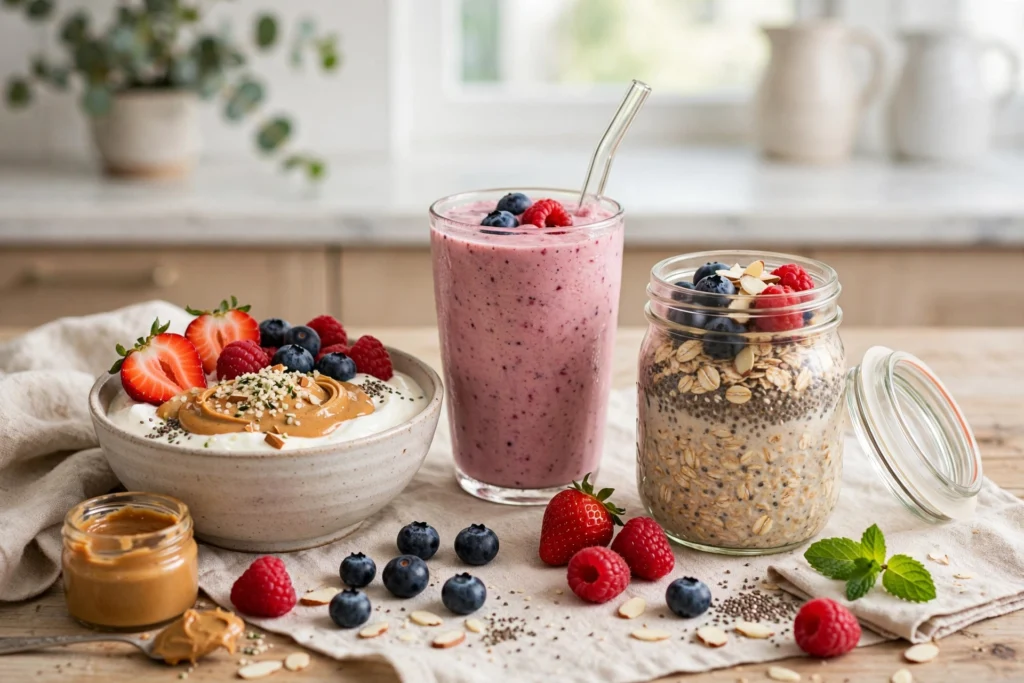
These muffins carry about 9 grams of protein and about 165 calories each, and the protein does not come from a trick. A full cup of nonfat Greek yogurt and two scoops of vanilla whey do the heavy lifting, eggs and flour hold the structure, and blueberries keep the crumb tasting like breakfast instead of a supplement. One batch makes 12, they freeze properly, and a muffin plus coffee is a genuinely filling start rather than a cake in a paper case pretending to be one.
Plenty of “protein muffin” recipes online land at 4 or 5 grams per muffin, which is roughly what a plain muffin gives you anyway. The gap between that and 9 grams is not magic — it is one ingredient swap (yogurt in place of most of the milk and oil) and one deliberate addition (whey, at a ratio the crumb can handle). Both are explained below, with the math shown, because a protein claim you cannot trace is just marketing.
If yogurt-based baking is your thing generally, our roundup of high protein Greek yogurt recipes covers the no-bake and savory side of the same tub. This post is the baked one: a single muffin recipe, done carefully.
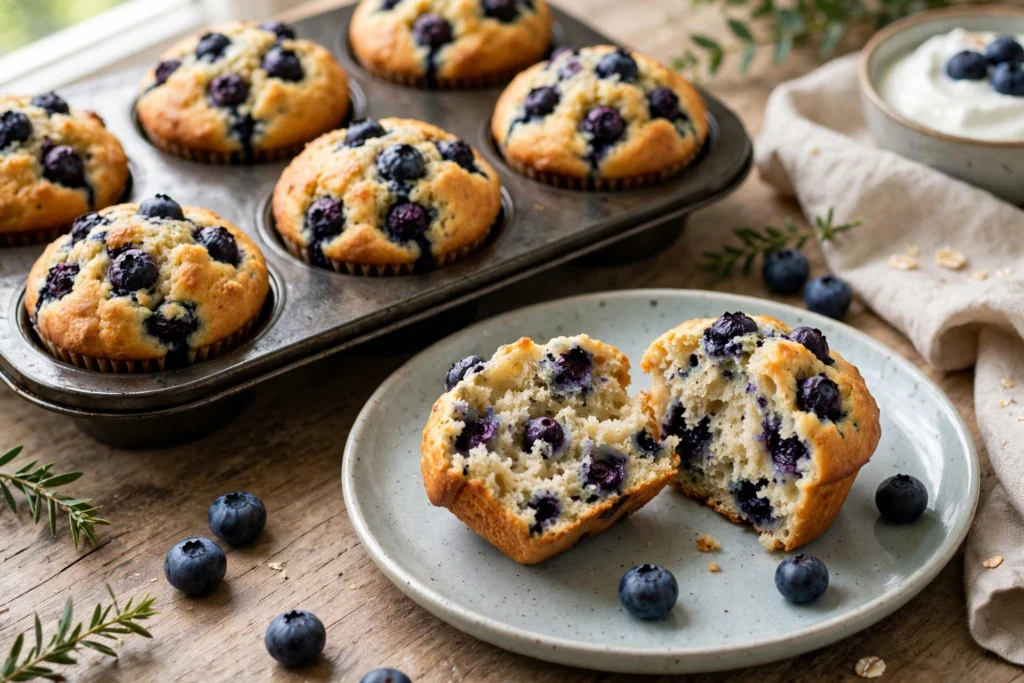
Table of Contents
ToggleWhere the 9 grams actually come from
Protein in a muffin is a budget, and every ingredient either contributes or dilutes. Here is the batch accounting, using USDA-style values: nonfat Greek yogurt at 10.2g protein per 100g, whey at 48g protein per two 30g scoops, all-purpose flour at 10.3g per 100g, eggs at 12.6g per 100g.
- Greek yogurt, 1 cup (245g): about 25g protein — the largest single contributor after the whey, and it replaces most of the liquid and fat a normal muffin gets from milk and oil.
- Vanilla whey protein powder, 2 scoops (60g): about 48g protein. This is the difference between a 5-gram muffin and a 9-gram one.
- All-purpose flour, 1¾ cups (210g): about 22g protein. Flour is not a protein food, but at this quantity it quietly adds up.
- Eggs, 2 large: about 13g protein, plus the structure that lets the muffins rise around everything else.
- Milk, blueberries, honey: about 3g combined. They are here for moisture, sweetness, and flavor, not protein.
That is roughly 111 grams across 12 muffins — about 9 grams each, with the full batch at about 1,980 calories, or about 165 per muffin. The flour-to-powder ratio matters here: 210g of flour to 60g of whey is roughly 3.5 to 1, and that ratio is the ceiling for a reason. Push more powder in and the crumb turns rubbery and dry no matter what the label promises; the yogurt can only compensate for so much.
Ingredients, and why each one earns its place
Nonfat Greek yogurt, 1 cup (245g). The base. It brings protein, acidity that activates the baking soda, and a thick moisture that keeps the crumb tender without a lot of oil. Plain and unflavored — flavored yogurts add sugar you did not budget for and enough extra liquid to change the batter.
Vanilla whey protein powder, 2 scoops (60g). Whey blends into batter more smoothly than most plant powders and bakes without the beany edge. Vanilla suits the blueberry base; unflavored works too, with a small extra splash of vanilla extract.
All-purpose flour, 1¾ cups (210g). Structure. Whole wheat flour can replace up to half of it for a heartier crumb; replacing all of it makes the muffins dense, because the bran cuts the gluten strands as they form.
Honey, ⅓ cup (113g). Sweetener and moisture keeper — honey holds water in the crumb, which is part of why these stay soft on day two. Maple syrup swaps in at the same measure and sets a touch softer.
Eggs, 2 large, at room temperature. Cold eggs straight from the fridge can seize slightly against the other ingredients and mix unevenly. Twenty minutes on the counter is enough; this is a small thing that makes the batter noticeably smoother.
Milk, ¼ cup (60ml), 2% or whatever is open. Just enough to bring the batter to a thick, scoopable consistency. Yogurt brands vary in thickness, so treat the last tablespoon as adjustable — the batter should drop from a spoon in heavy dollops, not pour.
Neutral oil, 2 tablespoons. A small amount of fat for tenderness. Two tablespoons is deliberately modest; the yogurt is doing most of the moisture work. Melted butter is fine if you prefer the flavor.
Blueberries, 1 cup (148g), fresh or frozen. Frozen berries go in frozen — thawing them first bleeds purple juice through the whole batch. Toss them in a teaspoon of the measured flour before folding in; the light coating helps keep them suspended instead of sinking to the bases.
Baking powder, 2 teaspoons, and baking soda, ½ teaspoon. Both, on purpose: the soda reacts with the yogurt’s acidity, the powder does the steady lifting. Salt, ¼ teaspoon; vanilla extract, 1 teaspoon; ground cinnamon, ½ teaspoon; lemon zest, 1 teaspoon (optional but recommended) — the zest makes the blueberries taste more like themselves.
How to make them
- Heat the oven to 350°F (175°C). Line a 12-cup muffin tin with paper liners or grease it well. Yogurt batters stick more than cake batters do, so liners are the safer choice.
- Whisk the dry ingredients. Flour, whey, baking powder, baking soda, salt, and cinnamon in a large bowl. Whisking the whey through the flour first is what prevents pale, gummy pockets of powder in the finished muffins.
- Whisk the wet ingredients separately. Yogurt, honey, eggs, milk, oil, vanilla, and lemon zest until completely smooth, with no white streaks of yogurt left.
- Combine with a light hand. Pour the wet into the dry and fold with a spatula until the last streaks of flour just disappear — about 15 to 20 folds. Lumps are fine. What most people miss is that every extra stir past this point develops gluten and works air out, and the muffins repay it by coming out tough and peaked instead of domed and tender.
- Rest the batter for 5 minutes. The whey and flour absorb liquid as they sit, and the batter thickens to its true consistency. Judge the thickness after the rest, not before, and add one extra tablespoon of milk only if it looks stiff and dry.
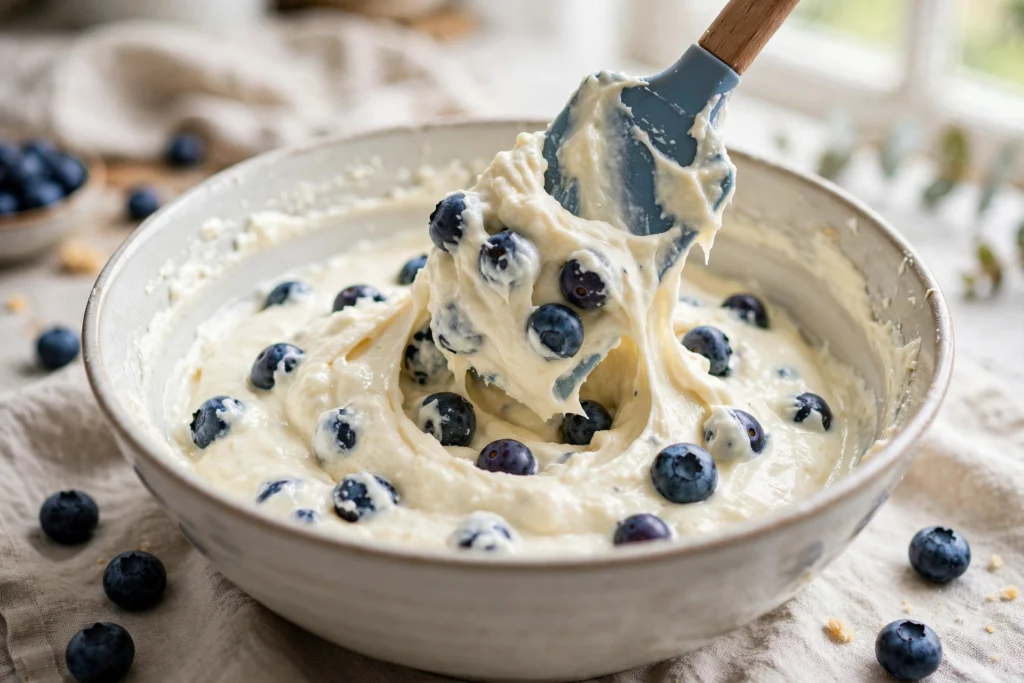
- Fold in the blueberries (flour-tossed, per the ingredient note) with three or four gentle turns.
- Divide the batter evenly, filling each cup about three-quarters full. An ice-cream scoop keeps the sizes honest, which keeps the baking even and the per-muffin numbers meaningful.
- Bake an estimated 18 to 22 minutes. The cues matter more than the clock: tops set and lightly golden, a toothpick coming out clean or with a few moist crumbs, and the tops springing back when pressed gently. Start checking at 18 minutes — with whey in the batter, the line between moist and dry is only a couple of minutes wide.
- Cool in the tin for 10 minutes, then move the muffins to a rack. Cutting or eating one straight from the oven makes the crumb seem gummy even when it is not; the center finishes setting as it cools.
Why yogurt muffins turn out dry or rubbery
This style of muffin fails in predictable ways, and almost all of them trace back to balance rather than technique.
Too much powder for the flour. The instinct to add a third scoop is understandable and wrong. Past roughly a 3.5-to-1 flour-to-powder ratio, whey dominates the crumb, and whey sets firm and dry when it bakes. If you want more protein per muffin, the honest routes are a smaller batch of larger muffins or a protein-rich side — not more powder in the same batter.
Overbaking by “just two more minutes.” A yogurt-and-whey crumb has less fat protecting it than a bakery muffin, so it dries faster at the end. Pull them when the toothpick shows moist crumbs, not when it shows nothing at all.
Overmixing. Covered in step 4, and worth repeating because it is the most common cause: a smooth, glossy, thoroughly stirred batter is an overworked one. Fold until the flour disappears, then stop.
Measuring flour by the scoop-and-pack. Scooping the cup directly from the bag can pack in 20 to 30 extra grams of flour, which quietly dries the whole batch. Spoon flour into the cup and level it, or weigh it — 210g is the target the nutrition above is built on.
The no-powder version
Skip the whey entirely and the recipe still works, with one adjustment: replace the powder with ½ cup (60g) extra flour and keep everything else the same. The crumb is a little less springy and the muffins eat more like a classic yogurt muffin. The numbers move to about 6g protein and about 165 calories each — the calories barely change because flour replaces the powder gram for gram in energy; what you lose is purely protein density. It is a fair trade if powder is not something you keep at home, and it is the version to make for anyone who dislikes the taste of whey in baked goods.
Three flavor changes, same base
Chocolate chip. Swap the blueberries for ½ cup (85g) mini chocolate chips. Minis distribute better than full-size chips in a muffin this lean. About 9g protein and 190 calories each — the extra 25 calories are all chocolate, and they are worth it on the days when breakfast needs to feel like a treat to happen at all.
Apple cinnamon. Swap the blueberries for 1 cup (125g) of finely diced apple and raise the cinnamon to a full teaspoon. Dice small — big chunks stay raw in the middle while the crumb around them finishes. About 9g protein and 165 calories each. This is the autumn version, and it reheats the best of the three.
Lemon poppy seed. Leave out the blueberries and cinnamon; add the zest of a second lemon, 1 tablespoon of lemon juice, and 1 tablespoon of poppy seeds. Bright, barely sweet, and the one that tastes most like a bakery muffin. About 9g protein and 165 calories each.
Swaps for different kitchens
Dairy-free. Use a pea-based protein powder (about 42g protein per 60g, typically a little less than whey) and an unsweetened coconut yogurt alternative in place of the Greek yogurt — the thick, spoonable kind, not a coconut yogurt drink, which is far too liquid for this batter. The method is unchanged, but be honest about the result: coconut yogurt alternatives bring almost no protein, so the muffins land at about 7g protein and 170 calories each. Plant powders also absorb more liquid — expect to use the full measure of milk, possibly a spoon more, and judge by batter consistency rather than the recipe’s exact amount.
Whole-milk Greek yogurt. A straight swap for the nonfat. Protein stays at about 9g per muffin (whole-milk yogurt is slightly lower in protein per gram, 9.0g per 100g against 10.2g, but the difference washes out in rounding), while calories rise to about 180 each. The crumb is richer; the trade is legitimate either way.
Gluten-free. A 1-to-1 gluten-free flour blend replaces the all-purpose flour at the same weight. Choose a blend that contains xanthan gum; without it, a low-fat batter like this one crumbles at the liner. Protein and calories stay effectively the same.
Sugar instead of honey. ½ cup (100g) granulated sugar plus 2 extra tablespoons of milk (honey was contributing liquid) lands within a few calories of the original. The crumb is slightly less moist on day two, which is the honest cost of the swap.
Meal prep and storage
This is a batch built for the week. Two muffins make an 18-gram-protein breakfast on their own; add a yogurt cup or a couple of eggs and the meal lands around 30 grams, close to the 35-gram high-protein breakfast that performed best in the breakfast study cited in the references below.
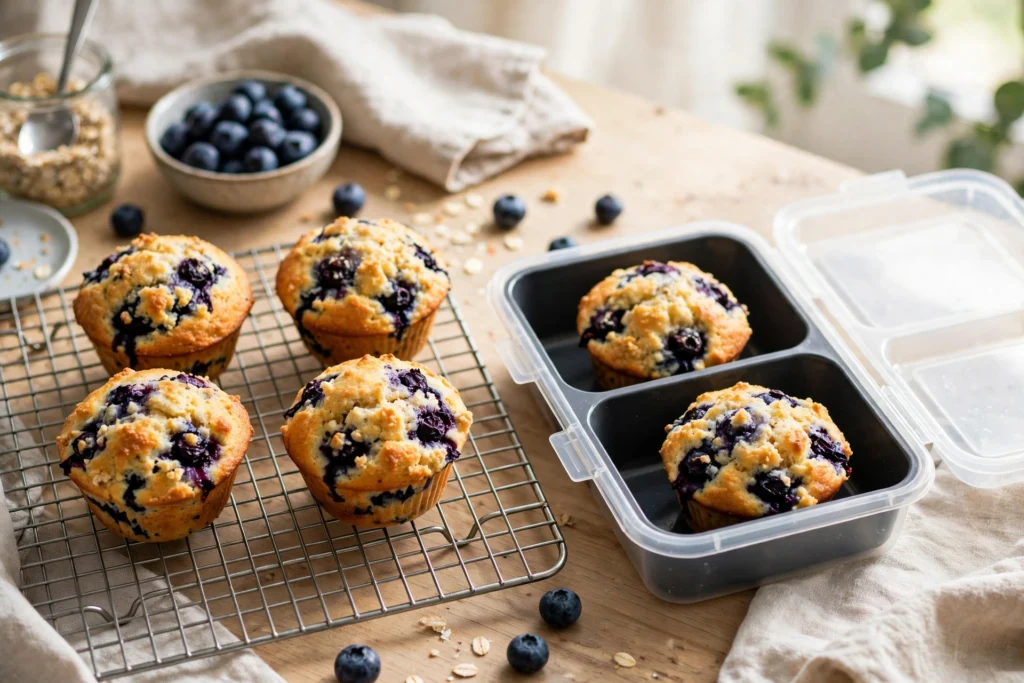
- Counter: airtight container, up to 2 days.
- Fridge: airtight container, up to 5 days. A paper towel under the muffins absorbs the condensation that would otherwise soften the tops.
- Freezer: wrap individually or freeze in a single layer in a freezer bag, up to 3 months. Thaw overnight in the fridge or in about 30 seconds in the microwave, straight from frozen.
- Reheating: 10 to 15 seconds in the microwave brings back the just-baked softness. Much longer and the whey in the crumb turns it rubbery — this is the one place the protein content works against you, so reheat gently.
For another Greek yogurt bake in a completely different format, our protein bagels with Greek yogurt use the same yogurt-and-flour logic as a no-yeast dough — chewy rings rather than a soft crumb, so the two recipes share a shopping list without repeating each other. And if oats are more your breakfast language, the protein baked oatmeal makes the same meal-prep case in a pan instead of a tin, while the protein waffles cover the freezer-friendly weekend option.
FAQs
Can I make these without protein powder?
Yes — that is the no-powder version above: replace the whey with ½ cup (60g) extra flour and change nothing else. Expect about 6g of protein and about 165 calories per muffin.
Why Greek yogurt and not regular yogurt?
Straining is the whole point. Nonfat Greek yogurt carries about 10.2g of protein per 100g against roughly 5.7g for plain nonfat regular yogurt, and it is thick enough to replace most of the oil and milk in a muffin batter. Regular yogurt makes a wetter batter and a muffin with noticeably less protein; if it is all you have, cut the milk entirely and expect a softer set.
Can I use flavored or sweetened Greek yogurt?
You can, and the muffins will work, but two things change: the sugar you did not account for (a sweetened cup can add the equivalent of several teaspoons across the batch) and the protein, which drops because sweetened yogurts are part yogurt, part syrup. The numbers on this page are built on plain nonfat.
Do these muffins freeze well?
Yes — up to 3 months, wrapped individually or in a single layer so they do not freeze into one block. Thaw in the fridge overnight or microwave from frozen for about 30 seconds. The texture after thawing is close to fresh; the tops soften slightly, which the 10-second reheat mostly fixes.
Why did my muffins sink or peak?
Peaked, cracked tops usually mean an overmixed batter or an oven running hot; sunken centers usually mean underbaking or opening the oven door early and often. Soda-heavy batters are also sensitive to sitting around — get the tin into the oven within a few minutes of mixing, while the leavening is at full strength.
Are these muffins good for kids?
The ingredients are ordinary breakfast ingredients and the flavor is mild and blueberry-sweet, so yes for most families. The whey is the only nonstandard item — the no-powder version at 6 grams of protein is the simpler choice if you would rather keep a child’s version powder-free.
Recipe: High Protein Muffins With Greek Yogurt
Description: Blueberry muffins built on Greek yogurt and whey — about 9g of protein each, calculated from the ingredients, mixed in about fifteen minutes and baked in one 12-cup tin.
Prep time: 15 minutes
Bake time: 18 to 22 minutes (estimated)
Total time: About 40 minutes, plus cooling
Yield: 12 muffins
Serving size: 1 muffin
Tin: 12-cup muffin tin, lined
Ingredients
- 1¾ cups all-purpose flour (210g), plus 1 tsp for tossing the blueberries
- 2 scoops vanilla whey protein powder (60g)
- 2 tsp baking powder
- ½ tsp baking soda
- ¼ tsp fine salt
- ½ tsp ground cinnamon
- 1 cup plain nonfat Greek yogurt (245g)
- ⅓ cup honey (113g)
- 2 large eggs, room temperature
- ¼ cup 2% milk (60ml), plus 1 tbsp if needed
- 2 tbsp neutral oil
- 1 tsp vanilla extract
- 1 tsp lemon zest (optional)
- 1 cup blueberries (148g), fresh or frozen
Instructions
- Heat the oven to 350°F (175°C) and line a 12-cup muffin tin.
- Whisk flour, whey, baking powder, baking soda, salt, and cinnamon in a large bowl.
- In a second bowl, whisk yogurt, honey, eggs, milk, oil, vanilla, and zest until smooth.
- Fold wet into dry until the flour just disappears; do not overmix. Rest 5 minutes.
- Toss the blueberries in the reserved teaspoon of flour and fold them in gently.
- Divide the batter between the cups, filling each about three-quarters full.
- Bake an estimated 18 to 22 minutes, until the tops are set, lightly golden, and spring back when pressed; a toothpick should show only moist crumbs.
- Cool 10 minutes in the tin, then move to a rack.
Storage: Counter 2 days airtight; fridge up to 5 days; freezer up to 3 months. Reheat 10 to 15 seconds in the microwave.
Nutrition per muffin (calculated from the ingredients above; varies by brand): about 165 kcal · protein about 9g · carbs about 24g · fat about 4g · saturated fat about 1g · fiber about 1g · sugar about 10g · sodium about 250mg.
References
- U.S. Department of Agriculture, Agricultural Research Service. FoodData Central — Yogurt, Greek, plain, nonfat (FDC ID 170894): 59 kcal and 10.2g protein per 100g. The calculation basis for the yogurt, flour, egg, honey, milk, and blueberry values used throughout this article. https://fdc.nal.usda.gov
- Leidy, H.J., Ortinau, L.C., Douglas, S.M., & Hoertel, H.A. (2013). Beneficial effects of a higher-protein breakfast on the appetitive, hormonal, and neural signals controlling energy intake regulation in overweight/obese, “breakfast-skipping,” late-adolescent girls. American Journal of Clinical Nutrition, 97(4), 677–688. https://doi.org/10.3945/ajcn.112.053116
- Jäger, R., Kerksick, C.M., Campbell, B.I., et al. (2017). International Society of Sports Nutrition position stand: protein and exercise. Journal of the International Society of Sports Nutrition, 14, 20. https://doi.org/10.1186/s12970-017-0177-8