Protein baked oatmeal is a pan of oats, milk, Greek yogurt, eggs and a scoop of protein powder baked in one dish until the center sets, then cut into portions that reheat all week. This recipe makes six servings with about 17 grams of protein and about 250 calories each, calculated from the ingredients below. Everything mixes in one bowl, the oven does the work, and breakfast is handled for days.
There is no saucepan and no stirring over a stove. The mixture goes into a 9×9-inch dish as a loose batter and comes out sliceable, with a soft middle and a lightly golden top. Bake it on a quiet day, refrigerate the squares, and reheat one each morning with a splash of milk.
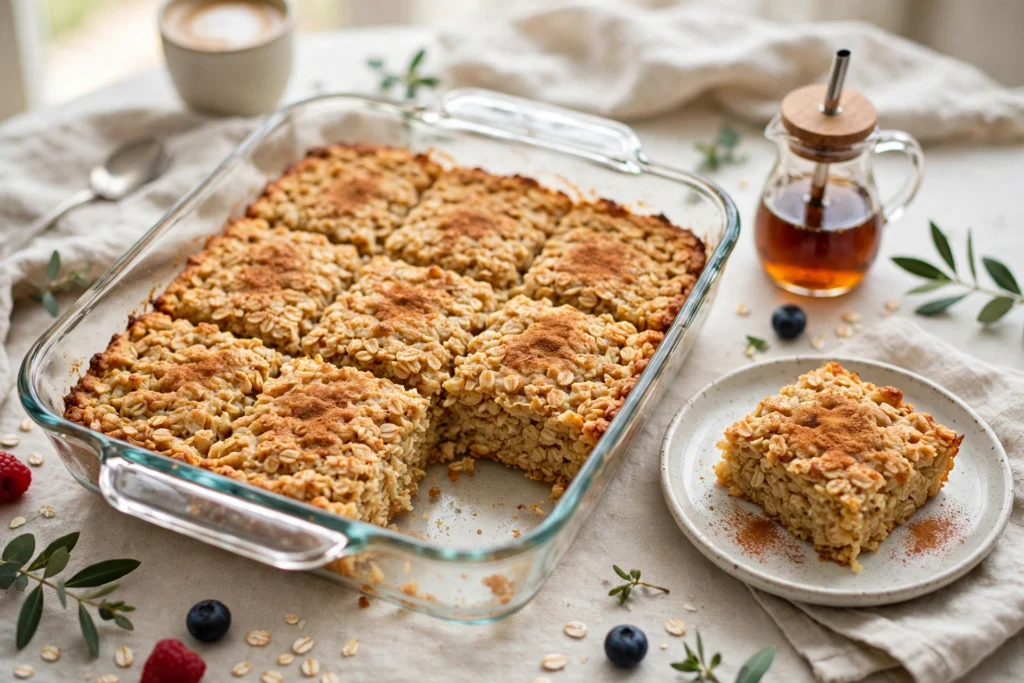
Table of Contents
ToggleWhat Is Protein Baked Oatmeal?
Baked oatmeal is oatmeal cooked in the oven instead of in a pot. The oats absorb the liquid as the eggs set, so the finished dish cuts into squares rather than spooning up like porridge. It eats somewhere between a soft breakfast cake and a firm bowl of oatmeal, and it holds its shape in a lunch container.
The protein in protein baked oatmeal does not come from the oats alone. Oats contribute some, but the bigger shares here come from Greek yogurt, milk, eggs and protein powder working together. That combination is also what keeps the texture tender: yogurt and milk keep the crumb moist while the eggs give the squares enough structure to slice cleanly.
If you would rather cook a single bowl on the stove, the stovetop protein oatmeal on this site covers that method. This recipe is the batch version — one dish, six portions, no standing at the stove.
Ingredients for Protein Baked Oatmeal
- 2 cups rolled oats (180g). The structure of the dish. Rolled oats bake into a soft, sliceable texture; see the oats section below before swapping types.
- 1 scoop vanilla whey protein powder (30g). Adds about 24 grams of protein across the pan. Vanilla suits the cinnamon base. Brands absorb liquid differently, so a batter that looks slightly thicker or looser than described is normal.
- 1 teaspoon baking powder. A small lift so the squares bake up tender instead of dense.
- 1½ teaspoons ground cinnamon. The main warm spice in the base recipe.
- ¼ teaspoon fine salt. Keeps the sweetness in balance.
- 1½ cups 2% milk (360ml). The main liquid. Dairy milk also brings protein; plant milks change both the protein and the set, so treat them as a different recipe.
- 1 cup plain non-fat Greek yogurt (245g). Protein and moisture in one ingredient, and the reason these squares stay soft after reheating.
- 2 large eggs. They set the mixture in the oven and hold the portions together.
- ¼ cup maple syrup (80g). Measured sweetness that spreads evenly through the batter, unlike sugar sprinkled on top.
- 2 teaspoons vanilla extract. Rounds out the cinnamon and maple.
Best Oats for Baked Protein Oatmeal
Rolled oats are the right buy for this recipe. Their flat flakes absorb the milk and yogurt evenly and bake into a tender, uniform crumb in the time given.
Quick oats absorb liquid faster and bake up softer and less defined. They can be used in the same quantity, but expect a smoother, more cake-like texture and check the center a few minutes early.
Steel-cut oats do not swap in directly. They are whole, dense kernels that need far more liquid and a much longer cook than this recipe provides; dropped into this batter they would stay hard and chewy. A steel-cut version needs its own liquid ratio and baking time, so keep them for recipes written for them.

How to Make Protein Baked Oatmeal
- Heat the oven to 350°F (175°C). Grease a 9×9-inch baking dish with butter or cooking spray.
- Mix the dry ingredients in a large bowl: oats, protein powder, baking powder, cinnamon and salt. Stir until the cinnamon and powder are evenly distributed, with no dry pockets of protein powder.
- Mix the wet ingredients in a second bowl: milk, Greek yogurt, eggs, maple syrup and vanilla. Whisk until the yogurt is fully smooth.
- Combine. Pour the wet mixture over the dry and stir just until everything is moistened. The batter will look loose and pourable, thinner than cake batter — that is correct. Let it stand 5 minutes so the oats start absorbing liquid.
- Fill the dish. Pour the batter into the prepared dish and spread it into an even layer with the back of a spoon.
- Bake 35 to 40 minutes. The oatmeal is done when the center is set and springs back lightly when pressed, the edges look matte and just start to pull from the sides, and the top is pale gold. A wet, glossy, jiggly center needs more time; give it 3 to 5 more minutes and check again. The middle should look moist, not soupy.
- Rest 10 minutes in the dish. The squares firm up as they cool slightly, and cutting too early makes them crumble.
- Cut into 6 portions and serve warm, or cool completely before storing.
How to Add More Protein to Baked Oatmeal
The protein in this pan comes from four ingredients stacking up: Greek yogurt (the largest share after the powder), milk, eggs and the scoop of whey. Raising the total means adjusting one of them, and each change moves the texture too.
Greek yogurt adds protein and moisture at the same time, which is why it anchors the recipe. Swapping the milk for more yogurt makes the batter tangier and thicker; it still bakes, but the crumb turns denser.
Milk contributes steady protein without changing the flavor much. Whole milk adds a little richness and almost the same protein as 2%.
Eggs set the structure. A third egg adds roughly 6 grams of protein across the pan and makes the squares firmer and more custardy — closer to a breakfast bake than to oatmeal.
Protein powder is the strongest lever and the easiest to overdo. A second scoop pushes the protein up, but whey absorbs liquid as it bakes, and too much of it turns baked oatmeal dry, dense and rubbery. If you add a second scoop, add ¼ cup more milk with it and expect a firmer slice. More powder is not automatically better; the balance in the recipe card is the version that stays moist.
How to Keep Protein Baked Oatmeal Moist
Watch the liquid-to-oat ratio. This recipe uses a generous amount of liquid for the oats — milk plus yogurt plus eggs — because oats keep absorbing moisture as they sit. A dry result usually traces back to measuring the oats heavy-handedly or swapping in extra protein powder without adding liquid.
Measure the powder properly. Spoon it into the scoop and level it off. A packed scoop can hold far more than 30 grams, and the extra powder drinks up liquid meant for the oats.
Pull it on time. The most common cause of dry baked oatmeal is extra minutes in the oven. The center should be set and matte at the edges while still looking soft in the middle; it finishes setting as it rests. Baking until the center looks completely dry guarantees a dry slice.
Rest before slicing. Cutting straight from the oven lets steam escape and the squares crumble and dry at the edges. Ten minutes in the dish keeps the moisture in the crumb.
Reheat with liquid. A stored square firms up in the fridge. Warm it with 1 to 2 tablespoons of milk poured over the top and it comes back soft instead of chewy.
Properly moist and underbaked are different things. A moist square holds its cut edges, feels tender, and shows no liquid when pressed. An underbaked one slumps, looks glossy and wet in the center, and leaves milky liquid on the knife — that one needs more oven time, not a shorter bake.
Easy Protein Baked Oatmeal Variations
Each variation starts from the base batter. None of them change the dish size or the oven temperature.
- Banana cinnamon: Mash 1 ripe banana into the wet ingredients and cut the maple syrup to 2 tablespoons. The banana adds moisture, so keep the milk as written and check the center at 35 minutes.
- Blueberry: Fold 1 cup of fresh or frozen blueberries into the batter before it goes into the dish. Frozen berries need no thawing; add 2 to 3 minutes to the bake if the center still looks glossy.
- Chocolate chip: Fold in ¼ cup of chocolate chips. No liquid or timing change.
- Apple cinnamon: Fold in 1 cup of finely diced apple. Small pieces soften fully in the bake; large chunks stay firm in the middle.
- Peanut butter: Whisk ¼ cup of peanut butter into the wet ingredients and reduce the maple syrup to 3 tablespoons. The batter will be thicker and the squares a little denser.
Toppings and mix-ins change the nutrition. The figures in the recipe card are for the plain cinnamon-vanilla base.
How to Meal Prep Protein Baked Oatmeal
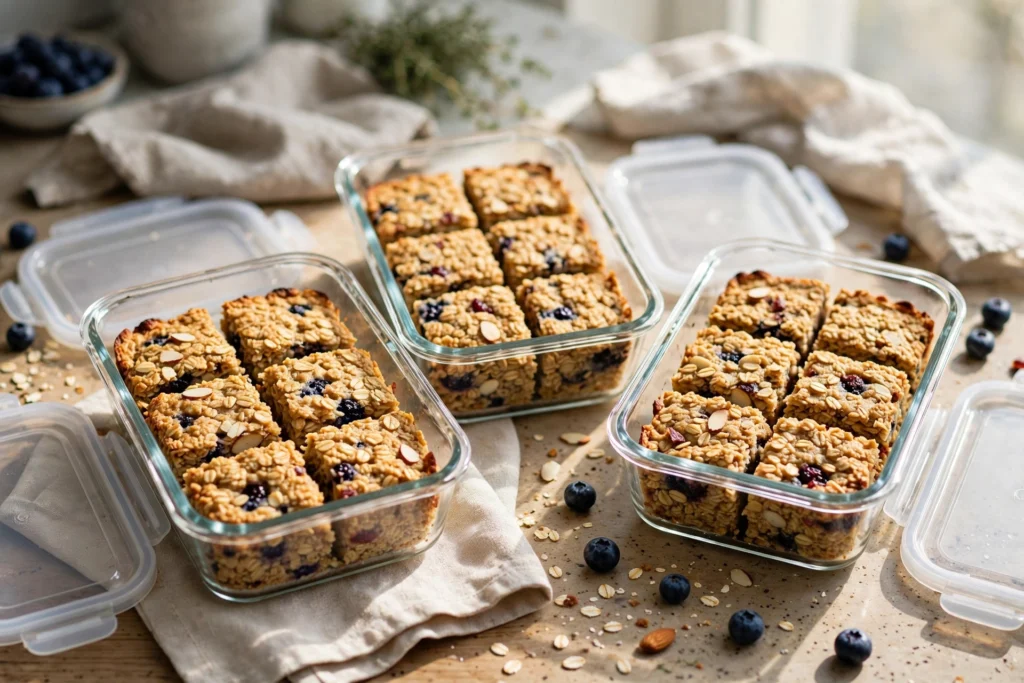
This recipe is built for making ahead. Bake the full dish, let it cool in the pan for about 30 minutes, then cut it into six squares. Pack each square in its own container, or wrap portions individually so weekday mornings are grab-and-go.
The squares firm up as they chill, which is normal for a baked oat dish — the eggs and oats set more firmly in the cold. A short reheat with a splash of milk brings back the just-baked softness.
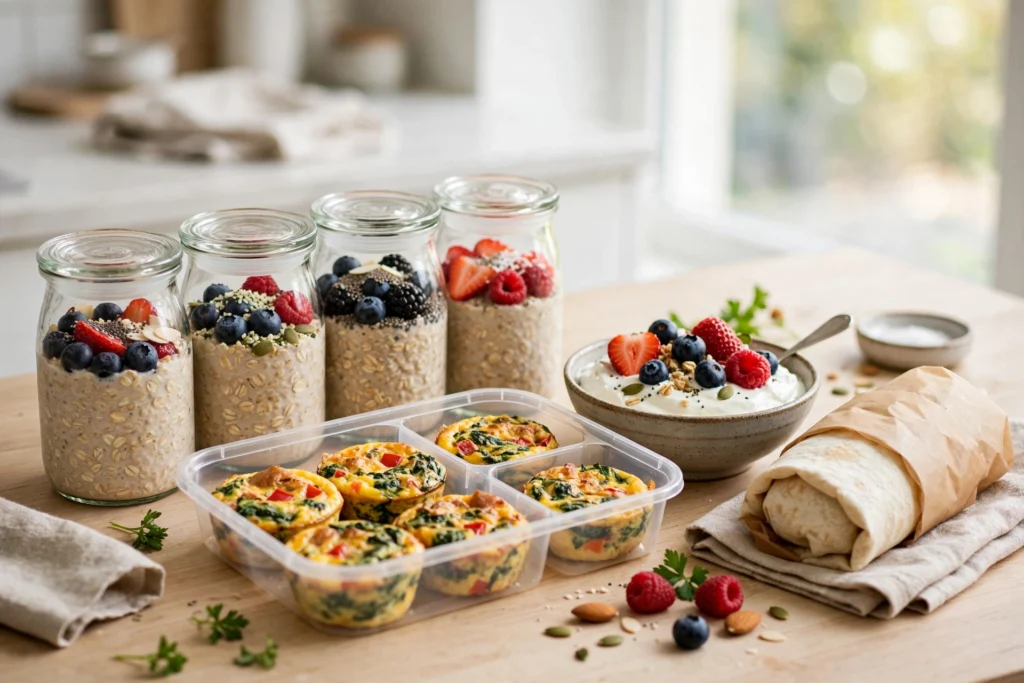
For more make-ahead breakfasts that travel well, the recipes in high-protein snacks include several options built for the same routine. And if eggs are not part of your breakfast, the ideas in high protein breakfast without eggs cover filling alternatives, while the high-protein breakfast smoothies are the option for mornings when even reheating feels like too much.
How to Store and Reheat Protein Baked Oatmeal
Refrigerator: Store portions in a covered container for up to 4 days, in line with standard leftover guidance for cooked dishes. Do not leave the baked oatmeal sitting out at room temperature for extended periods; refrigerate it once it has cooled.
Freezer: Wrap individual squares tightly and freeze for up to 3 months for best quality. Thaw one in the refrigerator overnight, or reheat it from frozen at reduced power.
Microwave reheat: Place a square in a microwave-safe dish, pour 1 to 2 tablespoons of milk over it, and heat for 60 to 90 seconds until warm through.
Oven reheat: Cover the dish with foil and warm at 300°F (150°C) for 10 to 12 minutes. The foil keeps the top from drying while the center heats.
Frequently Asked Questions
Is protein baked oatmeal a good meal-prep breakfast?
Yes — it is one of the better formats for it. One dish gives six portions, the squares hold together in containers, and they reheat in about a minute with a splash of milk.
How much protein is in baked oatmeal?
It depends entirely on the recipe. Plain baked oatmeal made with oats and milk alone lands much lower. This version, with Greek yogurt, eggs and protein powder, provides about 17 grams of protein per serving, calculated from the ingredients.
Can you make protein baked oatmeal without protein powder?
Yes. Leave the scoop out and the recipe still works, because the yogurt, milk and eggs carry the structure. The protein drops to about 13 grams per serving and the texture is a little softer.
Which oats are best for baked oatmeal?
Rolled oats. They absorb the liquid evenly and bake into a tender, sliceable texture. Quick oats work with a softer result; steel-cut oats need a different recipe with more liquid and more time.
Why is my baked oatmeal dry?
Usually one of three things: too much protein powder for the liquid, a few extra minutes in the oven, or reheating without added moisture. Pull it when the center is just set, and reheat with milk.
Can protein baked oatmeal be frozen?
Yes. Wrap the cut squares individually and freeze for up to 3 months. Thaw in the refrigerator overnight for the best texture.
How do you reheat baked oatmeal without drying it out?
Add liquid before heat. One to two tablespoons of milk over the square, then 60 to 90 seconds in the microwave, restores the soft texture the fridge took away.
Can you use frozen fruit in baked oatmeal?
Yes. Frozen blueberries or other small fruit can go in straight from the freezer. Give the center a visual check and add 2 to 3 minutes if it still looks glossy and unset.
References
- U.S. Department of Agriculture, FoodData Central — nutrient profiles for rolled oats, Greek yogurt, milk and eggs used in the recipe calculations: https://fdc.nal.usda.gov/
- FoodSafety.gov — storage guidance for cooked leftovers (refrigerate promptly; use within 3 to 4 days): https://www.foodsafety.gov/food-safety-charts/food-storage-chart
- Harvard T.H. Chan School of Public Health, The Nutrition Source — Oats (whole-grain and fiber profile): https://nutritionsource.hsph.harvard.edu/food-features/oats/
Recipe: Protein Baked Oatmeal
A cinnamon-vanilla baked oatmeal made with Greek yogurt, milk, eggs and a scoop of protein powder, baked in one dish and cut into six meal-prep portions.
- Prep time: 10 minutes
- Cook time: 35–40 minutes
- Total time: About 55 minutes, including a 10-minute rest
- Servings: 6
- Baking dish: 9×9-inch
Ingredients
- 2 cups rolled oats (180g)
- 1 scoop vanilla whey protein powder (30g)
- 1 teaspoon baking powder
- 1½ teaspoons ground cinnamon
- ¼ teaspoon fine salt
- 1½ cups 2% milk (360ml)
- 1 cup plain non-fat Greek yogurt (245g)
- 2 large eggs
- ¼ cup maple syrup (80g)
- 2 teaspoons vanilla extract
Instructions
- Heat the oven to 350°F (175°C) and grease a 9×9-inch baking dish.
- Stir the oats, protein powder, baking powder, cinnamon and salt together in a large bowl.
- Whisk the milk, Greek yogurt, eggs, maple syrup and vanilla in a second bowl until smooth.
- Pour the wet mixture over the dry, stir just until moistened, and let stand 5 minutes.
- Pour into the prepared dish and spread evenly.
- Bake 35 to 40 minutes, until the center is set, the edges are matte, and the top is pale gold.
- Rest 10 minutes, then cut into 6 squares.
Serving suggestions: Warm, with a splash of milk, extra cinnamon, or fresh fruit on top.
Storage: Refrigerate portions in a covered container for up to 4 days. Freeze wrapped squares for up to 3 months. Reheat with 1 to 2 tablespoons of milk.
Nutrition per serving (calculated from the ingredients above; brands vary): About 250 kcal · Protein: about 17g · Carbohydrates: about 34g · Fat: about 5g · Saturated fat: about 2g · Fiber: about 3g · Sugar: about 13g · Sodium: about 270mg