Protein cinnamon rolls are the real bake, not a shortcut version: a yeast-raised dough rolled around a butter, brown sugar, and cinnamon filling, cut into nine spirals, baked until the centers set, and finished with a cream cheese glaze while the pan is still warm. Each glazed roll works out to about 10g of protein and about 415 calories, calculated from the exact ingredients below — roughly double the protein of a standard homemade cinnamon roll, which usually lands near 5g. The protein comes mainly from vanilla whey worked into the dough, with the flour, egg, milk, and glaze adding their share. The dough asks for patience rather than skill: mix, knead, let it rise, roll, fill, slice, rise again, bake.

Table of Contents
ToggleWhy You’ll Love These Protein Cinnamon Rolls
Nothing about the format is faked. These are proper cinnamon rolls — soft spirals, a filling that turns syrupy at the edges, glaze that melts into the swirls. The protein is built into a dough that still behaves like dough, instead of being forced into a batter or a mug.
The batch size is sane. Nine rolls in one 9×9 dish. Enough for a weekend breakfast table with a couple left over, not a bakery case.
The protein boost is honest. About 10g per roll will not turn breakfast into a protein shake, and this article will not pretend otherwise. What it does is take a food people already love and roughly double its protein without changing what it is.
Every stage has a visual cue. Doubled dough, puffy rolls, lightly golden tops, set centers — you judge the bake by what you see, not by watching a clock and hoping.
Ingredients for Protein Cinnamon Rolls
Makes 9 rolls in a 9×9-inch baking dish.
For the Dough
All-purpose flour, 3 cups (375g). The structure of the roll. Flour is what forms gluten when the dough is kneaded, and gluten is what traps the gas the yeast produces — that is where the soft, fluffy interior comes from. Flour stays dominant in this recipe on purpose; it also happens to be the single largest protein contributor, at about 4.3g per roll.
Vanilla whey protein powder, 1 scoop (30g). The protein boost, at about 2.7g per roll. It replaces only about ¼ cup of the flour in the dough. Whey contains no gluten, absorbs liquid differently from flour, and firms up as it bakes, so more than this share starts costing you softness. Measure it loose, the way the scoop comes — packed powder throws off both the protein math and the dough’s hydration.
Instant yeast, 2¼ teaspoons (7g; one standard packet). The lift. Instant yeast can be mixed straight into the dry ingredients, but this recipe proofs it in the warm milk first so you can see it foam and know it is alive before the flour goes in.
Granulated sugar, 2 tablespoons (25g). A small amount in the dough itself. It gives the yeast an easy first meal and rounds out the flavor; the real sweetness lives in the filling and glaze.
Fine salt, 1 teaspoon (6g). Controls the yeast so the rise stays steady instead of racing, and keeps the dough from tasting flat. Do not drop it — unsalted enriched dough is bland no matter how good the filling is.
2% milk, ¾ cup (183g), warmed to 105–110°F. The main liquid. Warm, not hot: at 105–110°F the milk feels like warm bathwater and wakes the yeast up; much past 120°F you start killing the yeast you need. Milk also brings protein (about 0.7g per roll) and milk sugars that help the tops brown.
Egg, 1 large (50g). Enrichment. The yolk’s fat keeps the crumb tender, the white adds structure, and the egg contributes about 0.7g of protein per roll. Room temperature is easier to mix in evenly, but cold from the fridge still works.
Unsalted butter, 3 tablespoons (43g), melted. Fat in the dough shortens gluten strands slightly, which is baker language for a softer bite. Melted butter mixes into a shaggy dough more evenly than cold cubes at this small quantity.
For the Cinnamon Filling
Unsalted butter, 4 tablespoons (57g), softened to a spreadable paste. Soft, not melted. Melted butter runs out of the spiral during baking and pools in the dish; soft butter stays where you spread it and carries the sugar and cinnamon with it.
Brown sugar, ¾ cup packed (165g). The filling’s body. Brown sugar’s molasses is what gives the center its caramel-like depth and keeps it moist after baking.
Ground cinnamon, 1½ tablespoons (12g). Generous on purpose — this is the flavor the whole recipe is named for. If your cinnamon has been open in the cupboard for a year, this is the recipe that will tell on it; fresh cinnamon makes a visible difference here.
For the Glaze
Neufchâtel cheese, 3 oz (85g), softened. The glaze base. Neufchâtel is the lower-fat sibling of cream cheese, sold in the same style of block, and it brings a gentle tang plus about 0.9g of protein per roll. Regular cream cheese swaps in at the same weight with a slightly richer result. Let it soften fully or the glaze will stay lumpy no matter how long you whisk.
Powdered sugar, ¾ cup (90g). Sweetens and thickens the glaze. Sift it if it is clumpy — powdered sugar lumps do not whisk out.
2% milk, 2 tablespoons (30g), plus more by the teaspoon. Sets the glaze consistency. Two tablespoons gives a thick, spreadable glaze; add more only a teaspoon at a time, because glaze thins faster than it thickens.
Vanilla extract, 1 teaspoon (4g). Rounds out the tang of the cheese and ties the glaze to the vanilla in the dough.
A Greek yogurt glaze variation: swap the Neufchâtel for ½ cup (120g) of non-fat Greek yogurt and whisk with the same powdered sugar, vanilla, and just enough milk to loosen it. It comes out thinner and tangier, sets less firmly, and keeps the per-roll protein about the same. The recipe card and nutrition use the Neufchâtel glaze above; if you make the yogurt version, treat it as a pourable topping and add it right before serving rather than ahead.
What Protein Powder Works Best for Cinnamon Rolls?
This recipe is developed for vanilla whey, and that choice is load-bearing. The dough’s liquid, flour quantity, and bake time are all set around how whey behaves. The three common powder types are not interchangeable in a yeast dough:
Whey protein dissolves smoothly into warm milk, adds almost no grit, and its mild vanilla sweetness sits quietly under cinnamon. Its downside shows up in the oven: whey firms and dries as it bakes, which is exactly why it stays at 1 scoop here. At this level the crumb stays soft; push to 2 scoops without changing anything else and the rolls bake up noticeably denser and drier.
Casein protein absorbs considerably more liquid than whey and forms a thicker, pudding-like texture when mixed. In a dough, that extra absorption competes with the flour for the milk, so a casein version needs more liquid — roughly 2 to 3 extra tablespoons of milk to start — and even then the crumb tends to bake up heavier and brown faster. It can be done, but it is an adjustment, not a swap.
Plant-based protein blends (pea, rice, soy mixes) vary the most from brand to brand. They generally absorb more liquid than whey, often carry a detectable earthy flavor that cinnamon only partly covers, and many are sweetened differently, which shifts the dough’s flavor. If a plant blend is what you have, add the milk gradually and be ready to use a spoon or two more; expect a slightly denser roll.
Whatever you use, read the label before you start. Scoop sizes run from about 25g to over 40g across brands, and protein per scoop runs from under 20g to nearly 30g. This recipe assumes a roughly 30g scoop providing about 24g of protein. A very different scoop changes both the dough and the numbers at the end.
How to Make Protein Cinnamon Rolls
Total active work is about 30 minutes; the rest is rising and baking. Read the cues at each stage — they matter more than the minutes beside them.
- Warm the milk. Heat the ¾ cup of milk to 105–110°F. If you do not have a thermometer, it should feel like warm bathwater on the inside of your wrist — clearly warm, nowhere near hot. Too cool and the yeast wakes up slowly; too hot and it does not wake up at all.
- Proof the yeast. Stir the yeast and a pinch of the dough’s sugar into the warm milk and leave it 5 to 10 minutes. You are looking for a foamy, creamy layer on top. No foam means the yeast is dead or the milk was too hot — start this step over rather than building a dough that will never rise.
- Mix the dry ingredients. In a large bowl, whisk together the flour, protein powder, the rest of the sugar, and the salt. Whisking matters here: it distributes the salt evenly through the flour, so no bite is salty or bland, and breaks up any clumps in the protein powder before liquid hits it.
- Add the wet ingredients and form the dough. Pour in the foamy milk mixture, the beaten egg, and the melted butter. Stir with a sturdy spoon until a shaggy, sticky mass forms and no dry flour pockets remain at the bottom of the bowl. It will look rough. That is correct at this stage.
- Knead 8 to 10 minutes. Turn the dough onto a lightly floured surface and knead — push away with the heel of your hand, fold back, turn, repeat. Add flour only by the tablespoon if the dough is sticking so much you cannot work it; excess bench flour is a leading cause of dense rolls. The dough is ready when it is smooth, elastic, and only slightly tacky, springs back when poked, and can be stretched thin enough to let light through without tearing right away. In a stand mixer with a dough hook, this takes about 6 to 8 minutes on medium-low.
- First rise, about 1 hour. Place the dough in a lightly greased bowl, turn it once so the top is coated, cover, and leave it in a warm, draft-free spot until doubled in size. In a cool kitchen this can take 75 to 90 minutes; in a warm one, 45. Doubled is the cue, not the clock. A poke test helps near the end: a floured finger pressed in should leave an indentation that fills back only halfway.
- Make the filling. While the dough rises, stir the softened butter, brown sugar, and cinnamon into an even, spreadable paste. Set it aside at room temperature — cold filling tears soft dough.
- Roll out the dough. Punch the risen dough down gently, turn it onto a lightly floured surface, and roll it into a rectangle about 12 by 16 inches and roughly ¼ inch thick. Try to keep the thickness even and the corners reasonably square; thin spots become rolls with barely any swirl, and thick spots bake up doughy.
- Spread the filling. Spread the cinnamon paste over the rectangle in an even layer, leaving a bare strip about ½ inch wide along one long edge — that clean strip is what seals the log shut. Evenness matters: thick patches leak and burn on the pan, thin patches give you plain bread bites in the middle of a cinnamon roll.
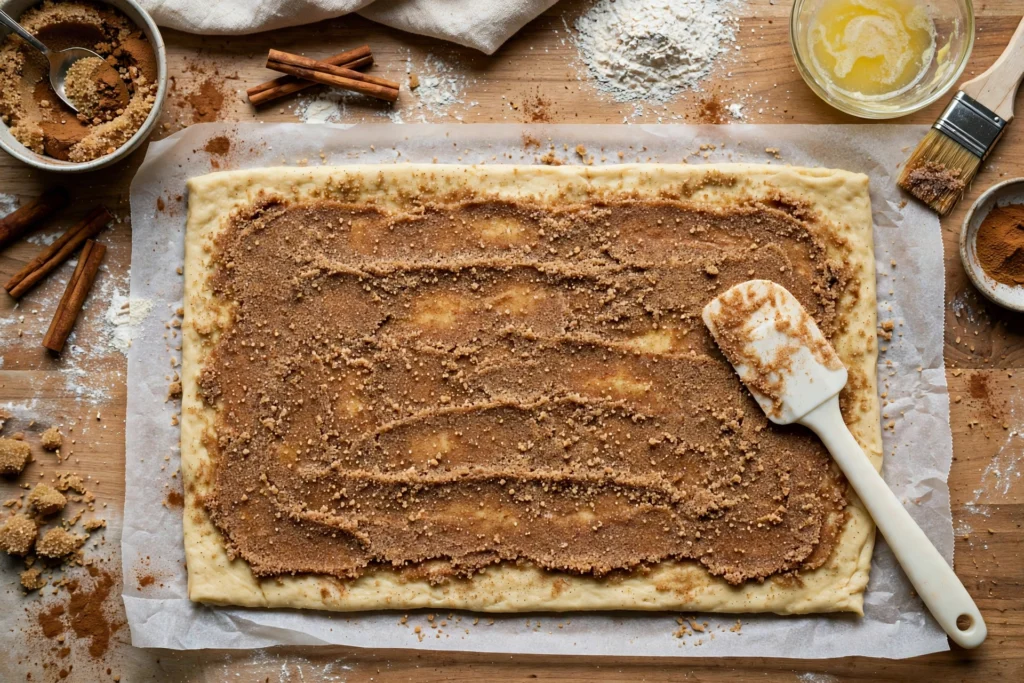
- Roll the log and cut 9 rolls. Starting from the long edge opposite the bare strip, roll the dough up snugly — not so tight you squeeze the filling out, not so loose the spirals gap. Pinch the bare strip against the log to seal. Cut into 9 equal pieces, about 1¾ inches each. Unflavored dental floss slid under the log, crossed over the top, and pulled gives the cleanest cut; a serrated knife with a gentle sawing motion is second best. A dull straight knife squashes the spiral you just built.
- Arrange the rolls. Place the rolls cut-side up in a greased 9×9-inch dish, three rows of three, with small gaps between them. They should not be packed tight — they need room for the second rise, and the gaps are where the soft, pull-apart sides come from.
- Second rise, 30 to 40 minutes. Cover the dish and leave it in a warm spot until the rolls look puffy and have expanded to touch each other, with the spirals starting to press together. Under-proofed rolls bake up small and tight; this short rise is where most of the final softness is decided.
- Bake at 350°F (175°C) for 20 to 25 minutes. The rolls are done when the tops are lightly golden, the edges look set, and the center roll’s middle feels firm rather than wet and doughy when pressed gently. An instant-read thermometer in the center roll should read about 190°F. Pale, soft-looking centers mean more time; deep golden tops before the centers set means your oven runs hot — tent loosely with foil for the remaining minutes.
- Cool briefly, then glaze. Let the pan cool about 10 minutes. The rolls should still be warm when the glaze goes on — warm enough to let it melt into the spirals, cool enough that it does not slide straight off into the dish. Spread the glaze over the tops and let it settle for a few minutes before serving.
How to Keep Protein Cinnamon Rolls Soft and Fluffy
Most dense protein cinnamon rolls fail for one of a handful of reasons, and nearly all of them happen before the pan reaches the oven.
Too much protein powder. This is the big one. Protein powder has no gluten. Every spoonful that replaces flour weakens the network that traps the yeast’s gas, and whey also firms as it bakes. The 1-scoop level in this recipe is a deliberate ceiling for a dough that still rises and eats like a cinnamon roll. If you want more protein at breakfast, put it beside the roll — eggs, yogurt, a smoothie — not inside the dough.
Too much flour at the bench. A sticky-feeling dough tempts you to keep dusting. Resist. Enriched dough starts tacky and smooths out as you knead and the flour hydrates. Flour added tablespoon after tablespoon during kneading is the most common route to rolls that bake like bread rolls instead of cinnamon rolls.
Wrong hydration. Milk measured carelessly, a jumbo egg, a heaped scoop of powder — small measuring slips stack up in a dough with this little liquid. Measure the milk in a liquid measure at eye level, and if the dough feels genuinely dry and crumbly after a few minutes of kneading (not just tacky), knead in extra warm milk one tablespoon at a time.
Cut proofing short. Yeast works on its own schedule, and room temperature sets the pace. Rolls shaped from under-risen dough, or baked before the second rise makes them puffy, come out tight and small no matter how good the dough was. Judge by size and puff, not by impatience.
Overbaking. Enriched, sugared dough dries out fast past done. Start checking at 20 minutes. The centers should look set and lightly golden — not browned through, and not glossy-wet. Remember the rolls keep cooking gently in the hot pan while they cool.
A different powder than the recipe assumes. Casein and plant blends absorb more liquid than whey (see the powder section above). Swapping without adding liquid produces a stiff dough that cannot expand, and the rolls bake dense even with perfect proofing.
How to Make the Cinnamon Filling
The filling is three ingredients and one idea: a paste, not a sauce. Stir the softened butter, brown sugar, and cinnamon together until you cannot see streaks of plain butter. The consistency you want is like thick peanut butter — it should hold on the spatula, spread without tearing the dough, and stay put when the rectangle is rolled.
Spread it with the back of a spoon or an offset spatula, working from the center outward, and keep the layer as even as you can. Evenness is not about looks. A thick ridge of filling melts, runs, and caramelizes hard on the bottom of the dish while a thin patch leaves a dry, plain bite — sometimes in the same roll. Leave that ½-inch bare strip on the far long edge so the log seals; filling on the seam is the main reason rolls unspiral in the pan.
One restraint worth keeping: more filling is not better filling. Doubling the sugar sounds generous and mostly produces leakage, burnt sugar on the pan, and rolls that are sweet at the bottom and plain at the top. The quantities here are balanced against a 12×16 sheet of dough; trust the thin, even layer.
Easy Protein Cinnamon Roll Glaze
Whisk the softened Neufchâtel and powdered sugar together first — this order matters. Cheese whisked smooth before any liquid goes in gives you a lump-free glaze; add the milk first and you will chase powdered-sugar lumps around the bowl. Then whisk in the vanilla and the milk, a tablespoon at a time, until the glaze falls off the whisk in a thick ribbon.
Consistency calls:
- Thick and spreadable (the recipe as written, 2 tablespoons of milk): sits on top of the rolls in a visible layer, sets softly as they cool. Best if the rolls will sit a while before serving.
- Thinner and pourable (add milk up to 1 extra tablespoon, a teaspoon at a time): soaks down into the spirals and gives a glossier, bakery-case finish. Best eaten soon after glazing.
Timing changes the result too. Glaze on rolls that are still warm (about 10 minutes out of the oven) melts slightly and seeps into the swirls. Glaze on fully cooled rolls stays thick and opaque on top. Neither is wrong; they are different finishes. The Greek yogurt variation described in the ingredients is thinner and tangier, does not set the same way, and is at its best spooned over individual servings rather than spread over the whole pan in advance.
Can You Make Protein Cinnamon Rolls Ahead of Time?
Yes — the make-ahead point is after shaping, before the second rise. That is the stage where the dough tolerates a pause without losing quality.
Here is the sequence. Make the dough, let it complete its first rise, roll it out, fill it, cut the rolls, and arrange them in the greased dish. Then cover the dish tightly (plastic wrap pressed so it will not stick as the rolls expand — a light greasing of the wrap helps) and refrigerate it for up to about 12 hours, overnight being the practical case.
In the morning, take the dish out and let it stand at room temperature for 45 to 60 minutes, until the rolls have lost their chill and look puffy and touching. Cold, flat rolls put straight into the oven will bake unevenly and stay tight in the center, so do not skip the counter time. Then bake exactly as directed — 350°F for 20 to 25 minutes — and glaze after the usual 10-minute cool.
What not to do: do not mix the dough and refrigerate it before the first rise as your make-ahead plan for this recipe. Cold dough that has never risen warms and proofs unpredictably, and the whey-containing dough can turn slack. The shaped-roll method above is the reliable route, and it is also the one that makes a holiday-morning bake genuinely easy — the work happens the night before, and the morning is just counter time, oven, glaze.
How Much Protein Is in Each Cinnamon Roll?
Each glazed roll provides about 10g of protein and about 415 calories, calculated from the exact ingredient quantities in this recipe — not copied from a competitor and not rounded up from a hope. The full per-roll line: about 66g carbs, 13g fat, 7.5g saturated fat, 2g fiber, 32g sugar, and about 330mg sodium. Skip the glaze and a roll is about 350 calories with about 9g of protein.
Where the protein actually comes from, per roll:
- Flour, about 4.3g. The quiet headline. Plain all-purpose flour is roughly 10% protein, and 375g of it outweighs every other contributor. This is also why keeping the flour dominant protects both the texture and the protein total.
- Whey protein powder, about 2.7g. One 30g scoop at 24g of protein, divided nine ways. Meaningful, but smaller than most readers guess — which is the honest math behind why adding a second scoop is a poor trade: it would add only about 2.7g more per roll while putting the dough’s softness at real risk.
- Neufchâtel glaze, about 0.9g. A small contribution, but a real one — and a reason the cheese glaze edges out a plain powdered-sugar-and-milk icing, which would add almost none.
- Egg and milk, about 0.7g each. Supporting players in the dough.
For context, a standard homemade cinnamon roll of similar size usually provides about 5g of protein. These land at roughly double that — a genuine improvement for a baked good, stated plainly rather than dressed up as something it is not.
Treat the figures as careful estimates. Flour protein content varies by brand and harvest, scoop sizes vary by powder, and brown sugar packing varies by hand. Your roll may sit a gram of protein either side of 10g; the figures here were worked out ingredient by ingredient from the list above, which is what keeps the number honest.
How to Store and Reheat Protein Cinnamon Rolls
Cinnamon rolls dry out on a schedule, so storage is mostly about sealing in moisture and being honest about which version you have.
Unglazed rolls keep best. Once fully cool, seal them in an airtight container at room temperature and eat within 2 days. The filling’s butter and sugar keep the crumb moist for that window; past it, the texture slides toward stale bread no matter the container.
Glazed rolls go in the fridge. The Neufchâtel glaze is a dairy product, so glazed rolls belong in the refrigerator in a covered container, and should be eaten within 3 to 4 days, in line with standard leftover guidance for perishable foods. If you know you will not finish the pan in a day or two, the smarter move is to refrigerate the rolls unglazed and keep the glaze in its own covered container in the fridge (also 3 to 4 days), adding it after reheating.
Freezing works — freeze them unglazed. Wrap each cooled roll individually in plastic wrap, then place them in a freezer bag or airtight container. They keep well for up to 2 to 3 months. The glaze does not freeze and thaw gracefully, so glaze after thawing, not before. Thaw a wrapped roll overnight in the fridge, or at room temperature for about an hour.
Reheating without drying them out. The microwave is fastest: 20 to 30 seconds for one roll takes it back to soft and warm. For several rolls, cover the dish loosely with foil and warm in a 300°F oven for about 10 minutes. Two small tricks protect the texture: cover the roll either way, so the surface does not lose moisture to dry heat, and if a roll has gone slightly firm, a light sprinkle of water or milk over the top before warming gives the crumb something to reabsorb. Glaze after reheating, or let fridge-stored glaze soften on the warm roll for a minute before spreading.
Frequently Asked Questions
Are protein cinnamon rolls healthy?
They are a treat with better numbers, and it is worth being straight about that. A glazed roll here has about 32g of sugar and about 415 calories — this is a cinnamon roll, not a health food. What the recipe does is roughly double the protein of a standard homemade roll (about 10g versus about 5g) while keeping the format people actually want to eat. Call it a smarter weekend bake, not a nutritious breakfast staple.
Can you add protein powder to cinnamon roll dough?
Yes, within limits. A modest amount — here, 1 scoop (30g) replacing about ¼ cup of the flour — blends into the dough without breaking it. Protein powder has no gluten, absorbs liquid differently from flour, and firms as it bakes, so large amounts make rolls dense and dry. Small share, real benefit; big share, different and worse product.
What protein powder is best for cinnamon rolls?
Vanilla whey is the best fit for this recipe and the one the quantities are built around. It dissolves cleanly into warm milk and stays mild under cinnamon. Casein absorbs much more liquid and needs extra milk plus gives a heavier crumb; plant blends vary widely by brand and usually need more liquid too. None of them are true one-for-one swaps.
Why are my protein cinnamon rolls dense?
The usual causes, in order: too much protein powder for the flour, too much extra flour added during kneading, dough that was under-proofed at one or both rises, milk that was hot enough to damage the yeast, or a full extra few minutes in the oven. The troubleshooting section above walks through each one; nine times out of ten it is the powder share or the proofing.
Can I make protein cinnamon rolls without yeast?
Not with this recipe — the soft, pull-apart texture here is yeast-raised, and baking powder cannot stand in within the same dough and produce the same result. No-yeast cinnamon rolls exist as a separate style: a biscuit-like dough leavened with baking powder, rolled and filled the same way, with a denser, scone-adjacent crumb. That is a different recipe, not a variation of this one, and it is not covered here.
Can I prepare protein cinnamon rolls the night before?
Yes. Shape the rolls, arrange them in the dish, cover tightly, and refrigerate for up to about 12 hours instead of doing the second rise. In the morning, give them 45 to 60 minutes at room temperature until puffy, then bake as directed and glaze. The full sequence is in the make-ahead section above.
How much protein is in one cinnamon roll?
About 10g per glazed roll in this recipe, calculated from the flour, 1 scoop of whey, egg, milk, and Neufchâtel glaze — roughly double a standard homemade roll’s 5g or so. Unglazed, it is about 9g. Your powder’s scoop size and protein content will nudge the figure slightly.
Can protein cinnamon rolls be frozen?
Yes — freeze them baked and unglazed. Wrap each roll individually, store in a freezer bag or airtight container for up to 2 to 3 months, thaw overnight in the fridge or about an hour at room temperature, warm gently, and glaze fresh. Freezing glazed rolls is not recommended; the cheese glaze turns watery and grainy as it thaws.
Serving Ideas for Protein Cinnamon Rolls
This is a year-round recipe, but rolls have their natural moments. They are built for a weekend breakfast when nobody is watching the clock, and they scale socially without scaling the recipe — nine rolls is a family brunch pan, especially next to eggs and fruit. The make-ahead method turns them into a genuine holiday breakfast table option: shape them the night before, and Christmas morning becomes counter time, oven, glaze, coffee — the bake smells like an occasion while asking almost nothing of the cook. They also hold up as the sweet anchor of a make-ahead brunch gathering, since the pan can be reheated gently and glazed at the last minute.
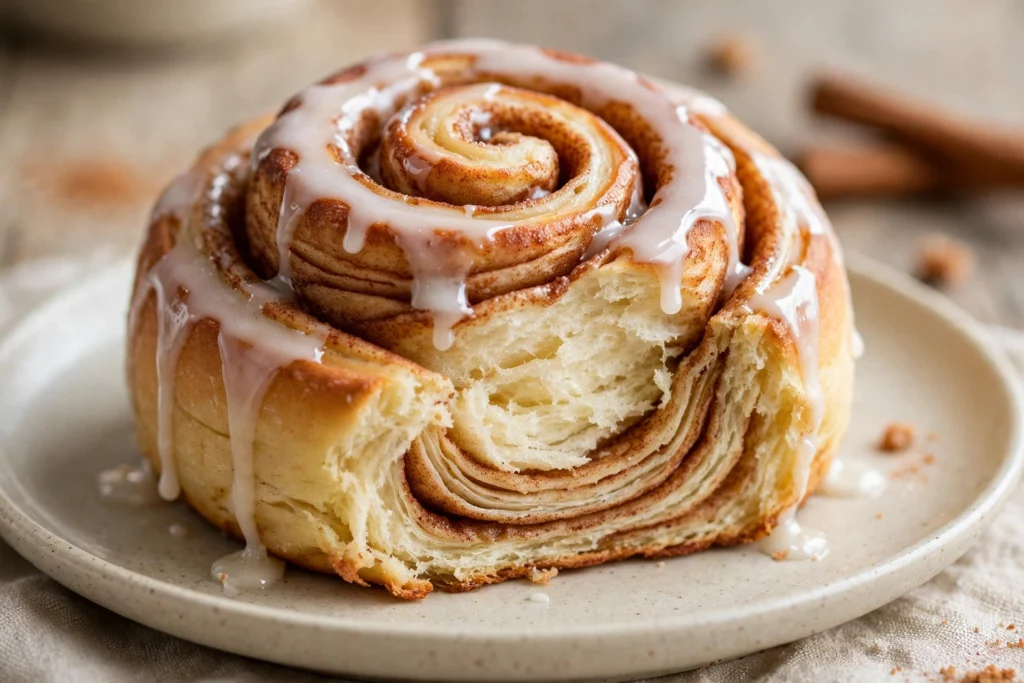
For everyday serving, a warm roll needs nothing else, but a protein-minded plate around it is easy: a bowl of Greek yogurt, a plate of eggs, or fresh berries to cut the sweetness. And for the wider breakfast rotation, a single warm serving of stovetop protein oatmeal is the weekday counterpart to this weekend bake. The protein baked oatmeal fills the same slot from the other direction — baked once, portioned, and reheated through the week.
Recipe: Protein Cinnamon Rolls
Soft, yeast-raised cinnamon rolls with vanilla whey worked into the dough, a classic brown sugar and cinnamon filling, and a Neufchâtel glaze. Nine rolls, baked in a 9×9 dish.
- Prep time: 30 minutes (active)
- Rise time: about 1 hour 40 minutes (first rise about 1 hour; second rise 30 to 40 minutes)
- Cook time: 20 to 25 minutes
- Total time: about 2 hours 45 minutes, including brief cooling before glazing
- Yield: 9 rolls
- Serving size: 1 glazed roll
Ingredients
Dough
- 3 cups (375g) all-purpose flour, plus a little more for the work surface
- 1 scoop (30g) vanilla whey protein powder (about 24g protein per scoop)
- 2¼ teaspoons (7g) instant yeast (one standard packet)
- 2 tablespoons (25g) granulated sugar
- 1 teaspoon (6g) fine salt
- ¾ cup (183g) 2% milk, warmed to 105–110°F
- 1 large egg (50g), beaten
- 3 tablespoons (43g) unsalted butter, melted
Filling
- 4 tablespoons (57g) unsalted butter, softened
- ¾ cup packed (165g) brown sugar
- 1½ tablespoons (12g) ground cinnamon
Glaze
- 3 oz (85g) Neufchâtel cheese, softened (or regular cream cheese)
- ¾ cup (90g) powdered sugar, sifted if lumpy
- 2 tablespoons (30g) 2% milk, plus more by the teaspoon if needed
- 1 teaspoon (4g) vanilla extract
Instructions
- Warm the milk to 105–110°F. Stir in the yeast and a pinch of the granulated sugar; leave 5 to 10 minutes until foamy.
- Whisk the flour, protein powder, remaining sugar, and salt in a large bowl.
- Add the foamy milk mixture, beaten egg, and melted butter. Stir to a shaggy dough with no dry flour remaining.
- Knead on a lightly floured surface for 8 to 10 minutes, until smooth, elastic, and only slightly tacky (stand mixer with dough hook: 6 to 8 minutes on medium-low). Add flour only by the tablespoon if the dough is unworkably sticky.
- Place in a lightly greased bowl, cover, and let rise in a warm spot about 1 hour, until doubled.
- Stir the softened butter, brown sugar, and cinnamon into an even paste.
- Roll the dough to a rectangle about 12 by 16 inches, roughly ¼ inch thick.
- Spread the filling evenly over the dough, leaving a bare ½-inch strip along one long edge.
- Roll up snugly from the opposite long edge; pinch the bare strip to seal. Cut into 9 equal rolls (unflavored dental floss or a serrated knife).
- Arrange cut-side up in a greased 9×9-inch dish, three rows of three, with small gaps between the rolls.
- Cover and let rise 30 to 40 minutes, until puffy and touching.
- Bake at 350°F (175°C) for 20 to 25 minutes, until lightly golden on top with set centers (about 190°F in the center roll).
- Cool in the pan about 10 minutes.
- Whisk the Neufchâtel and powdered sugar until smooth, then whisk in the vanilla and milk to a thick, spreadable glaze. Spread over the warm rolls and serve.
Storage: Unglazed rolls: airtight container at room temperature, up to 2 days. Glazed rolls: covered in the refrigerator, 3 to 4 days (the glaze is a dairy product). Freeze baked, unglazed rolls wrapped individually for up to 2 to 3 months; thaw, warm gently (microwave 20 to 30 seconds per roll, or a foil-covered dish at 300°F for about 10 minutes), and glaze after reheating.
Nutrition per roll (glazed, calculated): About 415 kcal · 10g protein · 66g carbs · 13g fat · 7.5g saturated fat · 2g fiber · 32g sugar · about 330mg sodium. Unglazed: about 350 kcal, about 9g protein. Estimates from ingredient labels and USDA database values; protein powder brands vary.
References
- USDA FoodData Central — nutrient values for all-purpose flour, milk, egg, butter, brown sugar, cinnamon, and Neufchâtel used in the per-roll calculation. https://fdc.nal.usda.gov/
- Red Star Yeast, Yeast Baking Lessons — yeast handling, liquid temperature ranges for activating yeast, and proofing guidance behind the 105–110°F milk and rise-by-size cues. https://redstaryeast.com/yeast-baking-lessons/
- FoodSafety.gov, Cold Food Storage Charts — refrigerator storage periods for perishable foods and leftovers, behind the 3-to-4-day guidance for glazed rolls. https://www.foodsafety.gov/food-safety-charts/cold-food-storage-charts
More breakfasts and bakes: For egg-free mornings, the high protein breakfast without eggs roundup covers the bases. For another glazed bake with calculated numbers, see the protein cheesecake. And the high-protein dessert roundup keeps the broader sweet options in one place.