Protein powder cookies are regular cookie dough with one deliberate change: a scoop of vanilla whey protein powder worked into the dry ingredients, so the batch you already know how to make comes out of the oven carrying real protein. This small-batch version makes 8 cookies at about 5g of protein each (4.6g in the actual calculation) — worked out from the actual ingredients below — using the whey powder most people already have in the cupboard. The texture is the part most protein cookie recipes get wrong, so this one is built around it: flour stays well ahead of the powder (roughly 3 parts flour to 1 part protein powder by weight), brown sugar and an egg yolk keep the crumb moist and chewy, and the cookies come out of the oven while the centers still look slightly soft. That last part matters more than any ingredient. Pull them at the right moment and they set up tender; leave them in “just to be safe” and no ratio will save them.
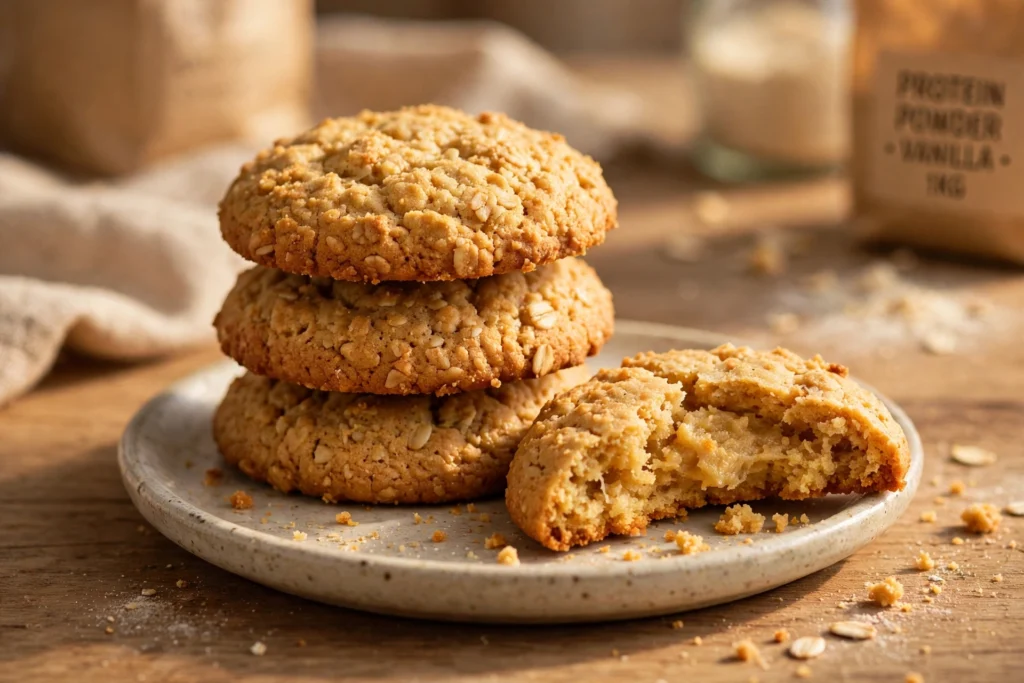
Table of Contents
ToggleWhy You’ll Like These Protein Powder Cookies
The batch is small on purpose. Eight cookies is a weekend bake, not a commitment — no trays rotating through the oven, no three dozen cookies going stale on the counter. The dough uses the powder as one ingredient among several rather than asking it to do flour’s job, which is where most homemade protein cookies turn dry, puffy, and cake-like. Every ingredient is a standard supermarket baking item. And because the dough portions into eight even balls, the nutrition per cookie is a known number, not a guess based on how big your scoop happened to be. If baked protein desserts are your thing generally, the site’s protein cheesecake works on the same principle — a real recipe first, with the protein built into the structure rather than sprinkled on top.
Ingredients for Protein Powder Cookies
Makes 8 cookies.
All-purpose flour, ¾ cup (94g). The structure. Flour is the majority of the dry mix by a wide margin, and that is the recipe’s main defense against dryness: protein powder has no gluten and absorbs liquid aggressively, so it can season a dough but it cannot be the dough. Spoon the flour into the measuring cup and level it — scooping straight from the bag packs in extra flour and dries the batch before it starts.
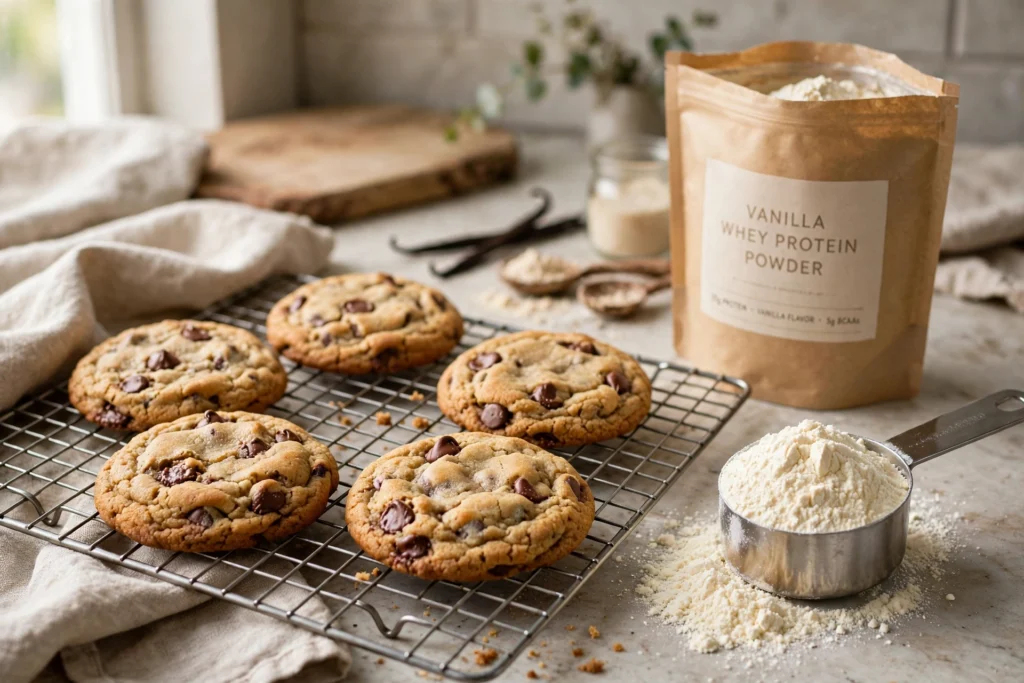
Vanilla whey protein powder, 1 scoop (30g; about 24g protein). The protein source and the largest single contributor — 24 of the roughly 37g of protein in the whole batch. This recipe is developed for whey specifically: it dissolves smoothly, adds a mild vanilla sweetness, and behaves predictably in a short bake. Check your own tub’s label before you bake. Scoops run from about 25g to 35g depending on the brand, and a heavier scoop quietly raises the powder ratio and dries the cookies out. Weighing the 30g is the single most reliable step in the recipe.
Salted butter, 4 tablespoons (57g), melted and slightly cooled. Fat is what makes a cookie tender instead of bready, and melted butter leans the texture toward chewy rather than cakey. Unsalted butter works the same; add a tiny extra pinch of salt if you swap.
Brown sugar, ¼ cup packed (55g). The chew sugar. Brown sugar holds moisture thanks to its molasses, sweetens, and helps the edges brown. Pack it into the cup as the recipe states — a loose scoop under-sweetens and under-moistens at the same time.
Granulated sugar, 2 tablespoons (25g). The balance. A smaller amount of white sugar keeps the flavor from going one-note molasses and helps the edges set with a slight crispness the brown sugar alone does not give.
Egg yolk, 1 large (about 17g). A yolk instead of a whole egg is a texture decision: the yolk brings fat and binding without the extra water and protein in the white, which is what pushes cookies toward a puffy, cake-like crumb. Room temperature is ideal so it blends evenly into the butter and sugars.
Baking soda, ¼ teaspoon. The lift and spread. A small amount is right for a small batch — soda also encourages browning, which is part of the finished flavor.
Vanilla extract, 1 teaspoon; fine salt, ¼ teaspoon. The vanilla backs up the whey powder’s vanilla so the cookie tastes like a cookie, not like a shake. The salt keeps the sugars in check.
Milk, 1 to 2 teaspoons, only if needed. The adjustment, not a fixed ingredient. Whey brands differ in how much liquid they pull from a dough. If your mixed dough feels dry and crumbly rather than soft and slightly tacky, stir in milk a teaspoon at a time until it holds together when pressed. It is not counted in the nutrition at this amount.
Optional: semisweet chocolate chips, ¼ cup (45g). Folded in at the end. They are a variation, not part of the base recipe, and they are excluded from the base nutrition — with chips, each cookie lands at about 180 kcal with the protein essentially unchanged.
What Protein Powder Works Best for Cookies?
This recipe is built for whey. That sentence matters because protein powders are not interchangeable, and most disappointing protein cookies come from treating them as if they were. Powders differ in how much liquid they absorb, how sweet they already are, and what heat does to their texture.
Whey protein dissolves cleanly and sets softly in a short bake, which is why it is the default for cookies. A whey isolate or a whey concentrate both work here; isolate tends to be a touch drier, so the milk adjustment in the ingredients list exists partly for it.
Casein protein absorbs considerably more liquid than whey and bakes up thicker and denser. In this dough it would produce a heavier, drier cookie unless the liquid went up — and at that point it is a different recipe being developed on the fly. If casein is what you have, expect to add milk beyond the amounts given and accept a denser result.
Plant-based protein blends (pea, rice, soy combinations) are usually the thirstiest of all and often bring a distinct earthy flavor that vanilla only partly covers. They also tend to bake up gritty if the dough is under-hydrated. They can be used, but go in knowing the dough will likely need the full milk adjustment and possibly a little more, and the finished texture will be firmer than the whey version.
Whichever powder you use, read its label before you start. The serving size, protein per scoop, and added sweeteners vary enough between brands to change both the nutrition and how much extra sweetness the dough needs. A heavily sweetened powder plus the full sugar below can overshoot; a completely unsweetened one may want the sugars left exactly as written.
How to Make Protein Powder Cookies
- Heat the oven and prepare the pan. Set the oven to 350°F (175°C) and line a baking sheet with parchment paper. The cookies spread modestly, so parchment is about easy release and even browning on the bottom, not containment.
- Whisk the dry ingredients. In a medium bowl, whisk together the flour, protein powder, baking soda, and salt until the powder is evenly distributed with no pale streaks. Protein powder clumps readily; whisking it through the flour now is what prevents a chalky pocket in a finished cookie.
- Combine the butter and sugars. In a separate bowl, stir the melted butter, brown sugar, and granulated sugar together until the mixture looks like wet sand and no dry sugar remains. Melted butter means no creaming step and no mixer — a spoon or a sturdy spatula does the whole recipe.
- Add the yolk and vanilla. Stir in the egg yolk and vanilla extract until the mixture turns glossy and uniform, about 30 seconds of real stirring.
- Bring the dough together. Add the dry ingredients to the wet and fold just until no dry flour shows. The dough should be soft, slightly tacky, and hold together when pressed between your fingers. If it feels dry or crumbly — some whey brands pull more moisture than others — stir in milk 1 teaspoon at a time until it does. If you are using the chocolate chips, fold them in now.
- Portion and shape. Divide the dough into 8 equal portions, about 2 tablespoons each (roughly 35g if you weigh them), and roll each into a ball. Arrange them on the prepared sheet with about 2 inches between them. Do not flatten them — they spread on their own, and starting as balls is what keeps the centers thick and chewy.
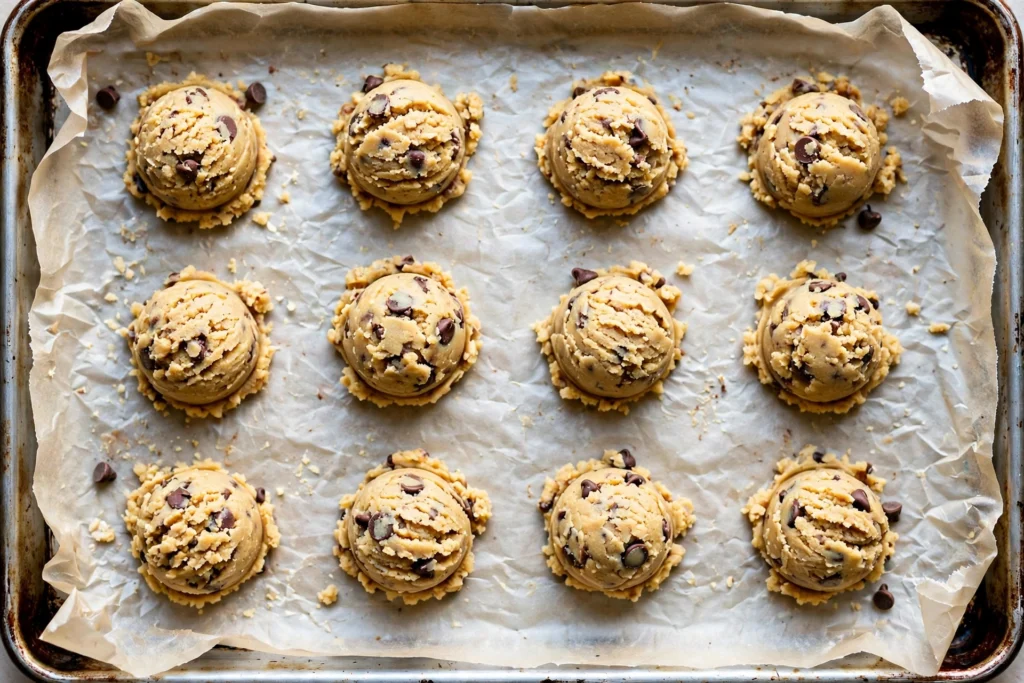
- Bake 9 to 11 minutes. The doneness cue is visual, not the clock: the edges should look set and very lightly golden while the centers still look soft and slightly underdone, almost puffy. That soft center is correct. It finishes setting as the cookies cool, and it is the entire difference between chewy and dry.
- Cool on the pan for 10 minutes, then move the cookies to a wire rack. Moving them hot tears them; skipping the rack and leaving them on a hot pan keeps cooking the bottoms. After the 10-minute rest they are firm enough to handle and at their best texture.
How to Keep Protein Cookies Soft and Chewy
Most dry protein cookies fail for one of four reasons, and all four are fixable.
The powder ratio crept up. Protein powder dries a dough out twice over: it absorbs liquid, and it dilutes the flour that gives a cookie its tender structure. The fix starts at the scale — scoop sizes vary by brand, so weigh the 30g rather than trusting the scoop that came in the tub. A heaped scoop can easily add several extra grams of powder, which is enough to tip a small batch from chewy to chalky.
The dough started too dry. Different whey brands absorb different amounts of liquid, and flour measurement varies with how the cup was filled. Judge the dough by feel before it goes in the oven: soft, slightly tacky, and able to hold a ball without crumbling. A dry dough never becomes a moist cookie; the milk adjustment in the ingredients exists for exactly this moment, used a teaspoon at a time.
They baked two minutes too long. Protein cookies firm up as they cool more than regular cookies do, because the whey keeps setting as it loses heat. A cookie that looks fully done and firm in the oven will be hard at room temperature. Pull the tray when the centers still look soft — this is the one step where trusting the cue over the timer pays off.
Size and temperature drifted. Smaller balls bake through faster and dry out sooner; a hotter oven sets the edges before the center catches up. If your first batch runs dry, check the portion size before changing anything else, and confirm the oven is actually at 350°F — many home ovens run noticeably hot, and a short bake like this one feels it immediately.
One storage habit helps too: the cookies stay softest in an airtight container, and a container opened and closed repeatedly lets them stale faster than the calendar says they should.
Can You Make Protein Cookies Without Flour?
Not by simply leaving the flour out of this recipe — that part needs to be direct. Flour is roughly three quarters of the dry structure here. Remove it and the dough has nothing to set into a cookie; you get a greasy, spreading puddle that bakes into a crisp, fragile wafer at best.
A genuine flour-free version needs its own formulation. The workable swap is finely ground oat flour: replace the all-purpose flour with ¾ cup oat flour (about 90g) and make the milk a standard ingredient rather than an adjustment — start with 1 tablespoon (15ml) mixed in, because oat flour absorbs more liquid than wheat flour and the dough otherwise runs dry. Keep every other ingredient and the method the same. Expect a different cookie, not an identical one: oat flour gives a denser, more tender crumb, the balls spread a little more, and the chew reads softer. The protein per cookie stays about the same at roughly 5g, since the whey does the protein work in both versions. Note that oat flour is only gluten-free if the oats are certified gluten-free; regular oat flour is not a safe swap for celiac readers.
Other alternative flours are not one-to-one here. Almond flour carries far more fat and no gluten, so the cookies spread further and set softer; coconut flour absorbs several times its weight in liquid and would need a full reformulation of the liquid and egg. Neither is a spoon-for-spoon substitute in this dough.
Easy Protein Cookie Variations
Each of these keeps the base dough and method; each changes the nutrition somewhat, so the per-cookie figures in the next section apply to the base cookie.
Chocolate chip: fold in ¼ cup (45g) semisweet chocolate chips at the end of mixing. Adds about 27 kcal and 3g of sugar per cookie; protein is essentially unchanged.
Double chocolate: replace 2 tablespoons of the flour with 2 tablespoons (10g) of unsweetened cocoa powder. The dough runs slightly drier, so keep the milk handy and use it. The flavor goes properly dark and the protein per cookie does not move.
Peanut butter: replace 2 tablespoons of the butter with 2 tablespoons (32g) of creamy peanut butter and keep the rest of the recipe the same — swapping fat for fat, rather than adding peanut butter on top, is what protects the texture. Adds about 1g of protein per cookie and a noticeably denser chew.
Cinnamon: add ½ teaspoon of ground cinnamon to the dry ingredients. Nothing else changes; the cookie reads warmer and slightly less sweet.
Straight vanilla: the base recipe as written is already the vanilla version — the whey and the extract do the work. For a cleaner vanilla flavor, use a vanilla-bean paste in place of the extract, same amount.
How Much Protein Is in Each Cookie?
About 5g per cookie — 4.6g in the actual calculation, across a batch total of roughly 37g of protein in 8 cookies. The breakdown by ingredient shows where it comes from:
- Vanilla whey protein powder, 30g: about 24g — close to two thirds of the batch total on its own.
- All-purpose flour, 94g: about 9.7g — flour is not a protein food, but at this quantity its contribution is real and often overlooked.
- Egg yolk: about 2.7g.
- Butter and sugars: about 0.6g combined — effectively nothing; they are there for texture and flavor.
Two honest limits on that number. First, it depends on the whey label: this calculation uses the common basis of 24g of protein per 30g scoop, and a powder with 20g per scoop drops each cookie to about 4g. Second, portioning matters — the figure assumes 8 equal cookies, and a batch divided into 7 larger ones raises each cookie’s protein and calories together. Nutrition from protein powder varies by brand more than almost any other baking ingredient, so treat 5g as this recipe with a typical whey, not as a promise about every tub.
How to Store Protein Powder Cookies
Cool them completely before the container. Warm cookies sealed in a box steam themselves, and the texture goes soft and gummy within hours. The 10 minutes on the pan plus time on a rack until they reach room temperature is enough.
At room temperature: store in an airtight container for 2 to 3 days. They are at their best on day one and still properly chewy on day two; by day three the edges start to firm up. A container that seals well matters more than any other variable at this stage.
In the refrigerator: an airtight container stretches them to about a week, but chilled whey cookies firm up noticeably. Let a cookie sit at room temperature for 15 minutes before eating, or give it 8 to 10 seconds in the microwave to bring the chew back.
In the freezer: these freeze well for 2 to 3 months. Freeze the baked cookies in a single layer until solid, then move them to a freezer bag with the air pressed out — this keeps them from freezing into one block and protects against freezer burn. Thaw at room temperature for about 30 minutes, or straight from frozen in a 300°F (150°C) oven for 4 to 5 minutes. Raw dough balls also freeze for the same period and can bake from frozen at 350°F with 2 to 3 extra minutes.
For more make-ahead protein snacks built on the same portion-and-store logic, the site’s protein granola bars keep a week of servings ready in the fridge.
Frequently Asked Questions
Can you bake cookies with protein powder?
Yes — as long as the powder stays a minority of the dry ingredients. In this recipe the whey is roughly a quarter of the flour-and-powder mix by weight, the dough carries enough fat and sugar to stay moist, and the bake is short. Cookies go wrong when powder replaces flour one-for-one, which no dough can absorb.
Which protein powder is best for cookies?
Whey, and this recipe is developed around vanilla whey specifically. It dissolves smoothly, adds gentle sweetness, and sets softly in a short bake. Casein absorbs much more liquid and bakes denser; plant blends are thirstier still and often taste earthy. Both can be used with liquid adjustments, but neither is a straight swap.
Why are my protein powder cookies dry?
The usual causes, in order: too much powder (scoop sizes vary — weigh the 30g), a dough that was already dry before baking (use the teaspoon-by-teaspoon milk adjustment), or two extra minutes in the oven. Protein cookies firm up a lot as they cool, so a cookie that looks done and firm in the oven will be hard by the time it reaches room temperature.
Can I replace flour with protein powder?
Not one-for-one, and not in this recipe. Protein powder has no gluten, absorbs far more liquid than flour, and sets into a dry, rubbery crumb when it dominates a dough. Flour provides the structure; the powder’s job is to raise the protein inside that structure, which is why the ratio here sits near 3:1 in flour’s favor.
Do protein powder cookies taste different?
Slightly, and it is better to say so plainly. There is a mild vanilla-sweetness from the whey and a texture that is chewier and a little denser than a classic butter cookie. What they should not taste is chalky — chalkiness almost always means undissolved powder pockets (whisk it through the flour) or a powder ratio that crept too high.
How much protein is in one homemade protein cookie?
In this recipe, about 5g per cookie (4.6g calculated), with about 155 kcal. The whey supplies most of it — roughly 3g of each cookie’s protein comes from the powder alone. The honest range across brands is about 4 to 5g, depending on the protein per scoop on your tub’s label.
Can you freeze protein powder cookies?
Yes. Baked cookies keep 2 to 3 months in the freezer if they are frozen in a single layer first and then bagged with the air pressed out. Thaw 30 minutes at room temperature or warm them from frozen for 4 to 5 minutes in a 300°F (150°C) oven. Dough balls freeze just as well and bake from frozen with a few extra minutes.
How do you keep protein cookies soft?
Four habits do it: weigh the powder instead of trusting the scoop, adjust the dough with milk until it feels soft and slightly tacky, pull the cookies while the centers still look underdone, and store them airtight as soon as they are fully cool. Day-two cookies also come back with 8 to 10 seconds in the microwave.
References
- USDA FoodData Central — nutrient values for all-purpose flour, butter, sugars, and egg yolk used in the per-cookie calculation. https://fdc.nal.usda.gov/
- FoodSafety.gov — food storage and freezer guidance applied to the storage periods given above. https://www.foodsafety.gov/keep-food-safe/foodkeeper-app
Recipe: Protein Powder Cookies
Small-batch vanilla whey cookies with brown sugar and an egg yolk for chew — 8 soft, chewy cookies at about 5g of protein each, mixed by hand and baked in about 10 minutes.
- Prep time: 15 minutes
- Cook time: 10 minutes
- Cooling time: 10 minutes
- Total time: about 35 minutes
- Yield: 8 cookies (serving size: 1 cookie)
Ingredients
- ¾ cup (94g) all-purpose flour, spooned and leveled
- 1 scoop (30g) vanilla whey protein powder (about 24g protein — check your label)
- ¼ teaspoon baking soda
- ¼ teaspoon fine salt
- 4 tablespoons (57g) salted butter, melted and slightly cooled
- ¼ cup packed (55g) brown sugar
- 2 tablespoons (25g) granulated sugar
- 1 large egg yolk, room temperature
- 1 teaspoon vanilla extract
- 1 to 2 teaspoons milk, only if the dough feels dry
- Optional: ¼ cup (45g) semisweet chocolate chips (not included in the nutrition below)
Instructions
- Heat the oven to 350°F (175°C) and line a baking sheet with parchment paper.
- Whisk the flour, protein powder, baking soda, and salt in a medium bowl until no pale streaks remain.
- In a separate bowl, stir the melted butter, brown sugar, and granulated sugar until combined and sandy.
- Stir in the egg yolk and vanilla until glossy and uniform.
- Fold the dry ingredients into the wet just until no dry flour shows. If the dough is dry or crumbly, stir in milk 1 teaspoon at a time until it feels soft and slightly tacky. Fold in the chocolate chips now, if using.
- Divide into 8 equal portions (about 2 tablespoons each), roll into balls, and place on the sheet about 2 inches apart. Do not flatten.
- Bake 9 to 11 minutes, until the edges look set and lightly golden and the centers still look soft and slightly underdone.
- Cool on the pan for 10 minutes, then move to a wire rack to finish cooling.
Serving suggestions: Best warm or at room temperature on the day they are baked. A cookie pairs well with a glass of milk or a coffee; for a fuller high-protein dessert plate, browse the site’s high-protein dessert recipes roundup.
Storage: Airtight container at room temperature for 2 to 3 days; refrigerated for about a week (let them come back to room temperature before eating); frozen baked or as raw dough balls for 2 to 3 months.
Nutrition per cookie (base recipe, calculated): about 155 kcal, about 5g protein, 19g carbohydrates, 7g fat, 4g saturated fat, less than 1g fiber, 10g sugar, about 180mg sodium. Figures are calculated from the ingredient values listed in this article’s nutrition basis and will vary with your protein powder’s label.