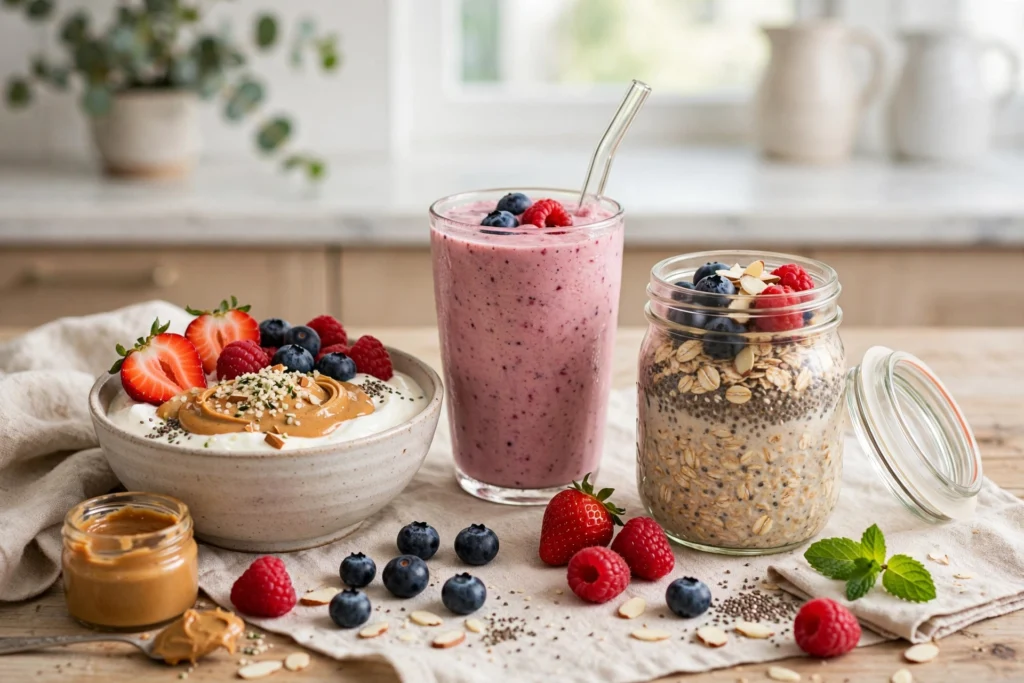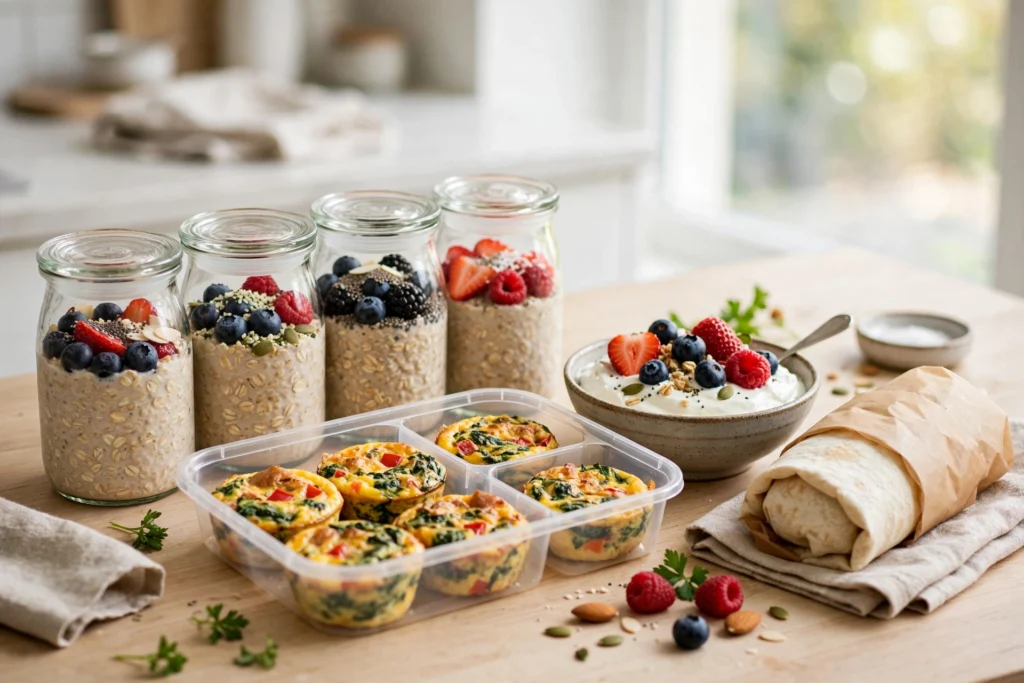
Greek yogurt is not a garnish in these recipes — it is the protein. These 12 high protein Greek yogurt recipes run from a breakfast bowl at about 30 grams of protein to dips and sauces that still carry 5 to 7 grams in a quarter cup, with marinated chicken at 28 grams and a creamy chicken salad at 27 in between. Sweet and savory both get a turn: overnight oats and frozen bark on one side, tzatziki and a garlic herb sauce on the other. Every number below is calculated from the actual ingredients, using plain 0% Greek yogurt at about 10 grams of protein per 100 grams as the baseline. Brands vary, sometimes by a gram or two per serving, and the tips section at the end explains what changes when your tub is different.
Table of Contents
ToggleWhy use Greek yogurt in high-protein recipes?
It starts with the straining. Greek yogurt is regular yogurt with much of the liquid whey drained away, and what leaves with that whey is mostly water and lactose — so the protein that stays behind is concentrated. Plain 0% Greek yogurt lands at about 10 grams of protein per 100 grams. Regular plain yogurt sits closer to 3.5 grams. Same shelf, same size tub, nearly three times the protein.
Texture does the rest of the work. A strained yogurt is thick enough to hold a dip upright, cling to chicken as a marinade, and stand in for mayonnaise in a chicken salad without the whole thing turning soupy. Its tang does quiet flavor work too, the job lemon juice and vinegar usually get hired for. That combination — density plus tang plus body — is what makes high protein recipes with Greek yogurt different from recipes that stir in a token spoonful and call it a day.
One honest warning before the recipes: there is no universal number. A 0% tub gives about 10 grams of protein per 100 grams; a whole-milk tub gives about 9, with more calories attached; extra-strained skyr-style brands can reach about 11. Fat level barely moves the protein — it mostly moves calories. Every figure in this roundup is built on the 0% baseline and says so, so if your tub is richer, expect the protein to land about the same and the calories a little higher.
High-protein Greek yogurt breakfast recipes
Breakfast is where a high protein Greek yogurt breakfast earns its keep, because the cooking is close to zero. Three of these four need nothing but a spoon, a jar, or a blender. The fourth asks for a frying pan and ten minutes.
Greek yogurt breakfast bowl
The fastest recipe on this page. No heat, no blender, one spoon to wash. The bowl works on contrast: cold, thick yogurt under crunchy granola and soft berries, with chia seeds adding a little body between bites.
Ingredients:
- 1 cup (245g) plain 0% Greek yogurt
- 1/4 cup (28g) granola
- 3/4 cup (110g) mixed berries, fresh or thawed
- 1 tablespoon (12g) chia seeds
Steps:
- Spoon the yogurt into a bowl and smooth the top with the back of the spoon.
- Scatter the granola over one half and the berries over the other.
- Sprinkle the chia seeds across the top and eat straight away, while the granola is still crunchy.
Prep time: 5 minutes. Makes 1 bowl. Per bowl: about 30 grams of protein and about 390 calories.
Swap the berries freely — sliced banana, diced mango, or stewed apples all sit happily here. What does not work is building the bowl the night before: the granola drinks the yogurt’s moisture and goes soft by morning. If mornings are rushed, portion the yogurt and berries into a container the night before and keep the granola in a separate small pot to add at the table.
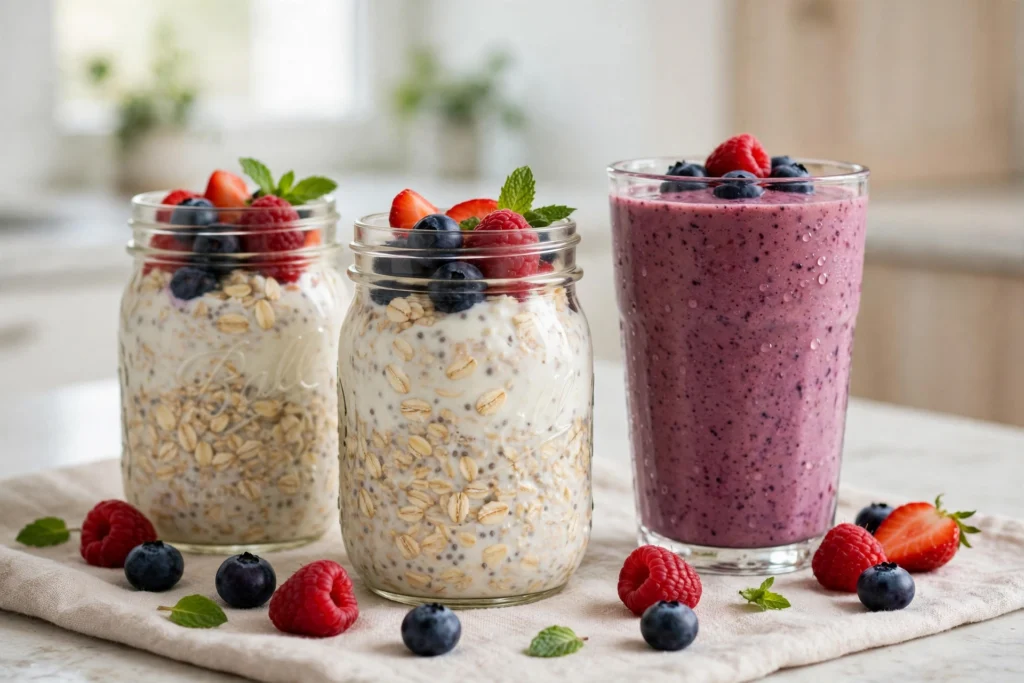
Greek yogurt overnight oats
The jar version of the same idea, built for people who want breakfast to happen without a decision. Yogurt replaces half the usual milk, which is why this jar carries more protein than most overnight oats: the oats bring about 5 grams, the yogurt brings 17.
Ingredients:
- 1/2 cup (40g) rolled oats
- 2/3 cup (170g) plain 0% Greek yogurt
- 1/2 cup (120ml) milk
- 1 tablespoon (12g) chia seeds
- 1/2 cup (75g) mixed berries
- 1/2 teaspoon vanilla extract, plus a pinch of cinnamon
Steps:
- Add everything except the berries to a jar or container and stir until no dry oats remain.
- Fold in the berries, or layer them on top if you want them to stay distinct.
- Cover and refrigerate for at least 4 hours, ideally overnight.
- Stir in the morning. Eat cold, or warm gently for a minute if cold oats are not your thing.
Prep time: 5 minutes, plus at least 4 hours of chilling. Makes 1 jar. Per jar: about 29 grams of protein and about 410 calories.
Thickness varies by tub. If your yogurt is an especially thick, strained style, the jar can set almost solid — loosen it with a splash of milk before eating rather than deciding the recipe failed. The jars keep in the fridge for up to 4 days, so a Sunday batch of four covers most of the working week.
Greek yogurt protein smoothie
Most protein smoothies lean on powder. This one leans on the yogurt, the peanut butter, and the milk, and lands in the same place. Frozen strawberries do double duty: flavor, and enough chill that the smoothie pours thick without watering it down.
Ingredients:
- 3/4 cup (185g) plain 0% Greek yogurt
- 1 medium banana (about 118g)
- 1 cup (150g) frozen strawberries
- 1/2 cup (120ml) milk
- 1 tablespoon (16g) peanut butter
- 1/2 teaspoon vanilla extract, plus a handful of ice
Steps:
- Pour the milk into the blender first, then add the yogurt — liquids at the bottom help the blades catch.
- Add the banana, frozen strawberries, peanut butter, vanilla, and ice.
- Blend for 45 to 60 seconds, until no strawberry pieces remain and the surface looks glossy.
Prep time: 5 minutes. Makes 1 large smoothie, about 2 cups (475ml). Per smoothie: about 29 grams of protein and about 415 calories.
If you want more blending ideas in this direction, the site’s collection of high protein breakfast smoothie recipes goes wider on flavor combinations. This one stays in the roundup because the protein comes from the yogurt rather than a scoop of anything. A fresh smoothie is best straight from the blender; it will keep in the fridge for up to 24 hours, but it thickens and separates, so give it a hard shake before drinking.
Greek yogurt pancakes
The one breakfast here that asks you to cook, and the trade is fair: a short stack with the soft, slightly tangy crumb of a yogurt batter, and about 15 grams of protein before anything goes on top. The batter is thicker than a standard pancake batter. That is the yogurt’s doing, and it is normal.
Ingredients:
- 1 1/2 cups (188g) all-purpose flour
- 2 teaspoons baking powder
- 1 tablespoon sugar
- 1/4 teaspoon salt
- 1 cup (245g) plain 0% Greek yogurt
- 2 large eggs
- 1/4 cup (60ml) milk
- 1 teaspoon vanilla extract
Steps:
- Whisk the flour, baking powder, sugar, and salt together in a large bowl.
- In a second bowl, whisk the yogurt, eggs, milk, and vanilla until smooth.
- Pour the wet mixture into the dry and stir until just combined. Lumps are fine; overmixing is what makes pancakes tough.
- Rest the batter for 5 minutes while a nonstick pan warms over medium heat.
- Cook 1/4-cup scoops of batter for 2 to 3 minutes per side, spreading each scoop gently with the back of the measuring cup, until golden and set in the middle.
Prep time: 10 minutes. Cook time: 10 to 12 minutes. Makes 8 pancakes; one serving is 2 pancakes. Per serving: about 15 grams of protein and about 265 calories.
Serve them with a spoonful of yogurt and a handful of berries instead of syrup and the serving climbs higher while staying in the same idea. Leftover pancakes keep in the fridge for 3 days, or freeze them between sheets of parchment for up to 2 months and toast them straight from frozen.
High-protein Greek yogurt snacks
A high protein Greek yogurt snack has a specific job: hold the line between lunch and dinner without becoming a second lunch. Both of these are make-ahead, fridge-or-freezer foods, which is the entire point — the snack that is already made is the snack that gets eaten.
Greek yogurt fruit dip
Fruit on its own is a snack that forgets you by 3 p.m. This dip fixes that with peanut butter stirred into the yogurt: sweet, salty, thick enough to cling to an apple slice instead of sliding off it.
Ingredients:
- 1 cup (245g) plain 0% Greek yogurt
- 1/4 cup (64g) peanut butter
- 1 tablespoon (21g) honey
- 1/2 teaspoon vanilla extract
- 1/4 teaspoon ground cinnamon
Steps:
- Put everything in a bowl and whisk until completely smooth, with no peanut butter streaks left.
- Cover and chill for 30 minutes. The dip firms up and the cinnamon settles in.
- Serve with apple slices, strawberries, banana chunks, or pear wedges.
Prep time: 5 minutes, plus 30 minutes of chilling. Makes about 1 1/2 cups; one serving is 1/4 cup. Per serving: about 7 grams of protein and about 95 calories.
Almond butter swaps in cleanly if peanuts are a problem at your table. The dip keeps in the fridge for 3 to 4 days; the honey can weep a little liquid to the surface after day two, which stirs back in without any drama.
Frozen Greek yogurt bark
Yogurt, frozen in a slab and broken into shards. It eats like a treat and behaves like a snack, and it is the recipe children at the table will vote for — mostly because breaking it apart is part of the method.
Ingredients:
- 2 cups (490g) plain 0% Greek yogurt
- 2 tablespoons (42g) honey
- 1 teaspoon vanilla extract
- 1 cup (150g) mixed berries, larger ones chopped
- 2 tablespoons (15g) chopped pistachios
Steps:
- Stir the yogurt, honey, and vanilla together in a bowl.
- Spread the mixture on a parchment-lined baking tray, about 1/2 inch (1.25cm) thick.
- Scatter the berries and pistachios over the top and press them in lightly.
- Freeze for at least 3 hours, until the slab is hard all the way through.
- Lift the parchment, break the slab into 8 rough pieces, and get it straight back into the freezer.
Prep time: 10 minutes, plus at least 3 hours of freezing. Makes 8 pieces. Per piece: about 7 grams of protein and about 70 calories.
Two small details make this work. Blot the berries dry with a paper towel first — surface water freezes into icy patches. And work fast once it leaves the freezer: bark melts at the edges within minutes at room temperature. Stored in a sealed container in the freezer, it keeps for up to 1 month.
Savory Greek yogurt recipes
This is the section that surprises people. Greek yogurt dips and sauces have centuries of history behind them in Greek, Turkish, and Indian cooking, where yogurt was never a breakfast food to begin with. The rules are simple: season boldly, respect the squeeze, and keep yogurt sauces away from a rolling boil.
Tzatziki sauce
The cucumber is the recipe. Everything else is stirring. Skip the draining step and the water in the cucumber will thin your tzatziki into a pale soup within the hour — this is the step that separates the real thing from the disappointing version.
Ingredients:
- 1 1/2 cups (368g) plain 0% Greek yogurt
- 1 medium cucumber (about 200g), coarsely grated
- 1/2 teaspoon salt, for drawing out the cucumber water
- 2 garlic cloves, finely grated or minced
- 1 tablespoon olive oil
- 1 tablespoon lemon juice
- 2 tablespoons chopped fresh dill, or 2 teaspoons dried
Steps:
- Toss the grated cucumber with the salt and leave it in a sieve for 10 minutes.
- Tip the cucumber into a clean tea towel or a double layer of paper towels and squeeze hard, twice. You want it to feel almost dry.
- Stir the cucumber into the yogurt with the garlic, olive oil, lemon juice, and dill.
- Chill for at least 30 minutes before serving, so the garlic mellows into the yogurt instead of sitting on top of it.
Prep time: 15 minutes, plus 30 minutes of chilling. Makes about 2 cups; one serving is 1/4 cup. Per serving: about 5 grams of protein and about 45 calories.
Serve it with grilled chicken, warm flatbread, or raw vegetables, or spoon it over rice bowls. Tzatziki keeps in the fridge for 3 to 4 days and loosens a little as the remaining cucumber gives up its water — a stir before serving puts it back together.
Greek yogurt ranch dip
Bottled ranch is a calorie delivery system: a quarter cup of a typical bottled dressing runs about 280 calories. This version keeps the flavor architecture — garlic, onion, dill, a little acid — and rebuilds the base out of yogurt, which brings the same quarter cup down to about 35 calories with 5 grams of protein attached.
Ingredients:
- 1 cup (245g) plain 0% Greek yogurt
- 2 tablespoons (30ml) milk, to thin
- 1 teaspoon garlic powder
- 1 teaspoon onion powder
- 1 teaspoon dried dill
- 1 teaspoon dried parsley
- 1 teaspoon lemon juice or apple cider vinegar
- 1/2 teaspoon salt
- 1/4 teaspoon black pepper
Steps:
- Whisk everything together in a bowl until the herbs are evenly distributed.
- Cover and chill for at least 30 minutes. Dried herbs need that time to hydrate and taste like themselves.
- Stir once more before serving and check the salt.
Prep time: 5 minutes, plus 30 minutes of chilling. Makes about 1 1/4 cups; one serving is 1/4 cup. Per serving: about 5 grams of protein and about 35 calories.
Thin it with extra milk, a tablespoon at a time, and it pours like a salad dressing. As a dip it holds up to carrot sticks, cucumber rounds, bell pepper strips, and the last of a rotisserie chicken. It keeps in the fridge for up to 4 days.
Garlic herb Greek yogurt sauce
Ten minutes of stirring buys you the sauce that rescues plain chicken, plain rice, and plain roasted vegetables all week. It was built for wraps — spoon it over the chicken in this site’s high protein wraps recipe and the wrap’s own yogurt dough means the meal is yogurt-based at both layers, which sounds odd and tastes like it was planned.
Ingredients:
- 1 cup (245g) plain 0% Greek yogurt
- 1 small garlic clove, finely grated
- 1 tablespoon lemon juice
- 1 teaspoon olive oil
- 2 tablespoons finely chopped fresh herbs — parsley, mint, or cilantro
- 1/4 teaspoon salt
- Pinch of black pepper
Steps:
- Stir everything together in a small bowl.
- Rest it for 10 minutes before serving. Raw garlic needs a short while to settle from sharp to savory.
- Taste and adjust the lemon and salt; cold food numbs both, so season a touch bolder than you think.
Prep time: 5 minutes. Makes 1 cup; one serving is 1/4 cup. Per serving: about 6 grams of protein and about 45 calories.
The one rule: this sauce goes on warm food, never in the pan. High heat splits yogurt into grains and whey, and no amount of stirring talks it back down. Spoon it over food at the table, or stir it into a finished dish off the heat. Leftovers keep in the fridge for 3 to 4 days.
Greek yogurt recipes for lunch and dinner
Yogurt at the stove is mostly a question of timing. In a marinade, its mild acid works on the chicken for hours before heat is involved. In a chicken salad, it replaces mayonnaise outright. In a sauce, it arrives after the cooking is done. Respect those three timings and Greek yogurt protein recipes stop being a breakfast category and become a cooking method.
Greek yogurt chicken marinade
Yogurt marinades are gentler than vinegar or citrus ones. The acid is milder, so the chicken tenderizes evenly over hours instead of turning chalky at the surface in twenty minutes — which makes this the forgiving marinade for anyone who has ever left chicken “for a bit longer” and paid for it. Grilled, sliced, and served over rice or salad, this chicken is also the one that anchors this site’s high protein chicken wrap.
Ingredients:
- 1 cup (245g) plain 0% Greek yogurt
- 2 tablespoons lemon juice
- 3 garlic cloves, minced
- 2 teaspoons smoked paprika
- 1 teaspoon ground cumin
- 1 teaspoon salt
- 1/2 teaspoon black pepper
- 1 pound (450g) boneless, skinless chicken breast
Steps:
- Whisk the yogurt, lemon juice, garlic, paprika, cumin, salt, and pepper in a bowl or a zip bag.
- Add the chicken and turn it until every surface is coated.
- Refrigerate for at least 30 minutes and up to 8 hours. Past 24 hours the surface turns mushy, so this is not a two-day marinade.
- Lift the chicken out and wipe off most of the marinade — a thin coating is what browns well. Discard the used marinade; it has done its job and it does not become a sauce.
- Grill or pan-cook over medium-high heat for 6 to 7 minutes per side, until the thickest part reads 165°F (74°C). Rest 5 minutes before slicing.
Prep time: 10 minutes, plus 30 minutes to 8 hours of marinating. Cook time: 12 to 15 minutes. Makes 4 servings. Per serving: about 28 grams of protein and about 155 calories, counting the chicken plus roughly half the marinade, which is the share that actually stays on the meat through cooking.
The same marinade takes chicken thighs without any adjustment, and the spice base bends easily — swap the paprika and cumin for 2 teaspoons of curry powder and the whole dish changes direction. Cooked chicken keeps in the fridge for 3 to 4 days, so a double batch covers lunches as well as the first dinner.
Creamy Greek yogurt chicken salad
The classic deli chicken salad is chicken held together with mayonnaise, and the mayonnaise is most of the calories. Yogurt holds it together instead, adds tang that mayo never had, and turns the binder itself into a protein source. Mustard and lemon keep it from tasting like a compromise, because nobody keeps making the version that tastes like one.
Ingredients:
- 2 cups (280g) cooked chicken breast, chopped or shredded
- 3/4 cup (185g) plain 0% Greek yogurt
- 2 celery stalks (about 80g), finely diced
- 1/2 medium apple (about 90g), diced
- 1 tablespoon (15g) Dijon mustard
- 1 tablespoon lemon juice
- 1/4 teaspoon salt, plus black pepper to taste
- 2 tablespoons chopped fresh parsley or dill (optional)
Steps:
- Stir the yogurt, mustard, lemon juice, salt, and pepper together in a large bowl.
- Add the chicken, celery, and apple, and fold until everything is evenly coated.
- Cover and chill for at least 30 minutes. The salad is noticeably better cold, once the flavors have had time to meet.
- Serve in lettuce cups, on toast, over greens, or straight from the container standing at the fridge, which is how a good share of it will be eaten.
Prep time: 15 minutes, plus 30 minutes of chilling. Makes about 3 cups; one serving is about 3/4 cup. Per serving: about 27 grams of protein and about 160 calories.
A rotisserie chicken works here with the skin removed, though dark meat nudges the calories up and the protein down slightly. The salad keeps in the fridge for up to 3 days; the lemon juice slows the apple browning but does not stop it forever, so this is a make-it-for-the-next-two-days dish rather than a weekly one.
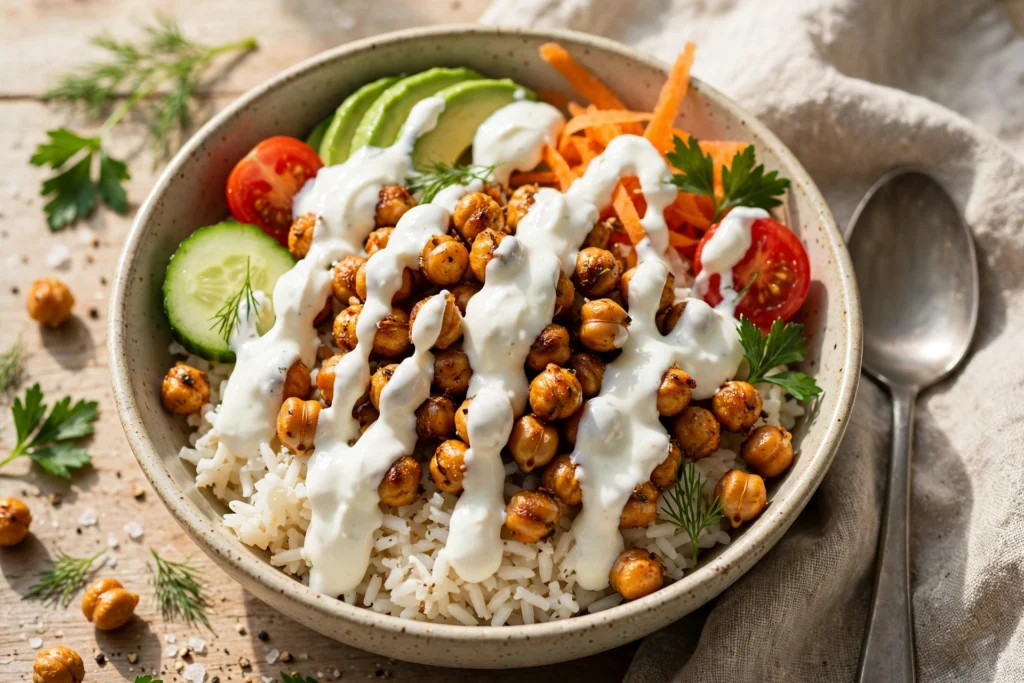
Greek yogurt sauce for grain bowls
Grain bowls fail in one predictable place: the top layer. The rice is fine, the vegetables are fine, and the whole bowl is dry by the third bite. This sauce is the fix — tahini gives it enough body to drizzle in ribbons instead of vanishing, and the yogurt keeps it light enough to use generously.
Ingredients:
- 1 cup (245g) plain 0% Greek yogurt
- 2 tablespoons (30g) tahini
- 2 tablespoons lemon juice
- 1 small garlic clove, finely grated
- 1/4 teaspoon salt
- 2 to 4 tablespoons water, to thin
Steps:
- Whisk the tahini into the yogurt first. It will seize and look grainy for a few seconds; keep whisking and it smooths out.
- Add the lemon juice, garlic, and salt and whisk again.
- Add water a tablespoon at a time until the sauce falls from the spoon in a slow ribbon.
Prep time: 5 minutes. Makes about 1 1/3 cups; one serving is 1/4 cup. Per serving: about 6 grams of protein and about 65 calories.
Drizzle it over bowls built on rice, quinoa, or farro, with roasted chickpeas, sweet potato, or leftover chicken from the marinade recipe above. It keeps in the fridge for up to 4 days and thickens as it sits — whisk in a teaspoon of water before serving and it pours like new. For a lighter version, leave out the tahini and add an extra squeeze of lemon; the sauce drops a few calories and leans brighter.
Tips for choosing and using Greek yogurt
Start with the label, not the brand name. The tubs worth buying for these recipes say plain and Greek (or Greek-style) on the front and show roughly 9 to 11 grams of protein per 100 grams on the back. Flavored tubs are a different product wearing the same shape: a fruit-flavored Greek yogurt often carries a little less protein and a lot more sugar than the plain tub beside it, and the sugar is doing flavor work you can do yourself with actual fruit, at better numbers.
Fat level is a smaller decision than it looks. Protein per 100 grams barely changes from 0% to whole-milk — about 10 grams versus about 9 — while calories climb from about 59 to about 97 per 100 grams. So pick by the job: 0% for everyday cooking and the numbers in this article, 2% when a sauce feels too lean, whole-milk when the yogurt is the dessert-adjacent event, like the bark, and richness matters more than the count.
Thickness varies more between brands than any label admits. Two tubs can both say 10 grams of protein and pour completely differently, because straining time is the manufacturer’s choice. If your yogurt is loose, set it in a paper-towel-lined sieve over a bowl for 30 minutes before making a dip, or hold back a spoonful of liquid in doughs and batters. And when you open a tub and find a pool of liquid on top, do not pour it off down the sink without thinking — that is whey, it carries protein, and stirring it back in costs you nothing.
Heat is the last rule, and it applies everywhere in this article: yogurt splits when it boils. Marinades are fine because the yogurt is mostly wiped off before cooking. Sauces are fine because they go on at the table. What fails is simmering a yogurt sauce like a cream sauce. If a hot dish needs yogurt stirred in, take the pan off the heat, stir a spoonful of the hot liquid into the yogurt first to warm it through, then add it — and serve without putting the pan back on the burner.
Frequently asked questions
Q: Is Greek yogurt really high in protein? A: Yes — by yogurt standards, clearly. Plain 0% Greek yogurt has about 10 grams of protein per 100 grams, against roughly 3.5 grams in regular plain yogurt, because straining removes whey and concentrates what is left. The exact figure moves with the brand: extra-strained skyr-style yogurts can reach about 11 grams per 100 grams, and whole-milk Greek yogurt sits nearer 9. That is also why this article states its baseline instead of printing one universal number.
Q: Can Greek yogurt be used in savory recipes? A: It has been used that way for centuries — tzatziki in Greece, raita in India, yogurt marinades across the Middle East. The tang that makes it bright in a breakfast bowl makes it useful anywhere lemon and salt are welcome: dips, sauces, marinades, and salad dressings all work. The savory section of this roundup — tzatziki, ranch dip, and the garlic herb sauce — is a starting point rather than a limit.
Q: Can I replace mayonnaise or sour cream with Greek yogurt? A: In cold dishes, almost always. Chicken salad, dips, and dressings take the swap directly, and the numbers improve sharply: yogurt brings protein where mayo brings only fat. Sour cream swaps work the same way in dips and dollops. The exceptions are hot dishes, where yogurt needs the gentle treatment described in the tips above, and baking recipes built specifically around sour cream’s fat, where the swap changes the crumb as well as the count.
Q: Will Greek yogurt curdle if I cook with it? A: It will if it boils — the proteins tighten and the sauce turns grainy, and it cannot be whisked back. Kept below a simmer it behaves well. Temper it by stirring a little hot liquid through the yogurt before adding it to the pan, add it at the end of cooking off the heat, and never let a yogurt-based sauce sit at a rolling boil while you answer the door.
Q: How long do these Greek yogurt dishes keep? A: The dips and sauces — tzatziki, ranch, garlic herb, the grain bowl sauce, and the fruit dip — keep in the fridge for 3 to 4 days in a sealed container, in line with standard leftover guidance; several thicken or loosen slightly and just need a stir. The chicken salad keeps for up to 3 days, the cooked marinated chicken for 3 to 4 days, and the pancakes for 3 days. Overnight oats hold up for up to 4 days refrigerated. The frozen bark is the long keeper: up to 1 month in the freezer.
Twelve recipes, one tub at a time. Greek yogurt stops being a breakfast ingredient the moment it tenderizes a chicken breast and holds a chicken salad together — buy the big plain tub, and let it work the whole day.
References
- Nutrition values for Greek yogurt, oats, chicken, peanut butter, and the other ingredients used in these calculations: USDA FoodData Central
- Storage times for prepared dishes and leftovers: FoodSafety.gov
- More yogurt-based breakfast blends: high protein breakfast smoothie recipes