
A high protein low calorie dessert has to pass two tests at once, and most recipes that claim the label pass neither. So the rules for this list are printed up front: every dessert below is under 200 calories per serving by calculation — the real range is about 95 to 180 — and every one carries between 12 and 21 grams of protein. Eight recipes, exact quantities, and the maths shown the same way as everywhere else on this site.
The honesty note, because it shapes the numbers: these are developed recipes, not lab work. Protein and calories are calculated from the ingredients as written, using the standard values under this intro, and timings are realistic estimates. Where a claim rests on published research, the study is linked next to it. And one trade-off deserves stating before the recipes start: a calorie cap costs protein. The full-size list in my high protein dessert recipes reaches 26 to 27 grams a serving because it is allowed 400-calorie puddings; this list trades some of that protein away to keep every serving under 200. Both lists are honest about which deal they are making.
Why the protein matters more than the calorie cut, in my view: a 2014 trial in Nutrition Journal gave women a 160-calorie afternoon snack and found the high-protein yogurt version cut hunger more than chocolate and led to about 100 fewer calories eaten at dinner (Ortinau et al., 2014). A small dessert that closes the kitchen beats a virtuous one that sends you back to it. That is the whole design brief for the eight below.
How the numbers were calculated: protein is counted from these standard values — Greek yogurt 23g per cup, skyr about 11g per 100g, cottage cheese 25g per cup, light cream cheese about 8g per 100g, skimmed milk 8g per cup, egg white about 3.5g each, silken tofu about 5g per 100g, protein powder 24g per scoop (check your tub; brands run 20 to 25), cocoa powder about 1g per tablespoon. Batch recipes state their servings, and every figure is per serving. Sweeteners are counted at zero calories, honey and sugar are not — where a recipe offers honey instead, the extra calories are printed. Treat the totals as solid estimates, not lab results.
Table of Contents
ToggleThe eight at a glance
1. Vanilla Protein Panna Cotta · Makes 2 · About 19g protein · About 125 kcal each
2. Baked Yogurt Custard · Makes 2 · About 17g protein · About 95 kcal each
3. Chocolate Tofu Mousse · Makes 2 · About 14g protein · About 120 kcal each
4. Cottage Cheese and Berry Whip · Serves 1 · About 19g protein · About 180 kcal
5. Skyr Chocolate Pot · Serves 1 · About 19g protein · About 125 kcal
6. Protein Hot Chocolate · Serves 1 · About 21g protein · About 160 kcal
7. Mini Baked Cheesecake Bites · Makes 6, a serving is 2 · About 12g protein · About 135 kcal
8. Strawberry Protein Fluff · Makes 2 · About 14g protein · About 110 kcal each
The recipes
1. Vanilla Protein Panna Cotta
1. Vanilla Protein Panna Cotta
1. Vanilla Protein Panna Cotta
Makes 2 · Prep 10 minutes + 3 hours setting · About 19g protein · About 125 kcal each
Ingredients: 1½ cups Greek yogurt, ½ cup skimmed milk, 1½ tsp powdered gelatin, 1 tsp vanilla, sweetener to taste, berries to serve if you like (a handful adds about 15 kcal).
Method: warm the milk (do not boil), sprinkle the gelatin over it, and stir until fully dissolved. Whisk into the yogurt with the vanilla and sweetener, divide between two glasses or moulds, and chill at least 3 hours. Panna cotta works at this calorie count because the set comes from gelatin, not cream — the classic version is built on double cream and usually lands past 300 calories a serving before flavouring even starts. If it has not set after 3 hours, the milk was too hot and weakened the gelatin; warm, never hot, is the whole technique.
2. Baked Yogurt Custard
Makes 2 · Prep 5 minutes · Bake about 25 to 30 minutes at 160°C / 325°F · About 17g protein · About 95 kcal each
Ingredients: 1 cup Greek yogurt, 3 egg whites, 1 tsp vanilla, sweetener to taste, a grating of nutmeg or lemon zest.
Method: whisk everything smooth, pour into two ramekins, and set them in a baking dish with hot water halfway up their sides. Bake until the centres just tremble when the dish is nudged — start checking at 25 minutes, and treat the first bake as the estimate you adjust, because ovens vary. At about 95 calories this is the lightest cooked dessert on the list, and the egg whites are doing quiet structural work: they set the yogurt without a single yolk’s calories. Eat warm or cold; cold firms it further.
3. Chocolate Tofu Mousse
Makes 2 · Prep 5 minutes + 1 hour chilling · No cooking · About 14g protein · About 120 kcal each
Ingredients: 300g silken tofu, ½ scoop chocolate protein powder (about 12g protein), 2 tbsp cocoa powder, sweetener to taste, ½ tsp vanilla, a pinch of salt.
Method: blend everything for a full minute until completely smooth, then chill an hour to firm up. Silken tofu is the one plant base that works at this calorie level — about 5 grams of protein per 100g and almost no flavour of its own once cocoa is involved. I think this is the recipe on the list that surprises people most, because nothing in the bowl announces itself as tofu. Drain the tofu well first; the liquid in the pack is the difference between a mousse and a sauce.

4. Cottage Cheese and Berry Whip
Serves 1 · Prep 5 minutes · No cooking · About 19g protein · About 180 kcal
Ingredients: ½ cup cottage cheese, ¼ cup Greek yogurt, ½ cup fresh or frozen berries, ½ tsp vanilla, sweetener to taste if your berries are sharp.
Method: blend the cottage cheese and yogurt until completely smooth — a full minute, scrape, thirty seconds more — then fold in the berries, lightly crushed with a fork so their juice streaks through. This is the highest-protein recipe here that needs no powder and no cooking, and the whip texture is what sells it: blended smooth, cottage cheese stops reading as cottage cheese. Frozen berries, thawed ten minutes, give more juice and better streaks than fresh.
5. Skyr Chocolate Pot
Serves 1 · Prep 3 minutes · No cooking · About 19g protein · About 125 kcal
Ingredients: 170g skyr, 1 tbsp cocoa powder, sweetener to taste, ½ tsp vanilla, 1 to 2 tbsp skimmed milk if it needs loosening.
Method: stir everything in the pot or a small bowl until the cocoa fully disappears. Skyr is thicker and slightly higher in protein than Greek yogurt — about 11 grams per 100g — which is why a single 170g pot, stirred with cocoa, lands at 19 grams with nothing cooked and nothing added but flavour. Stirred for a full minute it turns glossy, almost ganache-like. A spoon of instant coffee granules dissolved in the milk turns it mocha at no calorie cost worth printing.
6. Protein Hot Chocolate
Serves 1 · Prep 5 minutes on the hob · About 21g protein · About 160 kcal
Ingredients: 1 cup skimmed milk, ½ scoop chocolate protein powder (about 12g protein), 1 tbsp cocoa powder, a pinch of cinnamon or chilli if you like it.
Method: warm the milk in a small pan until steaming, not boiling. Whisk the powder and cocoa with a splash of the warm milk into a paste first, then whisk the paste back in — that order is what stops protein powder clumping, because powder tipped straight into hot liquid seizes into lumps that no whisk fully rescues. This is the highest-protein recipe on the list and the one that works as an evening ritual rather than an event: 21 grams, a warm mug, done. Marshmallows are not in the maths; add them and it is a different, also respectable, dessert.
7. Mini Baked Cheesecake Bites
Makes 6 bites, a serving is 2 · Prep 10 minutes · Bake about 20 minutes at 160°C / 325°F · About 12g protein · About 135 kcal per serving
Ingredients: 1 cup Greek yogurt, 100g light cream cheese, 1 egg, 1 tsp vanilla, zest of ½ lemon, sweetener to taste. No base — the base is where cheesecake calories hide.
Method: whisk everything smooth, divide between six lined muffin cups, and bake until the tops are set with the slightest wobble left — start checking at 18 minutes, and pull them early rather than late, because they firm as they cool. These are the lowest-protein serving here and the article will not pretend otherwise: at 12 grams for two bites they are a portion-control dessert, the kind you eat slowly with coffee. Chill at least an hour before eating; warm from the oven they taste eggy, chilled they taste like cheesecake.
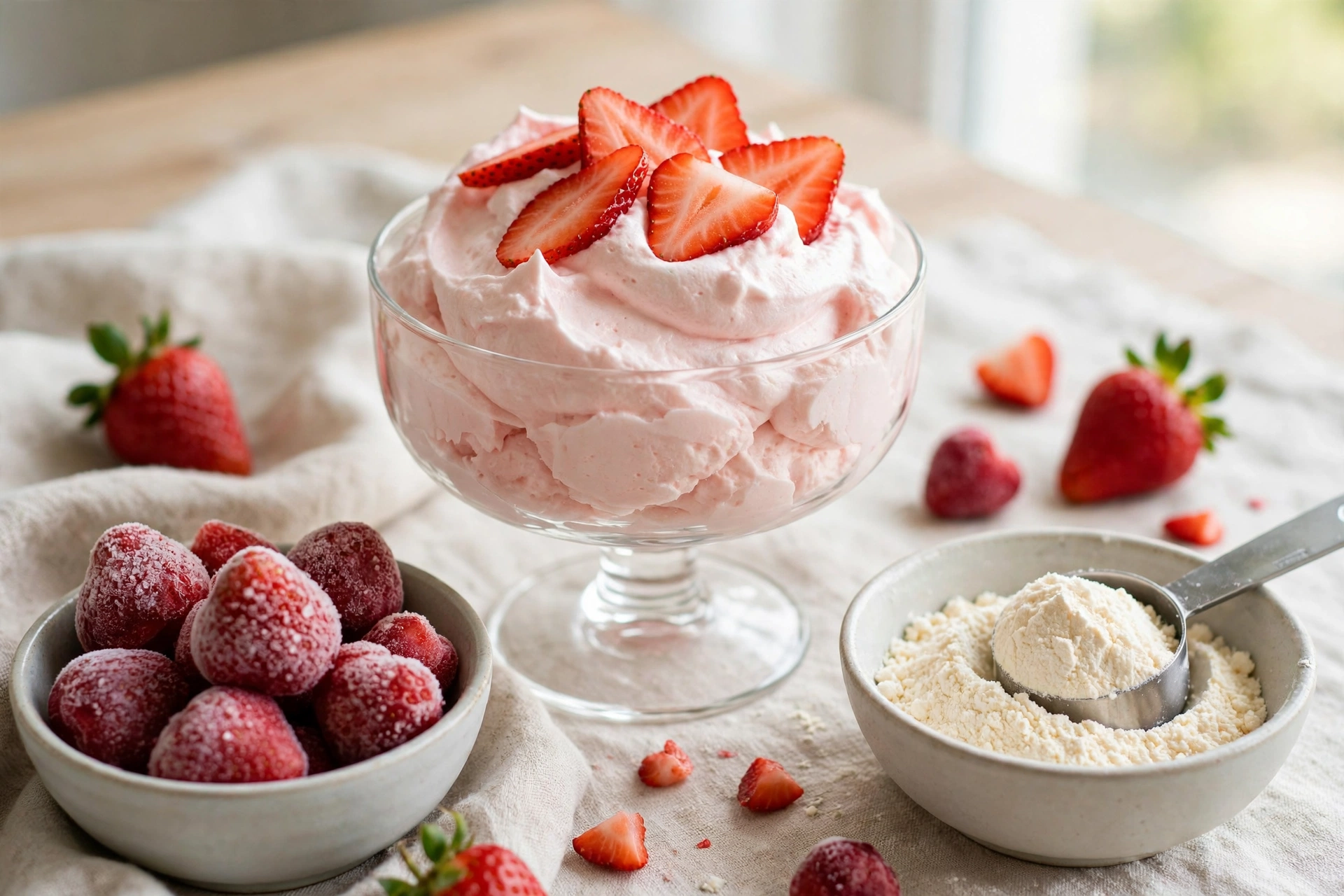
8. Strawberry Protein Fluff
Makes 2 · Prep 5 minutes · No cooking, eat immediately · About 14g protein · About 110 kcal each
Ingredients: 200g frozen strawberries, 1 scoop vanilla protein powder (about 24g protein), 100ml skimmed milk, ½ tsp vanilla.
Method: blend the frozen strawberries with the milk to a thick purée, add the powder, then whisk or blend on high for a full minute to whip air through it — the volume nearly doubles, which is the entire point of a fluff. Serve straight away in cold bowls. Honest limitation: a fluff deflates. Within twenty minutes it relaxes back toward a thick smoothie, still good, no longer a fluff — so this is the one recipe here with no make-ahead version, and it is better to know that before guests are involved.
How the calorie cap is actually kept
Three decisions do the work, and they are worth seeing plainly because they transfer to any high protein low calorie dessert. First, the base: skimmed milk at about 90 calories a cup instead of whole at 150, Greek yogurt and skyr instead of cream — every recipe above starts 100-plus calories ahead of its classic version before anything else changes. Second, sweetening: granulated sweetener at zero against honey at about 60 calories a tablespoon; across a two-serving recipe that single swap is worth 30 calories a serving, which at this end of the scale is real money.
Third, no structural calories: no biscuit bases, no butter, no pastry — the sets come from gelatin, egg white, and chilling. What most people miss is that none of these change the flavour architecture much. They change the scaffolding, and dessert scaffolding is mostly invisible once the spoon is in.
Make-ahead and storage
The panna cotta and tofu mousse keep 3 days in the fridge, covered, and both improve overnight. The baked custard and cheesecake bites keep 3 days chilled; the bites freeze for up to a month and thaw in twenty minutes. The berry whip and skyr pot are best within 24 hours — the whip weeps a little berry juice by day two, harmless but less pretty. Hot chocolate is a make-it-now recipe, and the fluff, as its recipe admits, waits for nobody.
The safety rules are the same as for every dairy dessert: into a fridge at 4°C / 40°F or below within two hours of making (one hour on a hot day), and if a chilled dessert smells off, it goes in the bin rather than back in the fridge for a decision it has already made.
Swaps and substitutions
Dairy-free: the tofu mousse is already there. For the rest, soy yogurt is the only plant swap that keeps meaningful protein — coconut and almond yogurts at 1 to 2 grams a cup cannot hold these numbers, and a dairy-free panna cotta built on them lands nearer 5 grams a serving; the article would rather say that than print a friendlier fiction.
No protein powder: the panna cotta, baked custard, berry whip, and skyr pot never used it — four of the eight stand exactly as written, including the two lightest.
Full-fat versions: whole milk and full-fat yogurt add roughly 40 to 60 calories a serving across these recipes and buy a little richness; the protein barely moves, so it is a flavour decision, not a nutrition one.
Sugar instead of sweetener: sugar adds about 48 calories per tablespoon used in a recipe and honey about 60 — divide by the servings for the per-serving cost; the cheesecake bites and custard tolerate the swap best.
Questions people ask
What actually counts as low calorie for a dessert?
There is no official line, so this article set its own and printed it: under 200 calories a serving, with the real range 95 to 180 shown on every recipe. Plenty of recipes online wear the label at 350. When a number is doing the marketing, check the number.
Why is the protein lower than on the main dessert list?
Because calories are where protein hides. The 27-gram chia pudding on the high protein dessert recipes list spends 400 calories getting there; cap the spend at 200 and 12 to 21 grams is what honest maths returns. I do not think that makes this list the worse one — a dessert you can eat on an ordinary Tuesday beats a better-scoring one saved for occasions.
Can I eat one of these every day?
Within a normal day’s eating, yes — that is what the cap is for. The two to rotate most easily are the skyr pot (125 calories, 19 grams, three minutes) and the hot chocolate (160, 21 grams), because neither needs a fridge shelf of prep behind it. Variety still matters more than any single recipe; rotate the list rather than marrying one entry.
Do sweeteners taste as good as sugar here?
In the chocolate recipes, most people cannot tell. In the panna cotta and custard, where the flavour is naked, a teaspoon of real honey stirred through buys more taste than it costs — about 10 calories a serving across a two-serving recipe. That trade is printed rather than hidden, which is the only rule worth keeping.
References
Protein snacks, hunger, and eating less at the next meal: Ortinau LC, Hoertel HA, Douglas SM & Leidy HJ, “Effects of high-protein vs. high-fat snacks on appetite control, satiety, and eating initiation in healthy women”, Nutrition Journal, 2014 — full text
Protein, fullness, and weight management: Leidy HJ et al., “The role of protein in weight loss and maintenance”, American Journal of Clinical Nutrition, 2015 — DOI record
Spreading protein across the day: Mamerow MM et al., “Dietary protein distribution positively influences 24-h muscle protein synthesis in healthy adults”, The Journal of Nutrition, 2014 — PubMed record
Practical protein targets for active people: Bean A, The Complete Guide to Sports Nutrition, 9th edition (Bloomsbury Sport, 2022).
Protein values for yogurt, skyr, cottage cheese, tofu, and skimmed milk: USDA FoodData Central
A low calorie dessert earns its place on a Tuesday, not a birthday. Keep skyr in the fridge and the hot chocolate method in your head, and the sweet course stops being the part of the day that needs apologising for — under 200 calories, protein in double figures, and nothing about it tastes like a compromise that was made for you rather than by you.