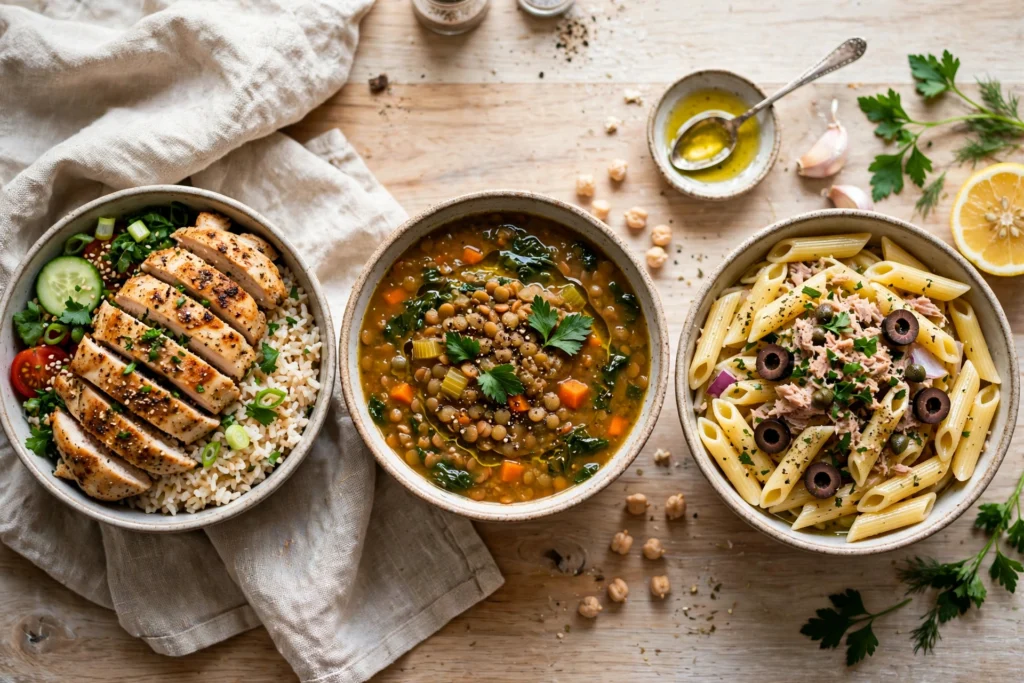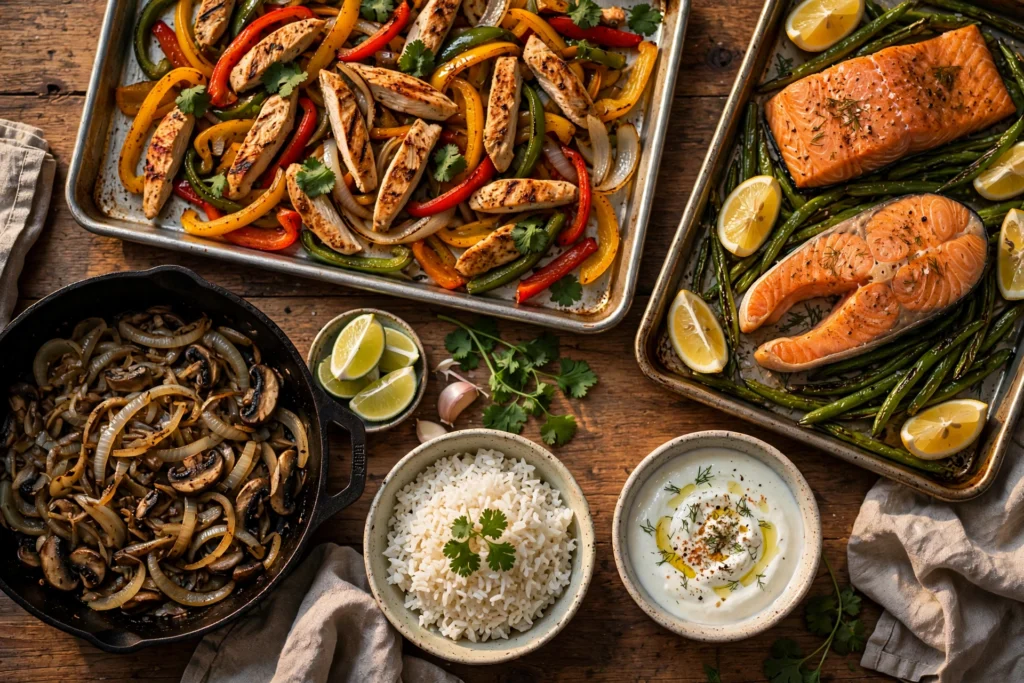
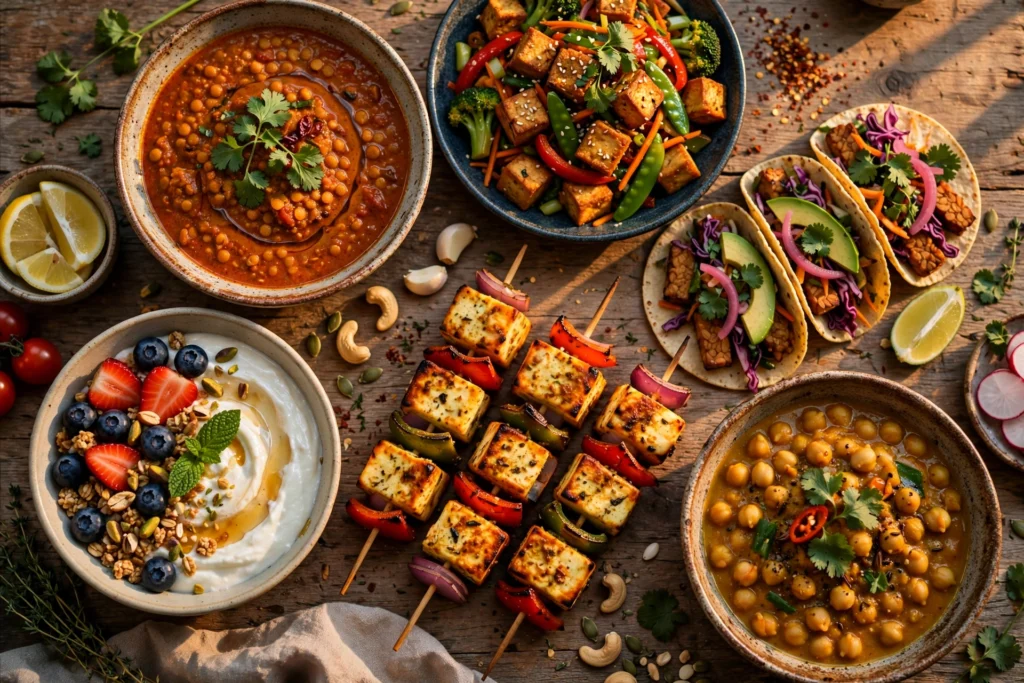
Here is what changed for me. A plate of pasta and vegetables gives you about 10 grams and a hungry evening. Swap in lentils, tofu, tempeh, beans, Greek yogurt, or cottage cheese — and count the sides instead of ignoring them — and 20 to 30 grams is not a struggle. It is just a habit.
Numbers note: the protein counts are conservative estimates from the main protein source in each serving, checked against standard food data — 1 cup cooked lentils is about 18g, a cup of black beans about 15g, chickpeas about 14g, 100g of tempeh about 19g, three-quarters of a cup of Greek yogurt about 17g, a cup of cooked quinoa about 8g. Where a meal reaches 20 only with its side or topping, that side is named and counted. No mystery math; I hate mystery math.
Table of Contents
ToggleWhat good high protein vegetarian meals look like
The worry I hear most is amino acids — the “incomplete protein” argument. I looked into it properly before writing this, and the research is calmer than the argument. A 2019 review in Nutrients by Mariotti and Gardner went through the evidence on vegetarian diets and concluded that protein-rich plant foods — legumes, nuts, seeds — are sufficient for full protein adequacy in adults, and that the amino acid deficiency concern has been substantially overstated. The Academy of Nutrition and Dietetics says the same in its position paper: appropriately planned vegetarian diets are nutritionally adequate, including for athletes. Planned is the working word. I plan one anchor per meal, and the rest is cooking.
Lentils and beans: my base layer
1. Red Lentil Curry with Greek Yogurt · About 25g protein · Serves 4
Red lentils simmered in canned tomato, onion, and curry powder, served over rice with a proper dollop of Greek yogurt on top. The lentils bring about 18g and the yogurt is counted in, which lands the bowl near 25g. This is the dinner I make when the fridge is nearly empty, because it is all cupboard food. It also works in the slow cooker — set it in the morning and forget it.
2. Black Bean and Quinoa Burrito Bowls · About 24g protein · Serves 4
A cup of cooked black beans (15g) over three-quarters of a cup of quinoa (6g), with corn, salsa, lime, cumin, and a little shredded cheese (about 3g). I think the bowl format is why this one survives in my rotation — everything separate, everyone builds their own, nobody negotiates.
3. White Bean and Kale Soup with Parmesan · About 20g protein · Serves 4
Two cans of white beans, half blended back in for creaminess, with kale, garlic, and vegetable stock. The beans give about 16g in a serving and two tablespoons of parmesan add roughly 4g more. Bread for dipping is not optional in my house. It is part of the recipe.
4. Chickpea Tikka Masala · About 21g protein · Serves 4
Two cans of chickpeas in a tomato-curry sauce finished with Greek yogurt instead of cream — the yogurt stirred in and spooned on top brings a generous serving to about 21g. Serve it over rice. I do this one when I want the house to smell like I tried harder than I did.
Tofu and tempeh: the heavy lifters
5. Crispy Tofu Stir-Fry with Peanut Sauce · About 26g protein · Serves 4
Extra-firm tofu, cubed and crisped properly — press it, hot pan, do not crowd it — tossed with vegetables in peanut sauce and served over rice or noodles. Tofu brings about 18g, the sauce about 4g, the base about 4g. When I first cooked tofu I made it soggy and swore off it for a year. The press and the hot pan fixed it; I have not had a bad batch since.
6. Tempeh Tacos · About 26g protein · Serves 4
Crumbled tempeh seasoned like taco meat — 100g a serving is about 19g — in corn tortillas with half a cup of black beans (about 7g), cabbage, and salsa. Two tacos land near 26g. Tempeh is the one I recommend to people who think they do not like soy: it is nutty, firm, and takes seasoning like it means it.
7. Tofu and Edamame Fried Rice · About 24g protein · Serves 4
Tofu cubes (about 12g a serving) scrambled through rice with shelled edamame (half a cup, about 9g), peas, and soy sauce. Add a beaten egg if you eat eggs and you gain 6g; as written, with a full tofu portion, it sits near 24g. This is my clean-out-the-fridge dinner, and it has never once tasted the same twice, which I count as a feature.
Dairy-powered: yogurt, cottage cheese, paneer
8. Paneer Tikka Skewers · About 25g protein · Serves 4
Paneer (100g is about 18g) marinated in Greek yogurt and tikka spices — the marinade that stays on adds roughly 5g — grilled or broiled with peppers and onion, raita on the side to pass 25g. If you have never cooked paneer, treat it like halloumi’s calmer cousin: it holds its shape, takes a char, and does not melt away.
9. Cottage Cheese Lasagna Roll-Ups · About 26g protein · Serves 4
Lasagna noodles rolled around cottage cheese blended smooth with spinach and parmesan, baked in marinara with mozzarella on top. The cottage cheese portion alone is about 19g a serving; the cheeses take it to roughly 26g. I serve this to people who swear they hate cottage cheese. Nobody has guessed yet. Blending it smooth is the whole trick.
10. Savory Greek Yogurt Bowls · About 26g protein · Serves 2
A cup of plain Greek yogurt (about 22g) topped with roasted chickpeas (a quarter cup, about 4g), cucumber, tomatoes, and za’atar. A light dinner or a serious lunch. I know sweet yogurt bowls get the attention, but the savory version is the one I actually eat — it tastes like a meal, not a compromise.
Eggs and meal-prep friendly
11. Veggie Frittata with Cottage Cheese · About 22g protein · Serves 4
Eight eggs whisked with a cup of cottage cheese and whatever vegetables are left standing. Per serving: two eggs (about 12g), the cottage cheese portion (about 7g), cheese on top (about 3g). It reheats like a champ, which is why a version of it also sits inside my low calorie meal prep plan.
12. Lentil and Walnut Bolognese · About 25g protein · Serves 4
Cooked lentils (a cup, about 18g) simmered in marinara with finely chopped walnuts, over pasta (a cooked cup adds about 7g). About 25g a plate, and the sauce freezes in portions for three months. I make a double batch on purpose; future me has been grateful more than once.
How I actually hit 20g+ per meal
I do not count all day. I follow four habits, and the counting takes care of itself. One: an anchor in every main — lentils, beans, tofu, tempeh, Greek yogurt, or cottage cheese; vegetables alone will not get you there, and I stopped pretending otherwise. Two: count the sides — quinoa instead of white rice adds 3 to 4g, and cheese and yogurt toppings are real protein, not garnish. Three: lean on the cheap anchors — beans and lentils are also the least expensive proteins I buy, which is why most of these meals also appear in my c roundup. Four: do not forget breakfast — my meatless mornings are covered in the heap high protein mealscheap high protein meals roundup. Four: do not forget breakfast — my meatless mornings are covered in the high protein breakfast without eggs list.
Questions people ask me
Can vegetarians really get enough protein?
Yes — and I say that as someone who checked before trusting it. The Academy of Nutrition and Dietetics position is that appropriately planned vegetarian diets are nutritionally adequate, and meals built the way these are reach 20 to 30 grams a serving without any strain. The planning is the whole job.
What vegetarian foods are highest in protein?
From my own kitchen, in order of how much work they do: tempeh (about 19g per 100g), Greek yogurt (about 17g per three-quarter cup), lentils (about 18g a cooked cup), cottage cheese, tofu, and edamame. If those six are in your weekly shop, you are most of the way there.
Are these meals vegan?
Not all of them, and I will not pretend otherwise. The lentil, bean, tofu, and tempeh meals — numbers 1 to 7 and 12 — are vegan or one swap away: use coconut yogurt instead of Greek yogurt in the curry and the tikka masala. The dairy and egg meals are vegetarian as written.
How do I add protein to a vegetarian meal I already make?
Add one anchor and upgrade one side. A cup of lentils or beans stirred into a soup, a block portion of tofu into a stir-fry, quinoa where the rice was, yogurt where the cream was. Each move adds 4 to 8 grams. I think people overcomplicate this; two small moves per meal is usually enough.
References
Protein adequacy and amino acids in vegetarian diets: Mariotti F & Gardner CD, “Dietary Protein and Amino Acids in Vegetarian Diets — A Review”, Nutrients, 2019 — DOI record
The dietetics position on vegetarian diets: Melina V, Craig W & Levin S, “Position of the Academy of Nutrition and Dietetics: Vegetarian Diets”, Journal of the Academy of Nutrition and Dietetics, 2016 — DOI record
Protein and amino acid needs at every life stage: Davis B & Melina V, Becoming Vegan: The Complete Reference to Plant-Based Nutrition, Comprehensive Edition (Book Publishing Company, 2014).
Protein values for lentils, beans, tofu, tempeh, yogurt, and quinoa: USDA FoodData Central
If you are where I was — eating vegetarian, feeling fine, quietly unsure about protein — pick two anchors this week and build dinners around them. I started with lentils and Greek yogurt. A month later the question had stopped following me around, and it has not come back.