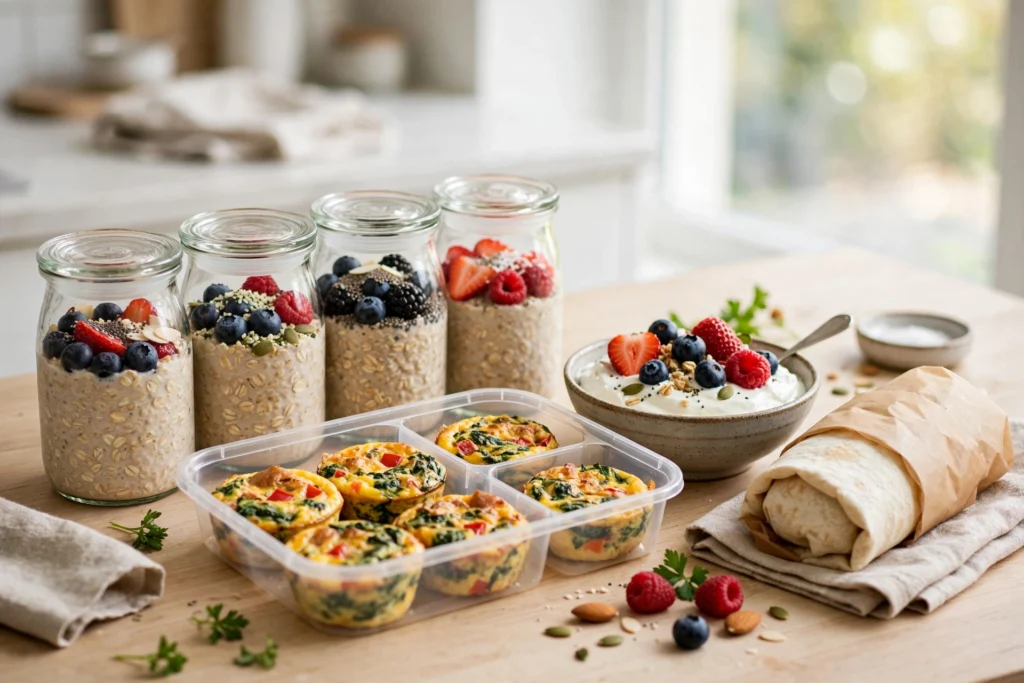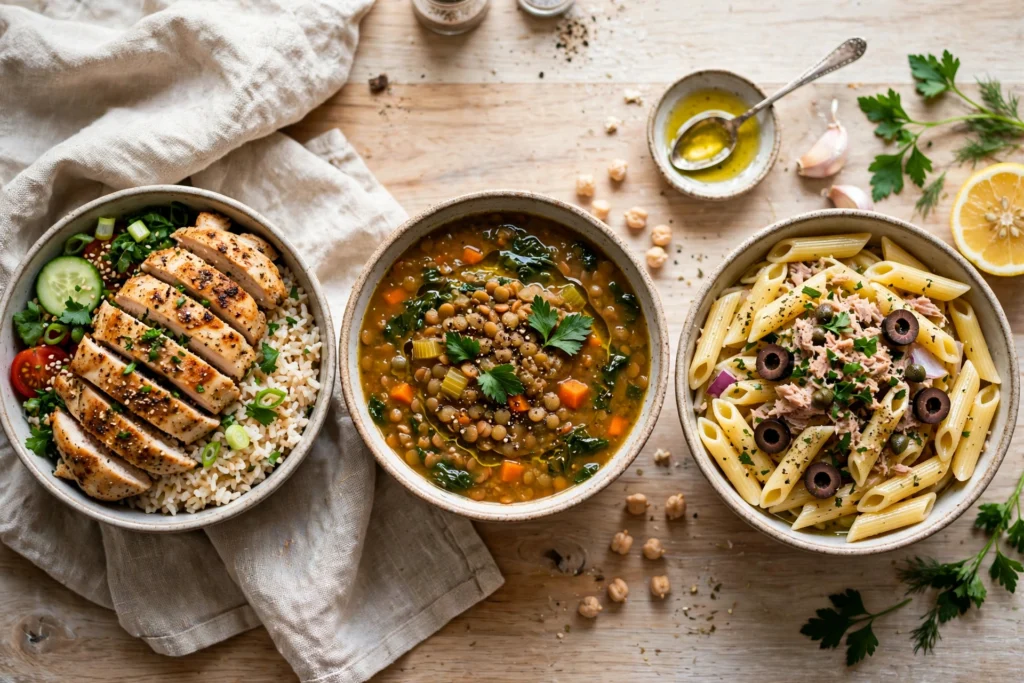
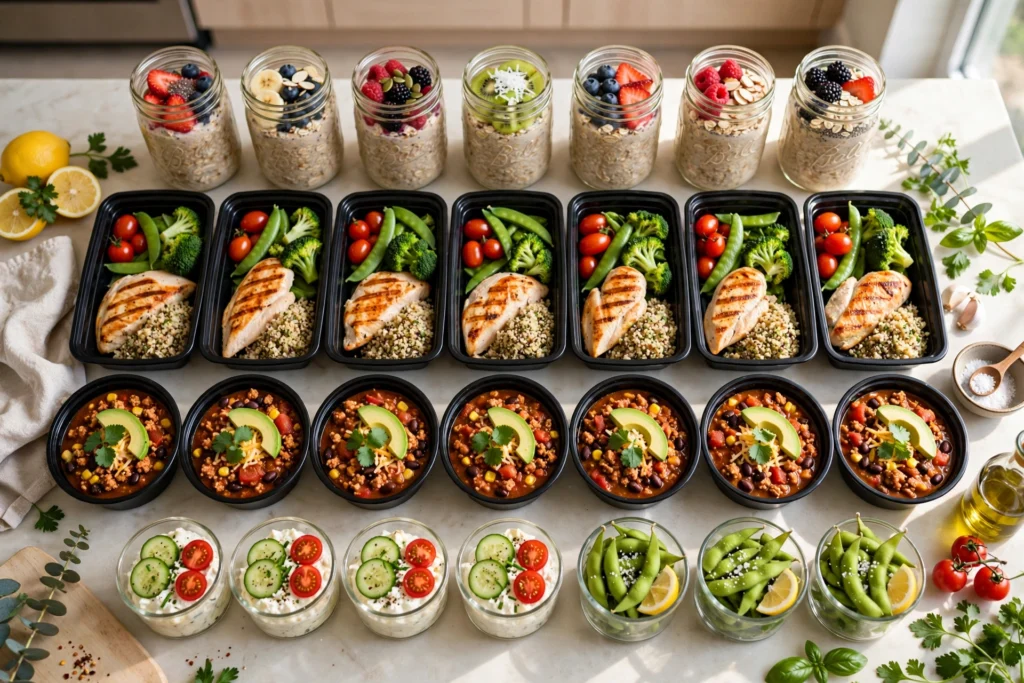
Low calorie high protein meal prep works best as a full week, planned once: two breakfasts, three lunches, three dinners, and two snacks, cooked in one Sunday session and rotated so no day repeats itself into boredom. This plan lands at about 1,650 calories and 135 grams of protein a day — breakfast around 38g, lunch 42g, dinner 45g, and a snack that isn’t an afterthought. Below is the whole system: the Sunday cook, every meal in the rotation, the day-by-day grid, storage rules, and the shopping list.
I built this plan after two failed versions. Version one prepped seven identical chicken-and-rice boxes, and by day four I was ordering takeaway with a fridge full of food — the plan was fine, the repetition was the failure. Version two had too much variety and took four hours to cook. This one is the middle: enough rotation to stay interesting, few enough moving parts to finish cooking in about two hours.
Numbers note: calories and protein are estimates from the ingredients as written. Treat the daily totals as a planning guide, not lab results.
Table of Contents
ToggleThe plan at a glance
Breakfast — about 400 calories · 35g protein (2 options, alternate days)
Lunch — about 460 calories · 37g protein (3 options, rotate)
Dinner — about 530 calories · 42g protein (3 options, rotate)
Snack — about 190 calories · 16g protein (2 options)
Day total — about 1,580–1,700 calories · 130–140g protein
If 1,650 calories is too low for you — bigger body, physical job, heavy training — the fix is not a different plan. Add a second snack or a bigger dinner portion and the same structure stretches to 1,900 without breaking.
What good low calorie high protein meal prep looks like across a week
Three things separate a plan that survives the week from one that dies on Wednesday. First, proteins cooked once, used in different shapes: the same Sunday chicken appears in a bake, a salad, and a chili across the week, seasoned differently each time. Second, calories budgeted per meal, not per day — deciding at 6 p.m. that you’ve “been good today” is how dinner becomes a pizza. Third, two meals in the freezer by midweek, because life happens and a frozen dinner you made beats a fresh one you didn’t.
The Sunday cook (about 2 hours)
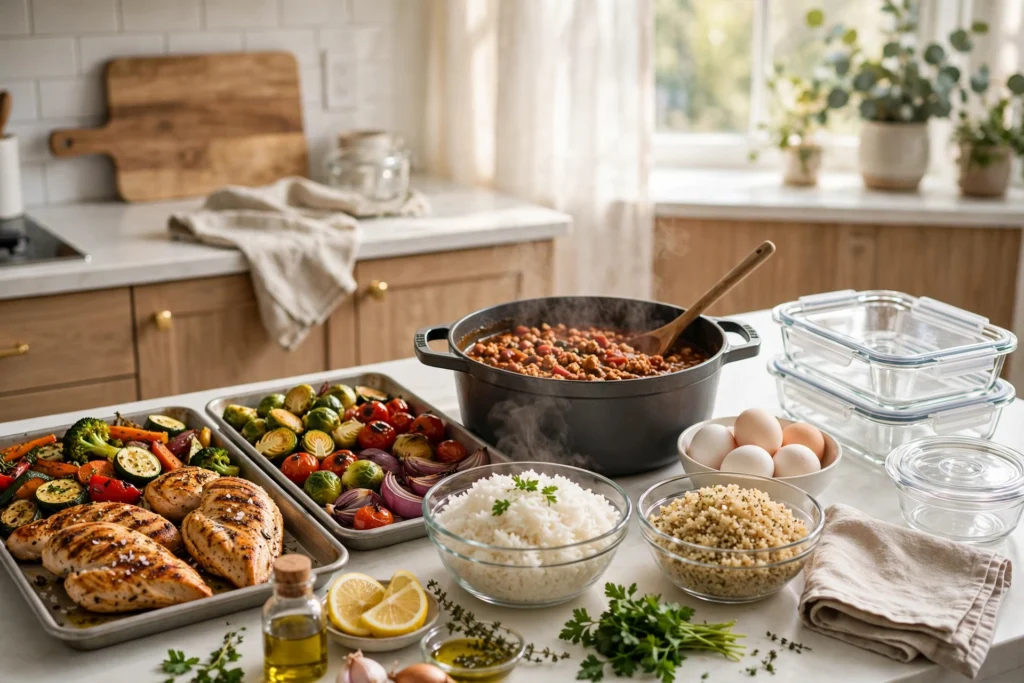
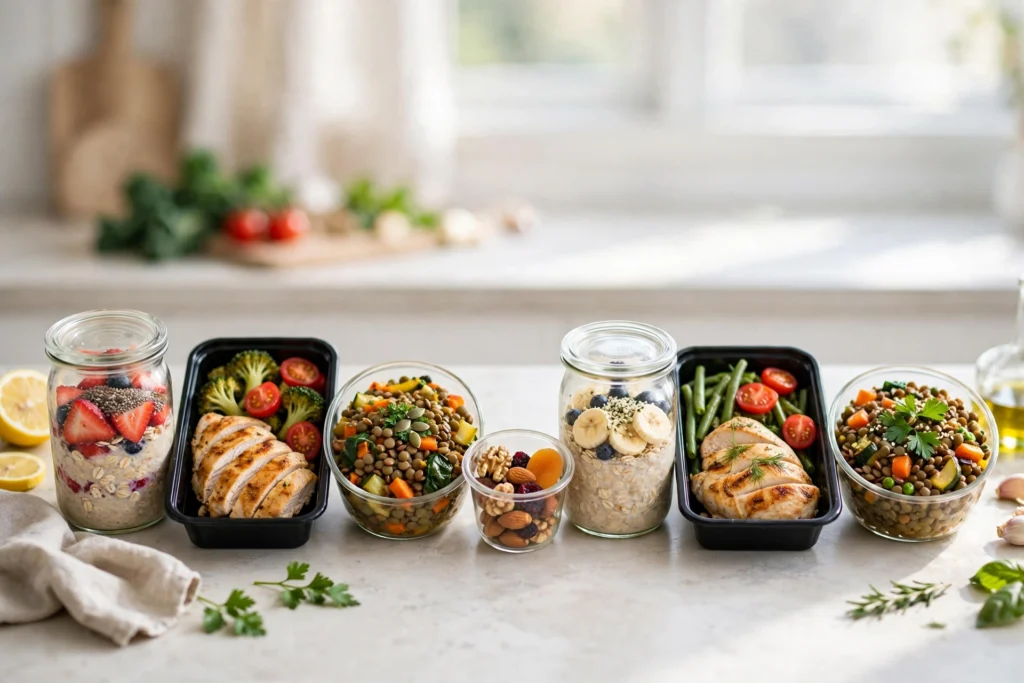
Everything in this plan comes out of one session, in this order: (1) Oven on — the breakfast bake goes in first and cooks while you work. (2) Proteins: grill or bake 3 lbs chicken breast; brown 2 lbs lean ground turkey (half becomes chili, half becomes meatballs); hard-boil 10 eggs. (3) Grains: cook 2 cups rice and 1 cup quinoa on the stove while the oven runs. (4) Vegetables: roast two trays — broccoli, green beans, peppers, zucchini — with the chicken. (5) Assemble: overnight oats jars, lunch boxes, snack pots. Sauces in small separate containers, always.
That’s the whole factory. Everything below is just these ingredients arranged seven ways.
Breakfasts (alternate A / B)
Breakfast A — Cottage Cheese and Egg Bake · About 410 calories · 36g protein
Whisk 6 eggs, 3 egg whites, and a cup of cottage cheese with spinach, peppers, and spring onions; bake in a dish 30 minutes; slice into 4 portions. It eats like a crustless quiche and reheats without going rubbery, which egg muffins in my experience do by day three. This is the savory anchor of the week — the same make-ahead thinking as my breakfast meal prep rotation, tuned lower in calories.
Breakfast B — Overnight Protein Oats · About 390 calories · 32g protein
Half a cup of oats, a cup of plain nonfat Greek yogurt, half a scoop of protein powder or an extra quarter cup of yogurt, milk to loosen, berries on top. Five jars, five mornings, zero cooking after Sunday. On days when the bake feels heavy, the oats feel like a break; that contrast is deliberate.
Lunches (rotate 1 / 2 / 3)
Lunch 1 — Turkey Meatball and Green Bean Boxes · About 460 calories · 38g protein
Sunday’s turkey, rolled into meatballs with garlic and Italian seasoning, over quinoa with roasted green beans and a spoon of marinara. Meatballs reheat better than sliced turkey ever will — they keep their moisture, and the marinara forgives a long microwave.
Lunch 2 — Salmon, Spinach and Lemon Rice · About 470 calories · 34g protein
A salmon fillet or pouch over lemon rice with wilted spinach and cucumber. The one lunch I don’t prep more than two days ahead — salmon on day four is a hard sell, so this one lands Monday and Tuesday only.
Lunch 3 — Tuna Pasta with Yogurt Sauce · About 440 calories · 33g protein
Short pasta, two cans of tuna, and a sauce of Greek yogurt, lemon, mustard, and dill instead of mayo. It tastes like tuna salad grew up. Eats cold, which makes it the no-microwave-queue lunch.
Want a deeper bench? My low calorie lunch meal prep guide has seven more lunches under 500 calories
Dinners (rotate 1 / 2 / 3)
Dinner 1 — Turkey Chili · About 520 calories · 42g protein
Sunday’s second half of turkey, simmered with beans, tomatoes, peppers, and chili spices. Makes four bowls; two go in the freezer the day it’s cooked. Chili is the plan’s insurance policy — the meal that rescues the evening everything runs late.
Dinner 2 — Chicken and Cauliflower Bake · About 540 calories · 46g protein
The highest-protein meal in the week. Sunday’s chicken, chopped over cauliflower and peppers, covered with a whisked mix of eggs and Greek yogurt and baked until set. It sounds odd and eats like comfort food. This is the dinner guests have asked about, which still surprises me.
Dinner 3 — Lentil and Chicken Mediterranean Mix · About 510 calories · 37g protein
Cooked lentils (20 minutes, no soak), chopped chicken, cucumber, tomatoes, olives, feta, lemon, oregano. Served warm or cold. The lentils do quiet work here — fiber that keeps a 510-calorie dinner feeling like more than it is.
Snacks (pick one a day, two if your calories allow)
Snack 1 — Cottage Cheese and Pineapple · About 180 calories · 14g protein
Sounds like a 1970s diet plate. Works anyway.
Snack 2 — Salted Edamame · About 190 calories · 17g protein
From the freezer, five minutes in boiling water, flaky salt. The snack that survives being eaten at a desk, in a car, or standing in the kitchen deciding what else to eat — by the time you finish it, the decision usually makes itself.
The week, day by day
Monday — Bake breakfast · Salmon lunch · Chili dinner (fresh) · Edamame
Tuesday — Oats · Salmon lunch · Chicken bake · Cottage cheese snack
Wednesday — Bake · Meatball lunch · Lentil mix · Edamame
Thursday — Oats · Tuna pasta · Chili (from freezer) · Cottage cheese snack
Friday — Bake · Meatball lunch · Chicken bake · Edamame
Saturday — Oats · Tuna pasta · Lentil mix · either snack
Sunday — Bake · whatever is left · cook the next week with a clear fridge
Notice the shape: nothing appears more than three times, fish stays early in the week, and the freezer meals land exactly when motivation is thinnest — Thursday and the second weekend lunch rush. That’s not an accident. That’s the whole design.
Storage rules that keep this safe
Cooked meals get four days in the fridge — which is why this plan freezes the second chili batch and the later chicken bake portions on Sunday, not on day three when you remember. Freeze in single portions, thaw overnight in the fridge, reheat until steaming. Sauces and anything crunchy stay separate until eating. The full fridge/freezer timelines I follow are the standard cold-storage guidelines; when in doubt, the nose knows, but the calendar knows better.
The shopping list (one trip)
Proteins: 3 lbs chicken breast, 2 lbs lean ground turkey, salmon (2 portions or pouches), 2 cans tuna, eggs + egg whites, lentils, edamame, canned beans
Dairy: plain nonfat Greek yogurt (big tub), cottage cheese, feta
Produce: spinach, broccoli, green beans, peppers, zucchini, cucumber, tomatoes, spring onions, lemons, berries, pineapple
Pantry: oats, rice, quinoa, short pasta, marinara, chili spices, olive oil
This list is built on store-cupboard staples, not specialty products — the same budget logic as my cheap high protein meals list. If your store runs a rotisserie chicken deal, buy one and skip grilling half the chicken breast; nobody will know, including you.
Questions people ask
Is 1,650 calories right for everyone?
No, and any plan that says otherwise is selling something. It’s a sensible deficit level for many adults; smaller or sedentary people may need less, larger or active people clearly more. Use the structure, scale the portions, and if you have a medical condition, talk to your doctor before running any deficit.
Is 135 grams of protein enough?
For most people cutting calories, yes — it’s roughly the level where muscle is protected and hunger stays quiet. Lifters chasing every gram can push the snack to a double portion and land near 150g without changing a single recipe.
Can I swap meals between days?
Freely. The grid is a default, not a contract. The only swaps I’d avoid: salmon after Tuesday, and anything from the fridge past day four that wasn’t frozen.
Do I have to cook it all on Sunday?
The plan assumes one session because that’s what makes weekdays effortless. A split works too — proteins and grains Sunday, assembly Wednesday evening — as long as the four-day fridge rule still holds for whatever you cooked first.
References
Nutrition values for chicken, turkey, salmon, eggs, lentils, and dairy: USDA FoodData Central
How much protein you actually need, and why it matters: Harvard T.H. Chan School of Public Health — The Nutrition Source: Protein
Fridge and freezer storage times used in this plan: FoodSafety.gov — Cold Food Storage Charts
Run the plan once, exactly as written. The second week, you’ll know which lunch bores you and which dinner you’d eat daily — swap those two slots and the plan becomes yours. A meal prep plan you repeat beats a perfect one you abandon, every single time.